

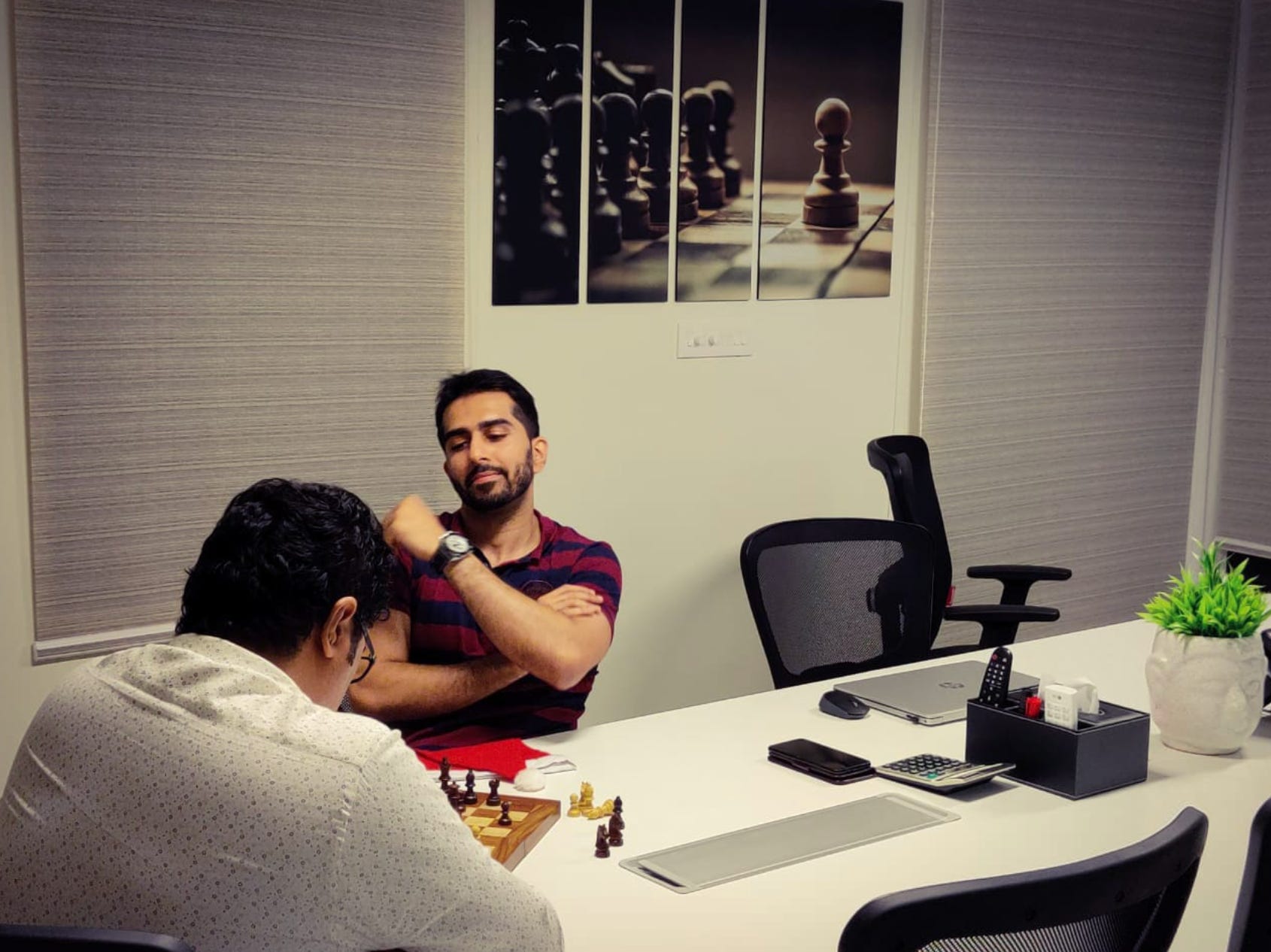
In a conference room in Bengaluru, on the wall behind the chair Tejas Khoday usually sits in, there is a framed picture of a chessboard.
On one side: a single white pawn. Facing it: a phalanx of black pieces — knights, bishops, rooks, the queen, the king. The pawn looks ridiculous. It also looks like it knows what it is doing.
Tejas hung that frame in the early days of Fyers and kept it visible to anyone who walked in.
"We were the white pawn against the behemoths. The odds were against us."
It was a daily reminder, and it was a permission slip — to be small, to be patient, to refuse the kinds of fights the bigger pieces want to have.
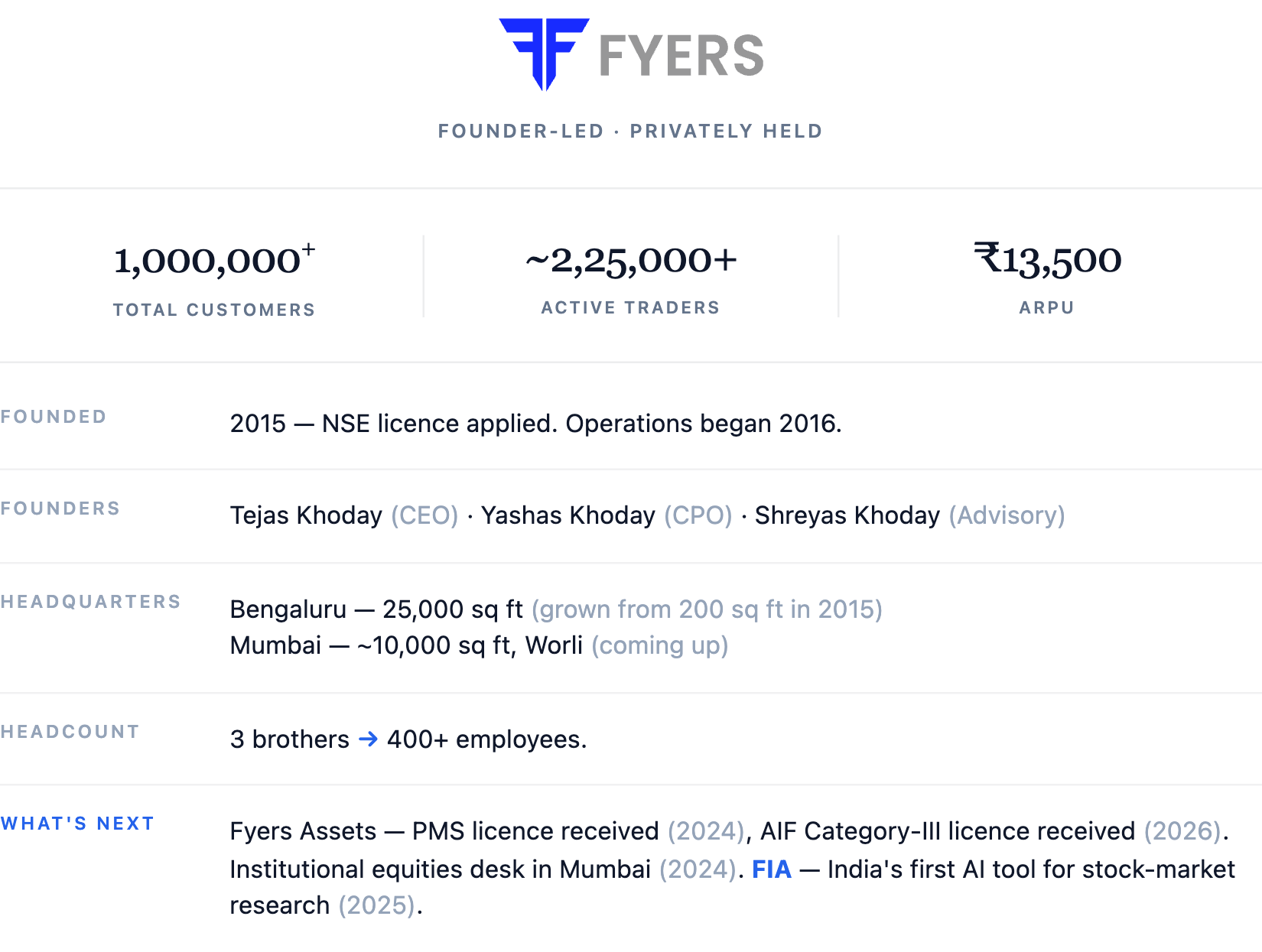
A decade later, the pawn has captured the seventh rank. Fyers crossed one million customers in early 2026, in its tenth year of operation. It has done so without taking a rupee of outside capital.
It has done so, charging a flat twenty rupees per trade — the same number it printed on the price page in 2016, never raised, never lowered. It has done so by deliberately ignoring the segments and pricing wars that consumed its larger competitors. It has done so while turning down over five buy-out proposals and roughly a dozen smaller approaches from the largest names in Indian financial services.
“Nothing in our journey has been a coincidence. It’s all been very intentional. When I hear other podcasters, so much of it is — you know, right place, right time, right thing. In our case, it’s been deliberate.”
This is the story of how that happened, told as much as possible in his own words.
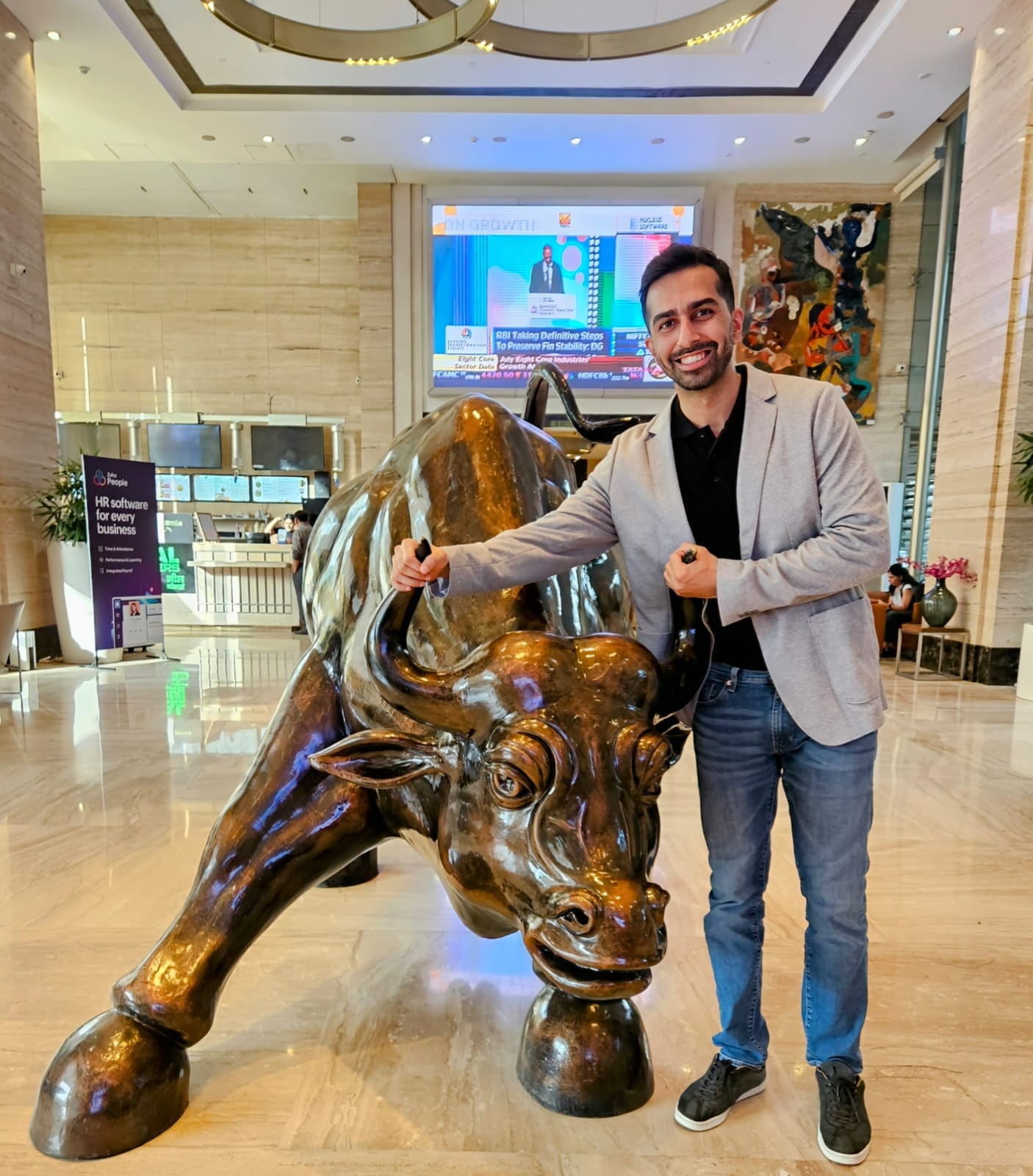
And they are just getting started. The foundation Fyers has laid over the last ten years will now enable a larger capital markets play.
A boy and a ticker
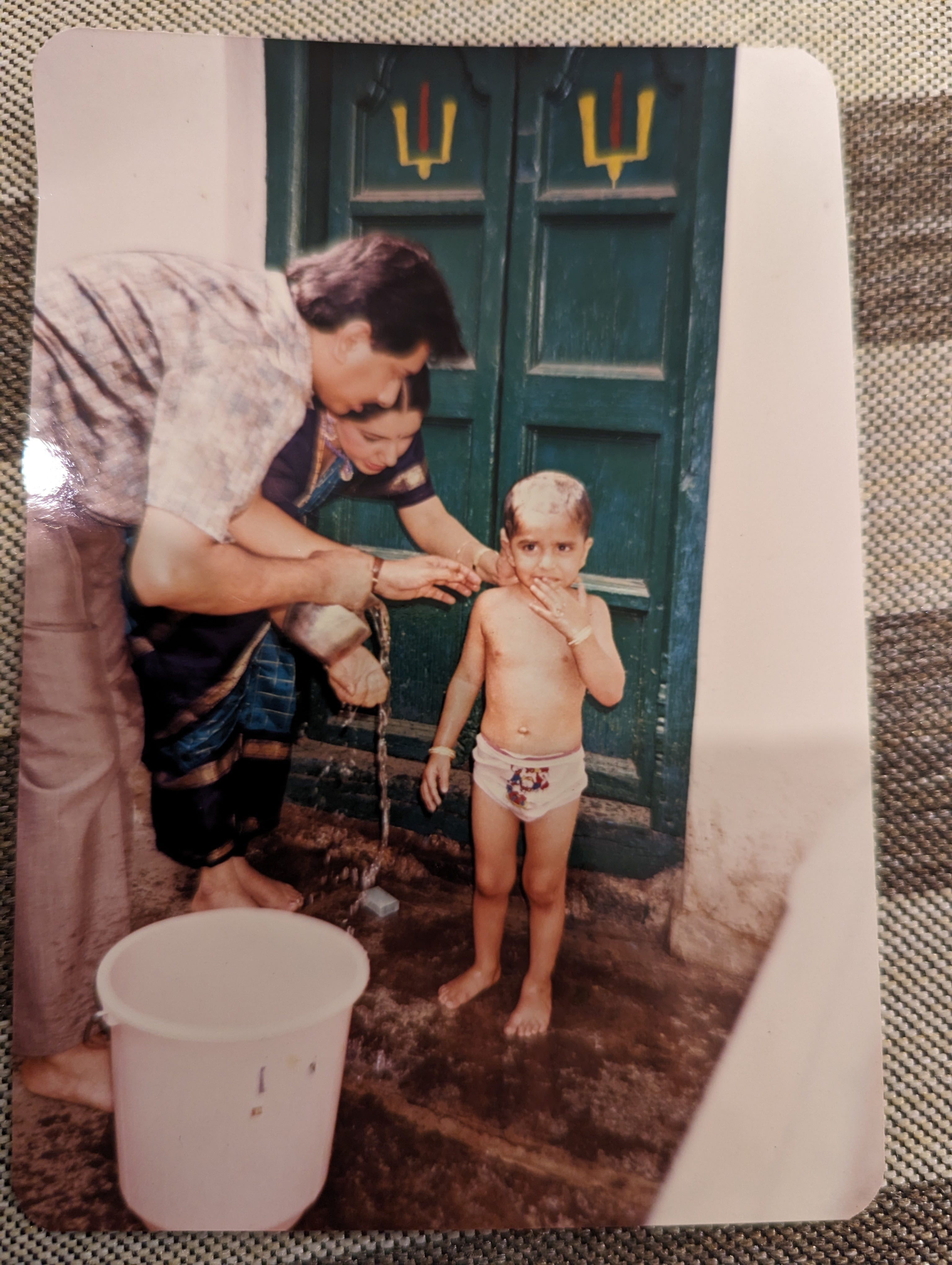
Tejas was born in 1989 in Bangalore, the middle of three brothers. Their father was a real-estate developer, one of the early movers in what was then Old Bangalore.
"My dad was one of the early guys who moved into the better parts of old Bangalore. He was a very ambitious man. Very smart. If you're taking that kind of debt in that era, you have to be."
Then 1998 happened.
"He went bankrupt. India was in recession after the Asian financial crisis, interest rates had shot up, and he was locked into debt across too many different projects. The banks came knocking to collect, and he couldn't pay."
The family's life rearranged itself around a single, finite event. Tejas was nine. His grandparents and his aunt raised the boys.
"My grandparents were still alive, and my aunt moved in. As an orphan, I learned to figure things out by myself. When you try to figure things out yourself, you have to rely on yourself. It comes down to your own judgement, all the time. You can't turn to somebody and say, should I or shouldn't I? You don't have the luxury of getting advice or support from anyone."
Tejas does not dwell on this part of his life. He prefers to talk about what came next.
What came next was a TV ticker. Sometime in the seventh or eighth grade, Tejas began noticing the numbers crawling along the bottom of the financial-news channel.
"And I wondered what they were. So I asked people around me. Nobody knew. Nobody from my family had ever been in the stock markets."
He took that as a signal, not an obstacle.
"I got that insight early — this is something nobody knows about. So I needed to invest time to learn it. I was just so curious. It was fascinating. What the hell is this? Why is the value of a company changing every day? Every second?"
He started writing the numbers down — the same Infosys ticker three minutes apart, the value different each time, why?
"The same Infosys ticker would come back three minutes later and the value was different. So I'd write the numbers down, try to understand, watch TV a lot. Just natural curiosity."
He borrowed old copies of Dalal Street magazine from a friend's father — a man who used his pension money to invest in the markets — and read them at home.
"He'd always have Dalal Street magazines and old newspapers lying around. I'd collect his old editions, take them home, study them, try to understand bits from here and there. That's honestly how I began."
Within two years he got to see the 2008 crash from up close.
"I used to borrow money from my uncle and others to invest in the market. Back then I was just buying IPOs — infrastructure IPOs, GMR, Lanco, all those stocks. I didn't actually lose money on the way down; I wasn't in the markets during the crash. But I was very curious about why it had happened. So I studied. And studied."
In high school, he made a clean break. He dropped science and switched to economics. He has not looked back.
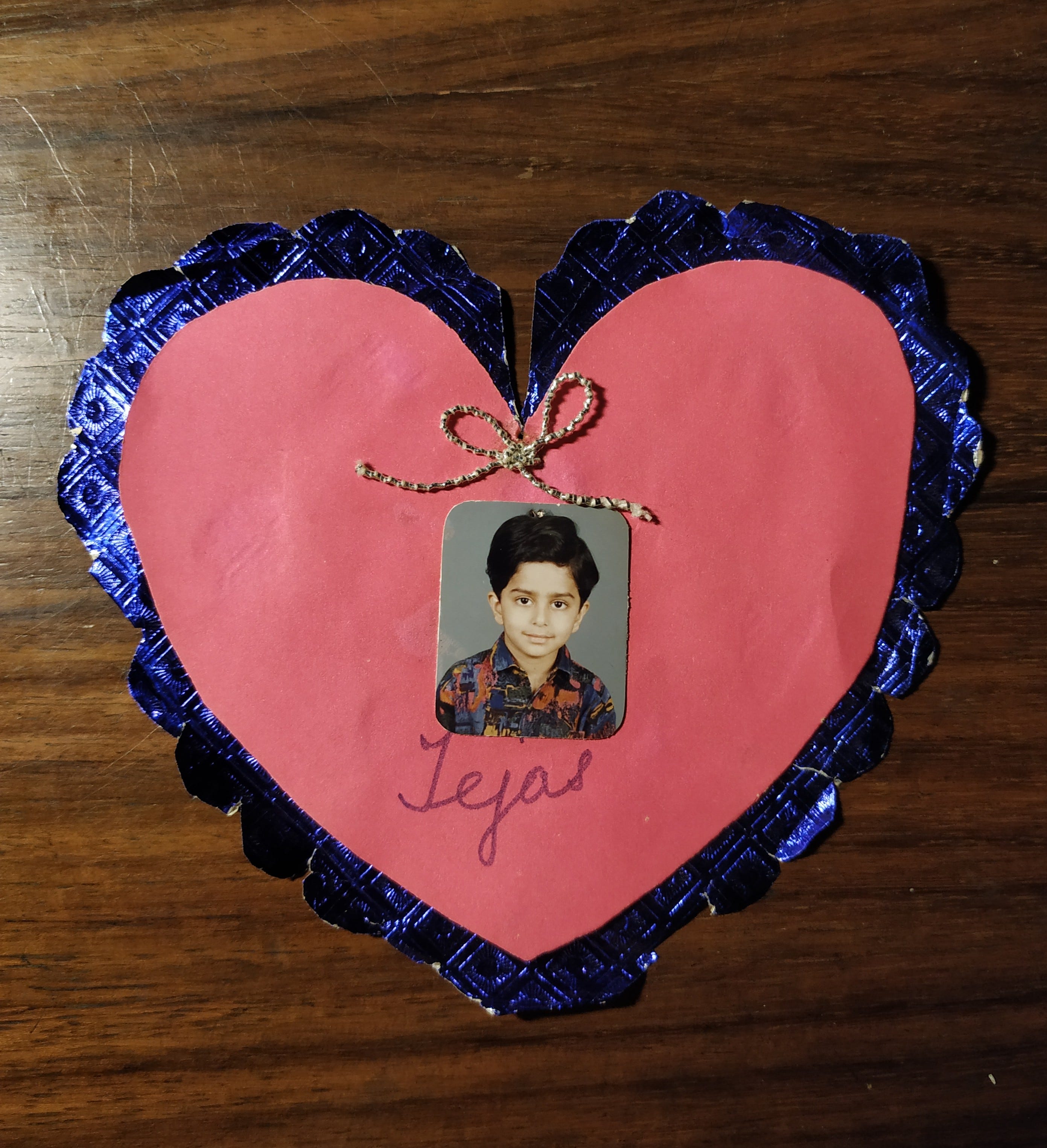
For undergrad, he went to JNCMS in Bangalore for a BBM, then to ISBF Delhi — the Indian School of Business and Finance, an LSE-affiliated institute — for a degree in finance and economics.
"I went there because I couldn't afford a UK education."
He started a CFA and gave it up partway through.
"I had studied so much finance theory that I felt it was time to actually put it into practice. So I was looking to get into the stock markets."
His first ambition was not the trading floor. It was the Ministry of Finance, or RBI.
"I was very eager to work for the Ministry of Finance, or RBI, because I was fascinated with macro — the big picture. But I couldn't, like, suffer it."
He never had a mentor along the way.
"I always felt — if only I had a mentor. I never had one, honestly. I've had to navigate everything by myself, because my parents died a long time ago."
So he went to Mumbai.
Nariman Point, then dengue
Mumbai from 2010 to 2013 was among the worst years anyone has had to look for a job in Indian institutional broking.
Tejas walked into office after office in Nariman Point. He met some good people along the way — he was even introduced to Parag Parikh, whose book on value investing he had read religiously as a student.
"My introduction to value investing was Parag Parikh, not Warren Buffett. I had read Intelligent Investor long before — it was a little too boring. Parag Parikh's books brought it down to the basic points: simply saying ‘this is what you do’."
But the doors did not open.
"It didn't happen, because it was also not the best time in stockbroking — 2010, 2011, 2012, 2013. Some of the worst years."
What did happen during this period was that Tejas nearly died.
"I got dengue. Almost died from it. I was misdiagnosed — they were treating me for malaria."
He went back to Bangalore. There, he stumbled across a website for a small Bangalore-based broker.
"The site was not that smooth. But I thought — you know, it's Bangalore-based, so I should go and speak to them. I immediately hit it off with everybody there. Very warm, welcoming team."
The company was called Zerodha. It was 2011. They had just started operating. He worked there for under a year.
"They had just started. They were a basic broker — no technology, just the NSE platform. A very small setup. I did a little bit of support, RMS, a little bit of everything — until I got really bored. The role was very limited."
He moved on.
The next stop was Futures First — the proprietary trading arm of GHF Group, a global market-maker that recruited from the IITs and IIMs. Tejas had never sat an IIT entrance exam in his life. They put one in front of him as part of their recruiting process. He bombed it.
"I was like, what the hell. I was, of course, not the top performer. So they said no. And I said, what the fuck — this is not the way to interview people. Bringing people in based on whether they can memorise something is probably not the right way."
He was insistent on a second chance. He got one. He passed it. He was put on a desk trading energy, and commodity spreads — gas, oil, crude.
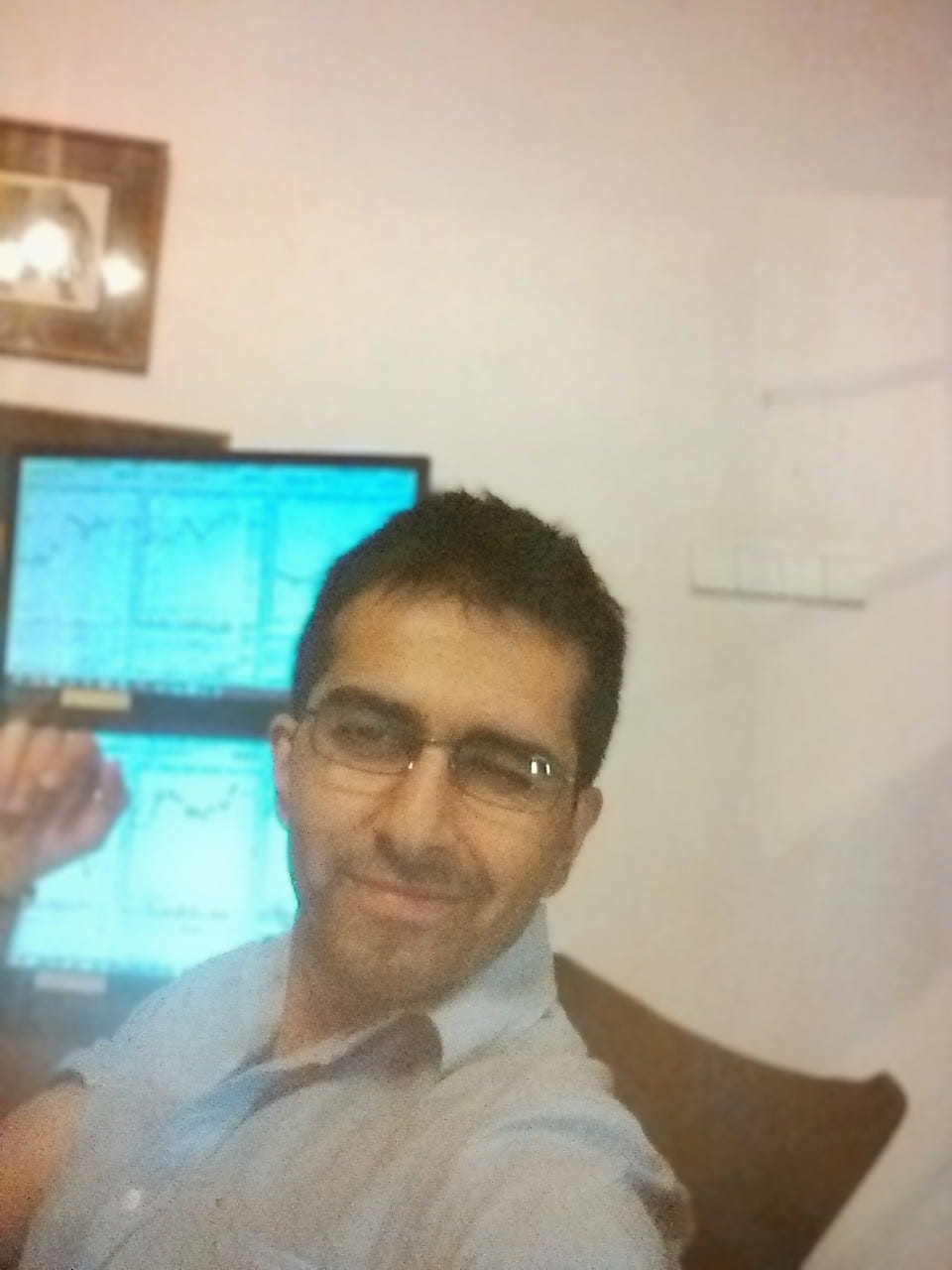
The work was repetitive, but the schooling was real. The vendor stack, in particular, was where it clicked. Brokers in India ran on platforms supplied by a tiny group of vendors — Financial Technologies (Jignesh Shah’s company) being the dominant one.
“The Indian brokers don’t understand tech, and the tech guys don’t understand broking. So maybe the opportunity is in combining the two. The vendors weren’t interested, and they weren’t connected directly to the customers. And the brokers who were connected to the customers didn’t know how to build their own tech. I’m no tech expert, but I could see where the gap was. Because if you know what the customers want as a broker, and you can build it, you can change the game. That’s how I got the confidence to start.”
Futures First was less than a year too.
“It got boring. And on top of that, you’re not allowed to do anything apart from what’s assigned to you. So I came out and started trading for others.”
He took some capital, borrowed more, and set up an independent trading shop in 2012–13.
“Gold and silver were moving like crazy in 2012 to 2014. So I traded gold and silver for a few people, and I also traded my own capital. I’d borrow money from others and trade. I employed a trader. I had a trading setup. We were actually running a proper trading business.”
By the end of 2013, he had used every Indian price ladder and charting tool he could get his hands on, plus most of the international ones.
“I had real, strong confidence that money can be made in trading, that the right people can make it happen, and that I could build a business facilitating that. And I wanted to make big things happen, honestly.”
That is what he took into 2014. Twenty-five years old. No grey hair. No track record anyone outside a small circle would credit. And one very specific insight that almost no one else in the country had built up the same way.
Twenty rupees
In 2014, Tejas applied for an NSE broking licence. He was twenty-five.
The licensing process is, by design, slow and ungenerous.
"The NSE first gives you an in-principle approval. Then they give you the licence. And then, after the licence, they still don't let you operate for several months — there's a whole process. So we really started the business in 2016."
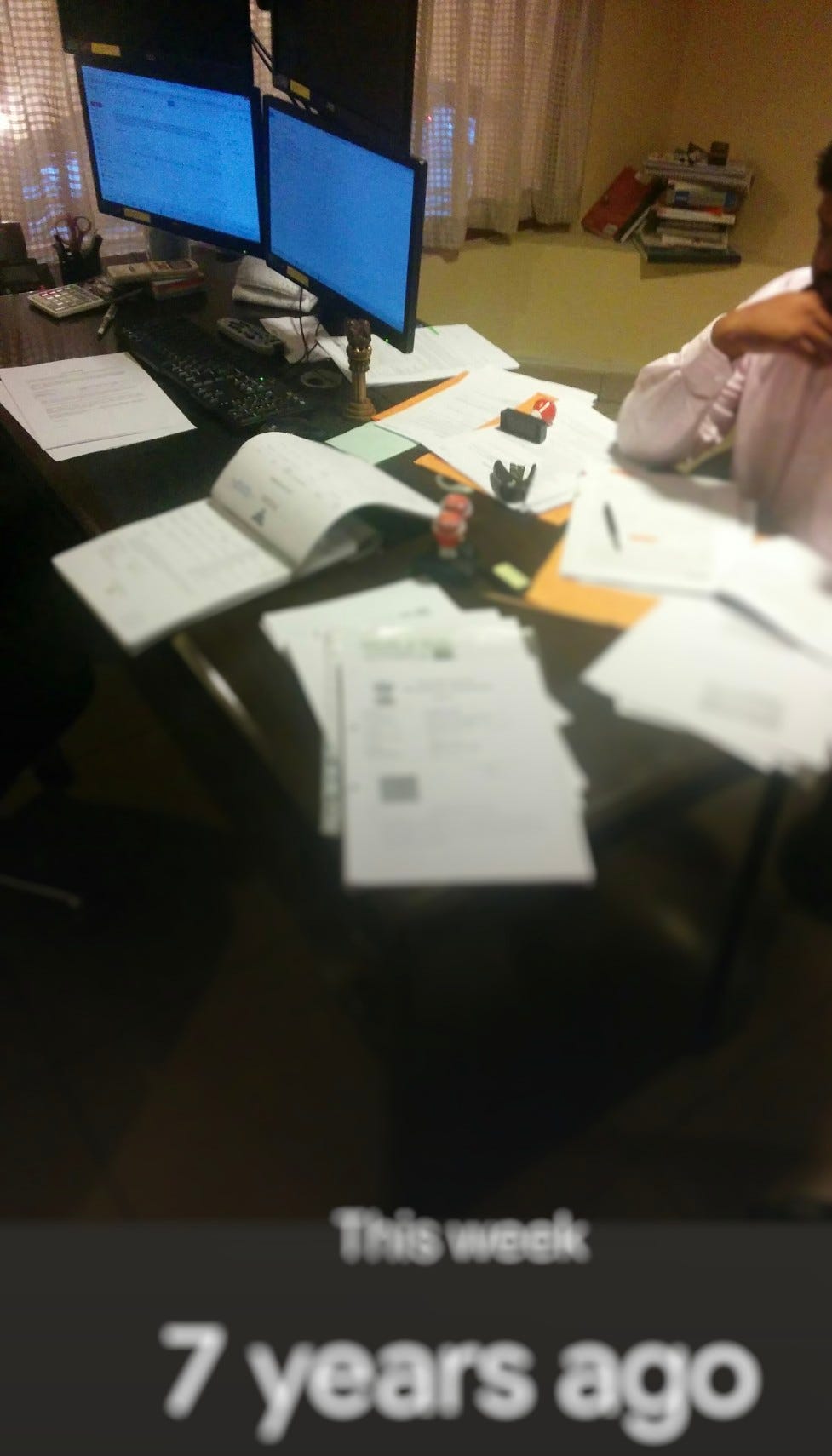
By that point, Zerodha — which had started in 2010 and had found Kailash Nadh, its legendary tech czar, in 2014 — was already a substantial business.
“By the time we started, Zerodha was already a large group. The head start was already there. Our online account opening process only went live in COVID for example.”
For the first four years of the company’s life, opening a Fyers account was a paper-form affair.
The customer had actually to want to come to them.
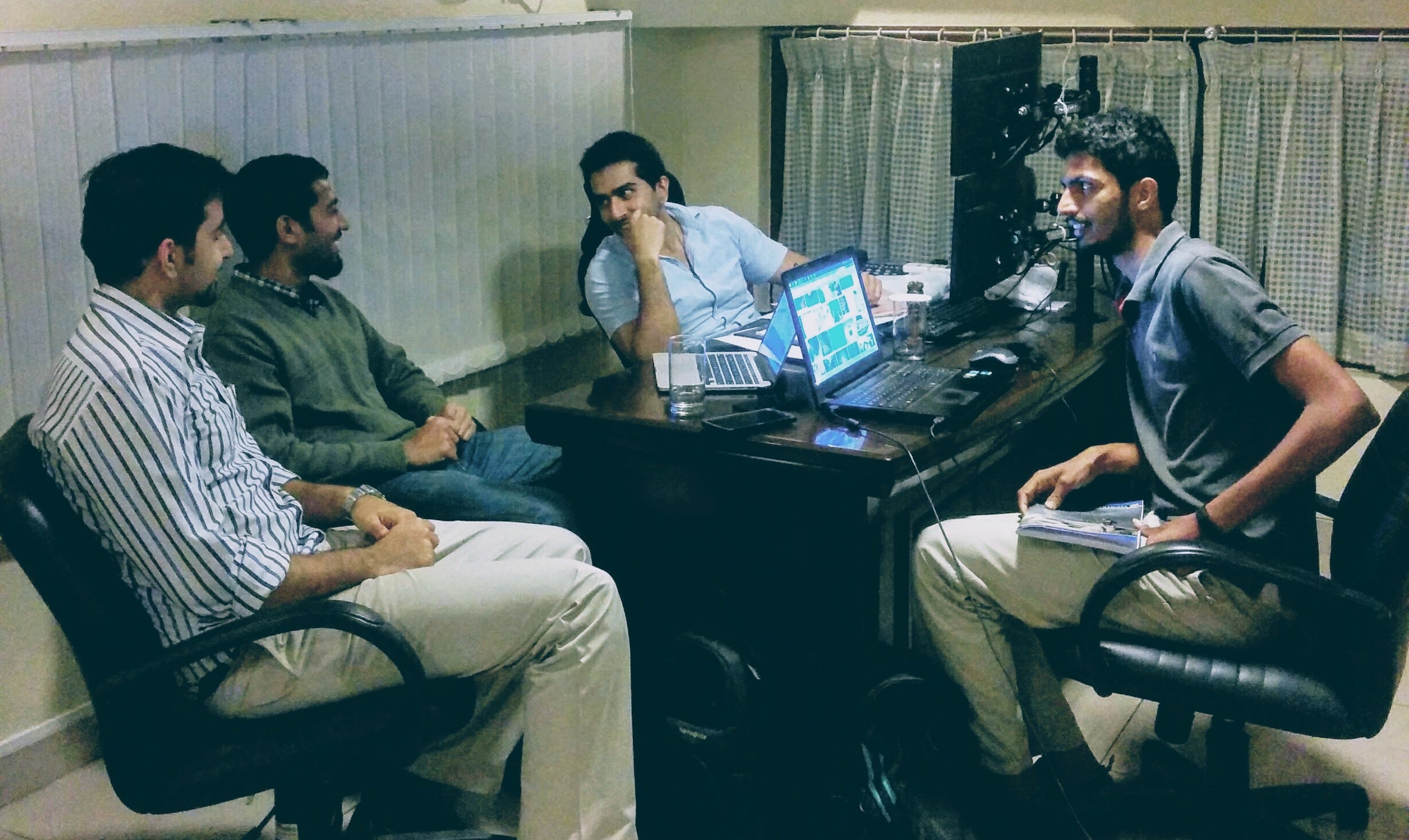
The first office was 200 square feet. The price page said ₹20 per trade — a number already a norm among discount brokers, but also arrived at by the kind of arithmetic that any working trader recognises.
“The average trade size is fifteen to twenty thousand rupees. So if you calculate at 0.1% on a twenty-thousand-rupee trade, you get twenty rupees. So let’s just make it a flat twenty rupees. That was our logic. The discount broking community as a whole framed it like that, and it stuck.”
The number has not changed in ten years.
Pricing was the easy decision. The harder decision — the one that almost everyone Tejas pitched to in those years tried to talk him out of — was the segment.
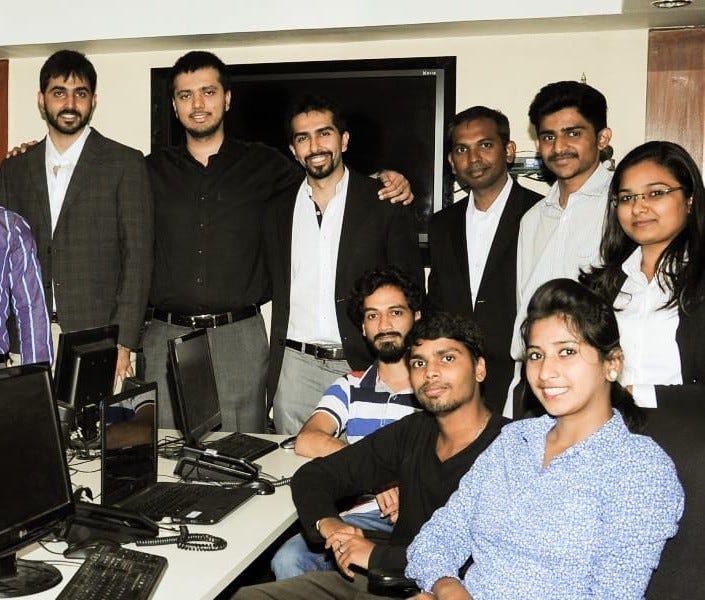
Cockpit for serious traders
The pitch Tejas walked into VC offices with in those years was not a discount-broking pitch. It was a pitch about depth.
"For a trader in 2016, the constraint was that they didn't have any data to make informed decisions. Everybody was relying on news channels and free websites — assimilating some information from here, some from there, some from MoneyControl — and then trading. What we were building was actionable. We were giving them real-time data insights so they could make better decisions in the market."
He kept reaching, and still reaches, for the cockpit metaphor.
"It was a cockpit for traders. What we're building is the cockpit. A pilot needs tools/features to operate the aircraft. Likewise, the trader needs the same to manoeuvre the market — to get a sense of control."
The product roadmap, in those first years, looked less like a roadmap and more like a list of things that no Indian broker had ever bothered to do.
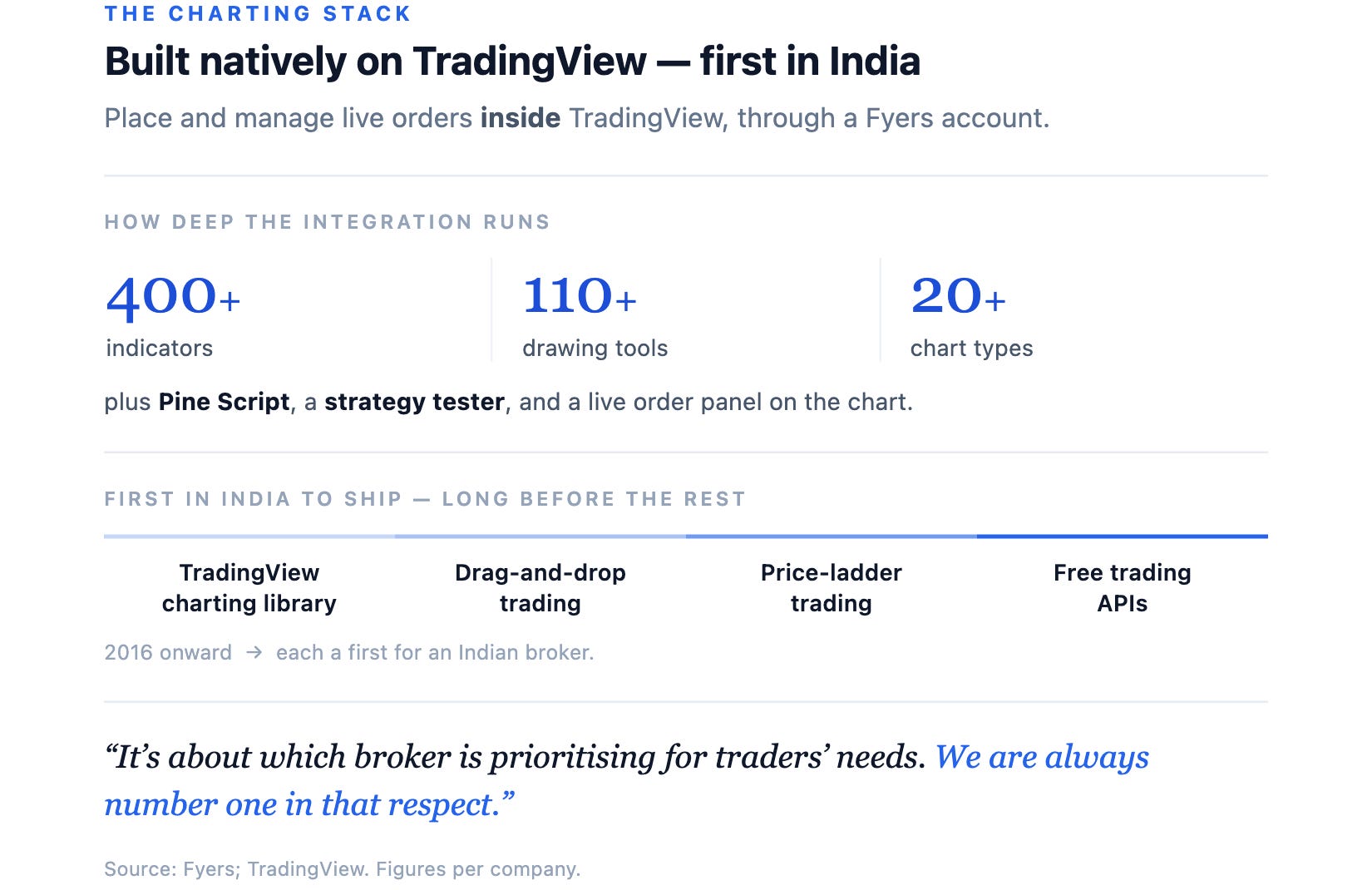
"We were the first in India to use the TradingView charting library. We introduced drag-and-drop trading for the first time ever. We brought in price-ladder trading. We were the first or second to introduce APIs — but the first to give free trading APIs."
The corporate-action work was the kind of grind almost no one else was doing.
"For example, when a company does a split — Bajaj Finance ran up a lot, they did a split — on the chart, it would show the price dropping from 6,000 to 600. You have to back-adjust everything. It needs to reflect the split-adjusted price. No broker used to do that. We were the first. We also started showing when dividends were declared, how much was declared, things like that."
Heat maps, market-breadth indicators, options analytics, screeners — Tejas and Yashas would build a feature that some VC had recently called engineering bandwidth wasted on the wrong customer, and a few months later, traders on Twitter would be loudly complaining that every other broker still didn't have it.
The car analogy was the one Tejas reached for to explain why depth, not breadth, was the bet.
"Why do people buy a Porsche or a Ferrari? Is it because they want to go from A to B? No. Will they ever hit top speed? Will they ever do 0–100 in a few seconds? No. Then why are they wasting their money? Because people who love cars, who feel a car should be fast, will pay for that. It's valuable to them. You can't tell a Maruti 800 guy, you know, buy this Porsche. And vice versa. The Maruti 800 guy always thinks — what the hell, these guys have gone insane. But they're doing it for a different reason."
Then the Schumacher line, which is the closest he comes to a single-sentence product philosophy.
"How does Ferrari help Michael Schumacher? Not by telling him when to take a right or left — by giving him a better car. It's about enabling people to become the best. It’s about enabling traders to perform at their best."
At what? At trading — and ten years in, that still is the motive, he says.
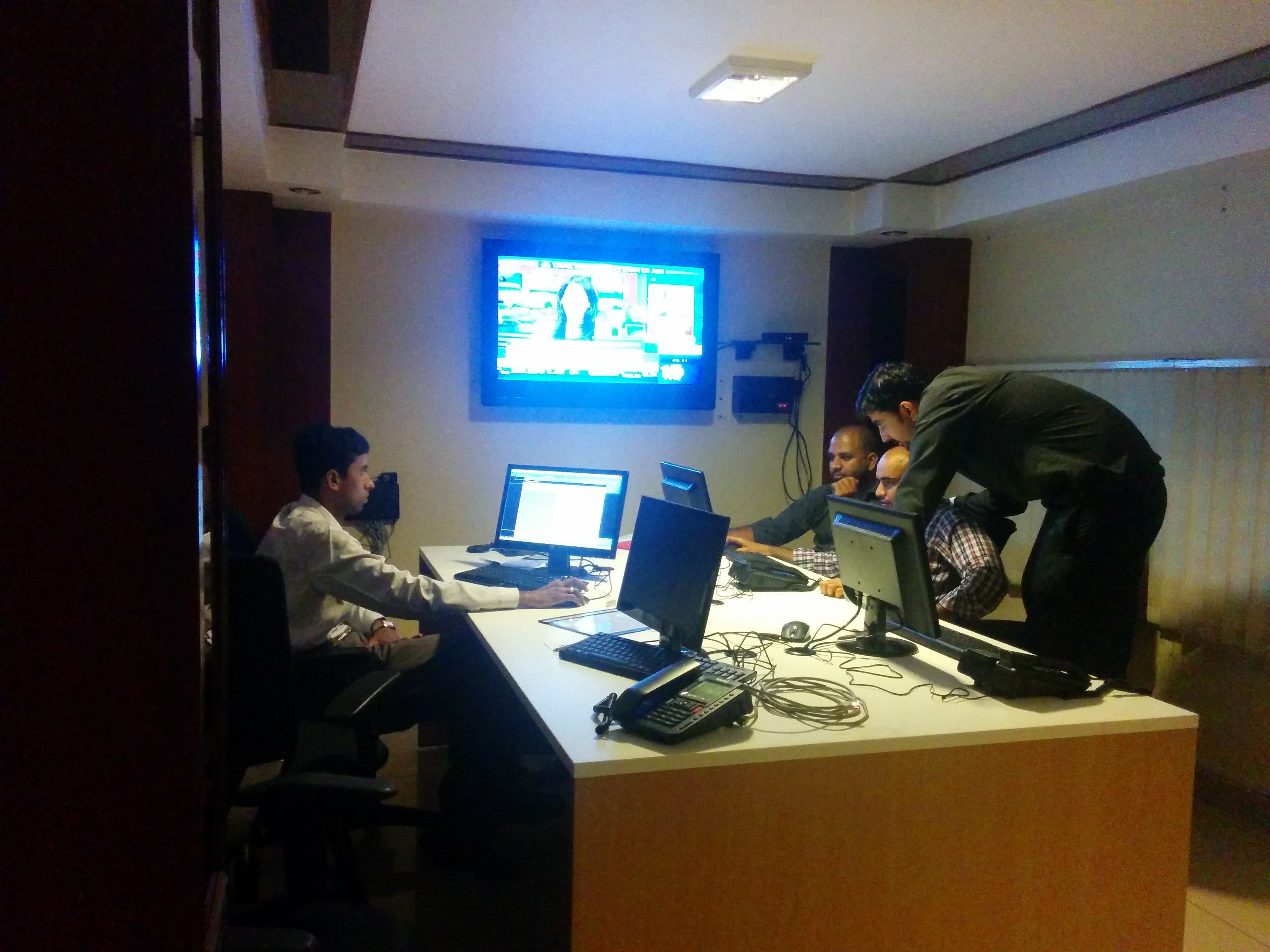
Saying no
The capital raise meetings, all of them, told the same story.
"I pitched to all kinds of investors. They were all very curious — because money was being made by one player. But their thesis wasn't strong enough yet. So they were firming up their thesis, strengthening it, and taking a lot of inputs from me. For the most part."
He did not begrudge it.
"How else will you build your intelligence? Of course you want to speak to people."
The deals didn't materialise because the worldviews didn't match.
"They didn't see the potential of the trading community. They were always after — okay, how big can this become? They didn't see it that way, actually. They still don't, by the way. They've always invested in companies going after a very large TAM from day 0. They put money in smallcase, they put money in Groww — and these players were focused in serving the retail investors."
The VCs wanted Fyers to become a financial marketplace — selling mutual funds, selling insurance, selling pensions — or to pivot into SaaS and license the platform to other brokers.
Or to take a buy-out, lock, stock, and barrel, from one of the BFSI giants who had come knocking.
"We had over five buy-out proposals and a dozen-odd smaller approaches. All the big BFSI envelopes — from banks to very large NBFCs, the who's who, everybody from ICICI on down."
He turned them all down.
"Trading is a specialist discipline. We're hardcore capital markets. We don't want to get married to somebody who wants us to be a financial marketplace — a very general one at that, selling pensions. Look, it's okay to do that when the company is mature. But when we're still fighting for our identity and market share, it would be foolish to become diluted across everything."
On SaaS, he had a longer answer.
"SaaS existed before us and will exist after us. But one thing will remain constant — they don't make money. SaaS in fintech hasn't made money. Even the most successful SaaS in fintech was Jignesh Shah at 63 Moons — and he ultimately had to set up exchanges to make any serious money relative to what the brokers were making (he founded MCX). I guess it's a different worldview. In any case, we moved on."
He stopped taking pitch meetings sometime around 2018 and hasn't taken external capital since.
The other thing the VCs kept telling him was that the way to compete with Zerodha was on price. Drop the brokerage to ten rupees. Drop it to zero.
"The easiest thing for a new entrant with a low cost base is to fight on price. You have less to lose."
Fyers refused.
"Making money is important. It's not just important to gain market share. We didn't really compromise on that principle. Making money is important as you scale a business."
Tejas was aware, perfectly aware, that the VC fashion of the day pointed in the other direction.
"When we started, Flipkart was in its heyday. Losses were being shoved under the carpet. We felt — it's important to make money while we scale. And if that comes at the cost of growing slowly, we're okay with that."
The competitive posture was not naïve.
"We're very aware of our competitive landscape, always have been. The question is — how do you compete effectively when you don't have money? What's the best analogy? David versus Goliath. So we figured out ways. We chose a balanced growth model as against explosive growth, because we felt that if we could double revenues every year, we'd make a real change."
For a long time, this looked, from the outside, like stubbornness. From the inside, it looked like a chess move.
The white pawn does not start trying to checkmate on move three.
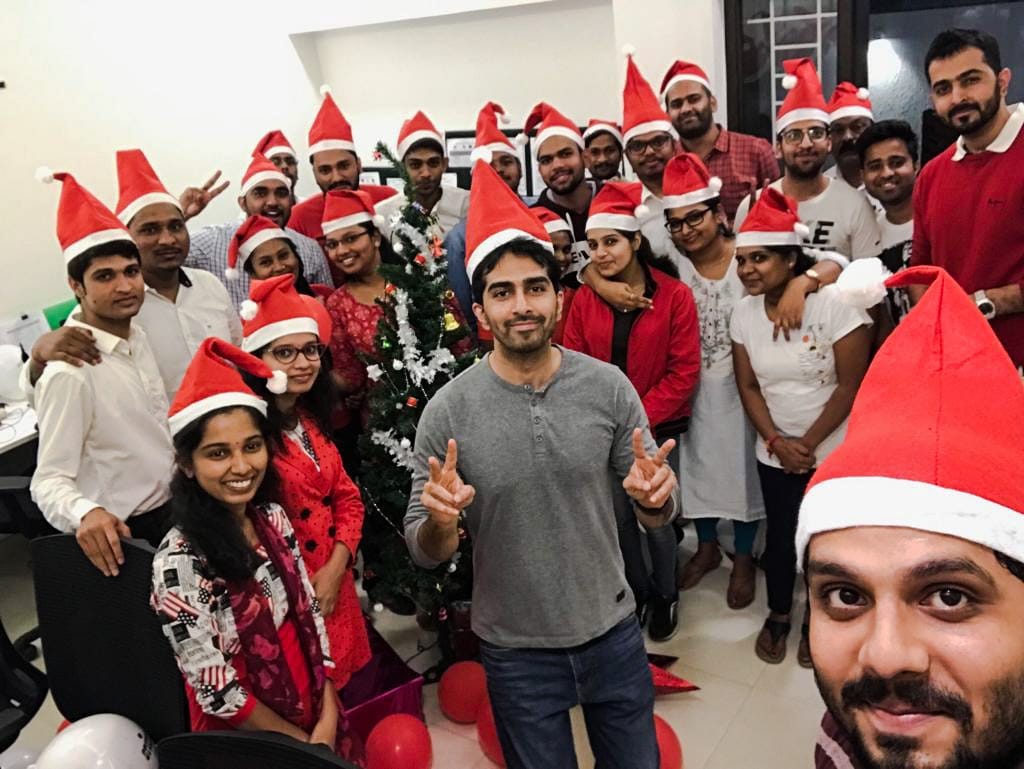
Word of mouth
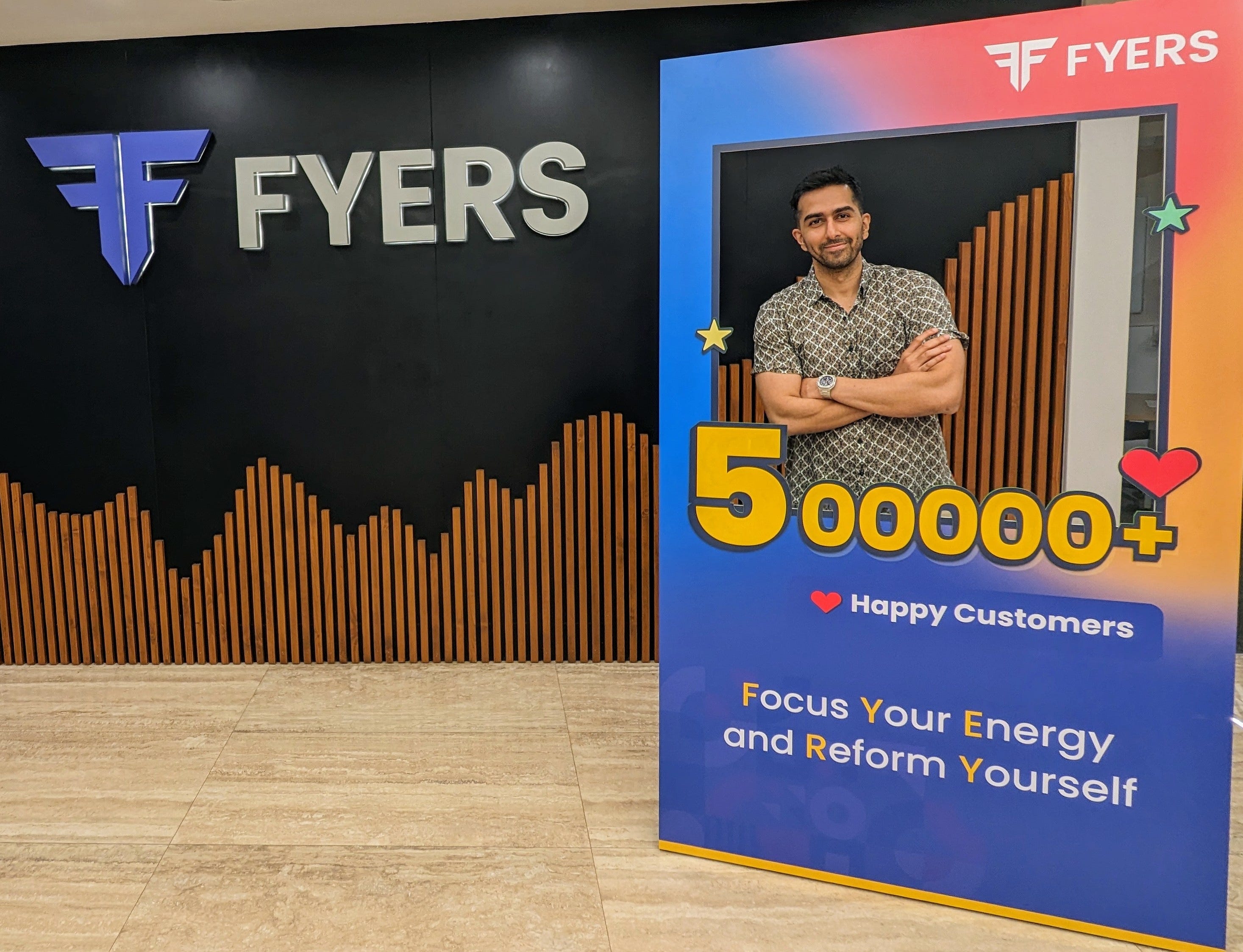
By the end of 2017, Fyers had crossed its first symbolic milestone — 5,000 customers, which Tejas later called the team’s first real break.
By 2019, the company was moving into a new full-building third office in Bangalore — its third in five years — with 30,000 active traders. By early 2020, approximately 50,000 active traders.
Then COVID happened.
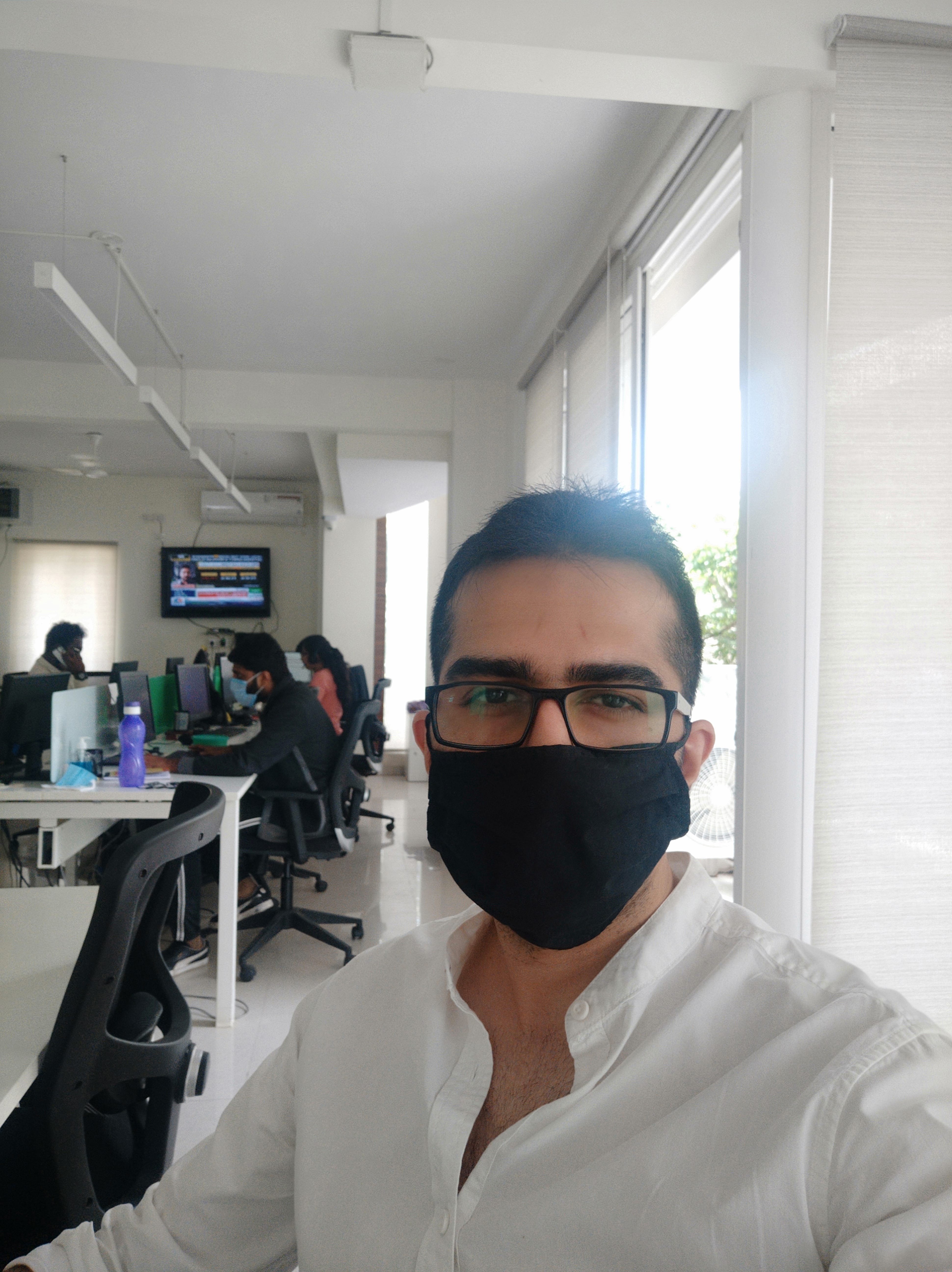
During the lockdown, Tejas himself caught COVID but did not stop working…
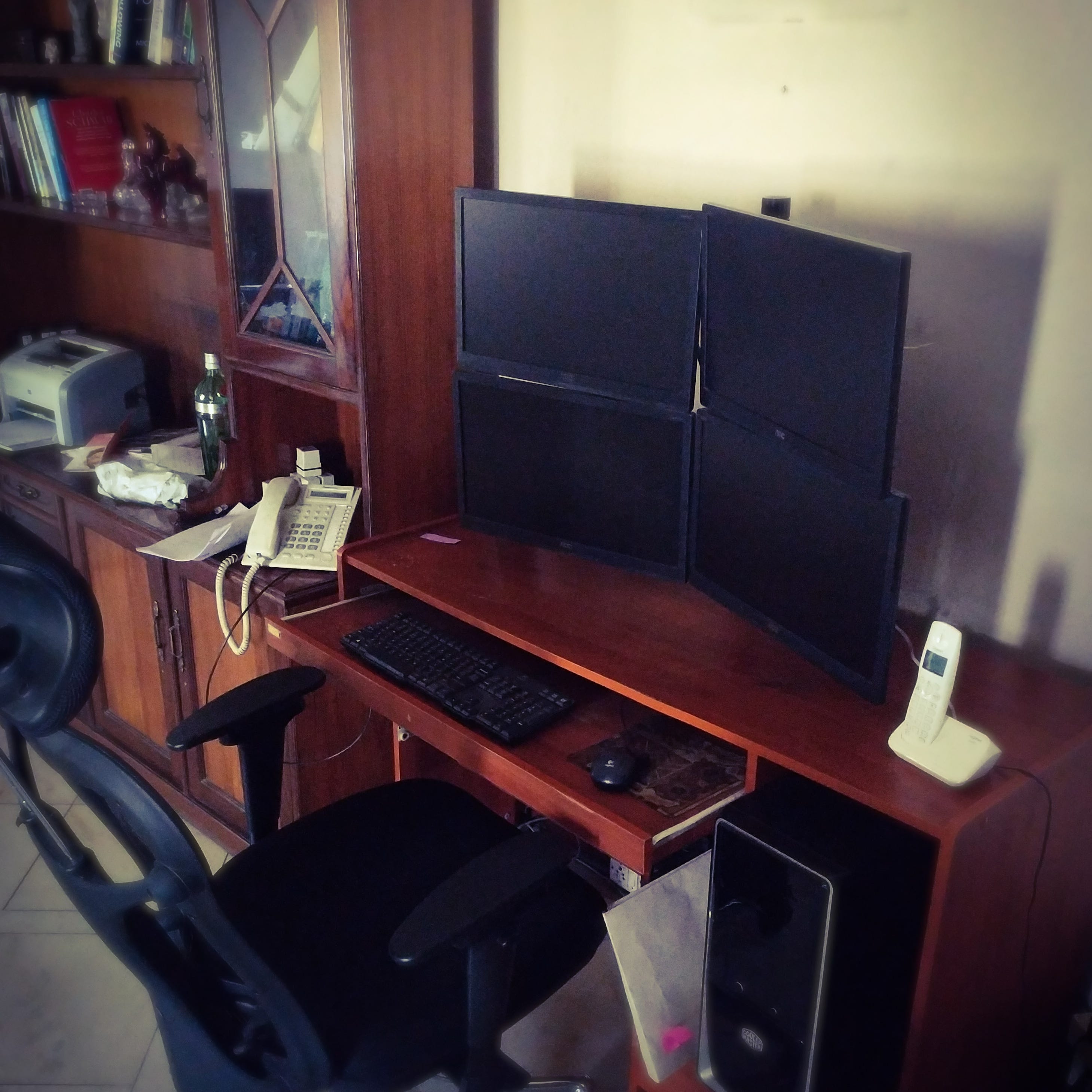
He came back to the office, watched NIFTY break 16,000, and made the call to scale the company up — a new HQ, a doubled workforce. The team that had been 120 to 150 grew past 300 within the next year.
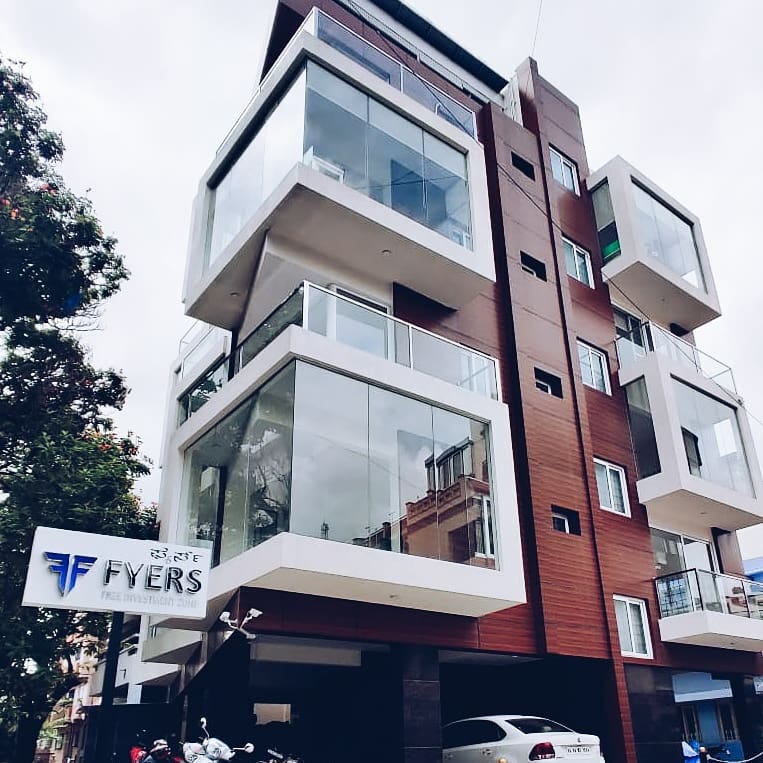
Two things changed at once. The lockdown forced an end to paper KYC across the industry, and Fyers shipped end-to-end digital onboarding within weeks — account-opening collapsed from days to about forty seconds. And the existing Fyers customer base started talking.
“We were very active during COVID, in terms of telling people about the platform. We never spent money on it. By then, these twenty, thirty, forty thousand customers had used it for a long time. So when the boom happened, we grew 10x by word of mouth alone.
By the end of 2022, Fyers had crossed one lakh active customers and was in a brand-new building.
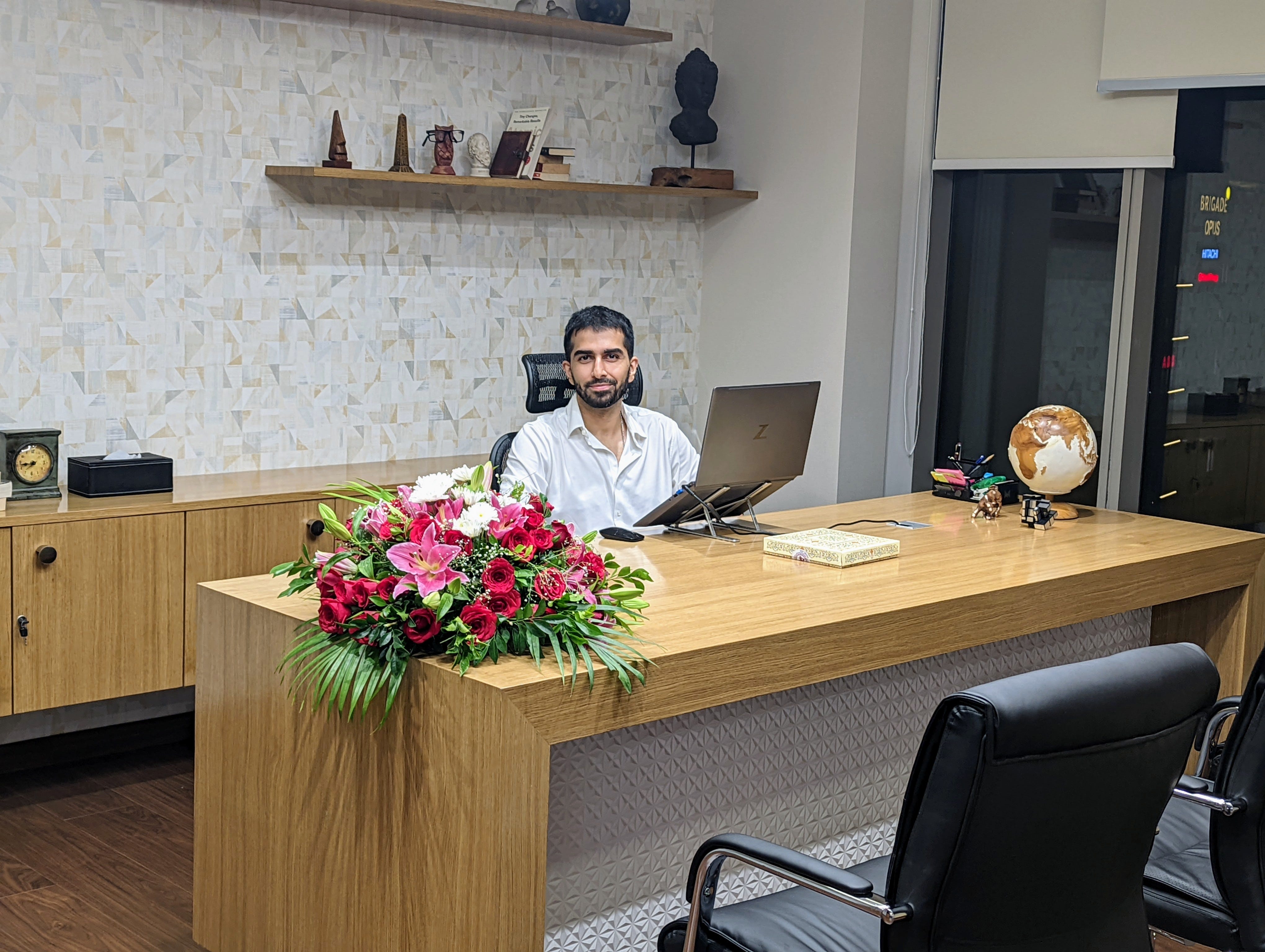
“At that point, we had around 120 to 150 people at Fyers. Soon after setting up the new HQ in Bengaluru, we hit the aspirational one-lakh customer milestone. The customer-onboarding team surprised me with flowers that evening. A moment I remember and cherish. I told them — just get us to one lakh, and I guarantee you, I’ll take it to one million in a few more years.”
They did.
We went straight to five lakh customers by 2022-23. By word of mouth. No expense whatsoever. We became massively profitable, because we weren’t paying to acquire.”
The phrase we weren’t paying to acquire deserves more attention than it usually gets in startup circles.
Most Indian broking growth in 2020–2022 was paid growth. The CAC numbers being whispered between Bangalore offices were eye-watering. Fyers, which had no marketing budget worth the name, simply did not participate in that auction.
“The bigger players that had scaled up — they kept failing. Their platforms would crash. Users would look for alternatives, and they’d come to us. So we won on product merit, to some extent. And I wouldn’t say won — we’re still a very small, tiny company compared to the largest ones out there. But if you compare us to startups, we’re reasonably big, in terms of profit. There are very few profitable ones out there.”
Power to the Traders
Ten years in, Fyers' product offers everything that the larger Indian discount brokers offer. But at the same time, it’s fundamentally different due to its obsessive focus on powering serious traders.
"We already offer everything that Groww has. We offer everything that Zerodha has. It's just that vanilla offerings aren't our priority areas today."
The difference is what gets prioritised. The recent launches are a study in his priorities.
Nowhere are the priorities clearer than in the charts.
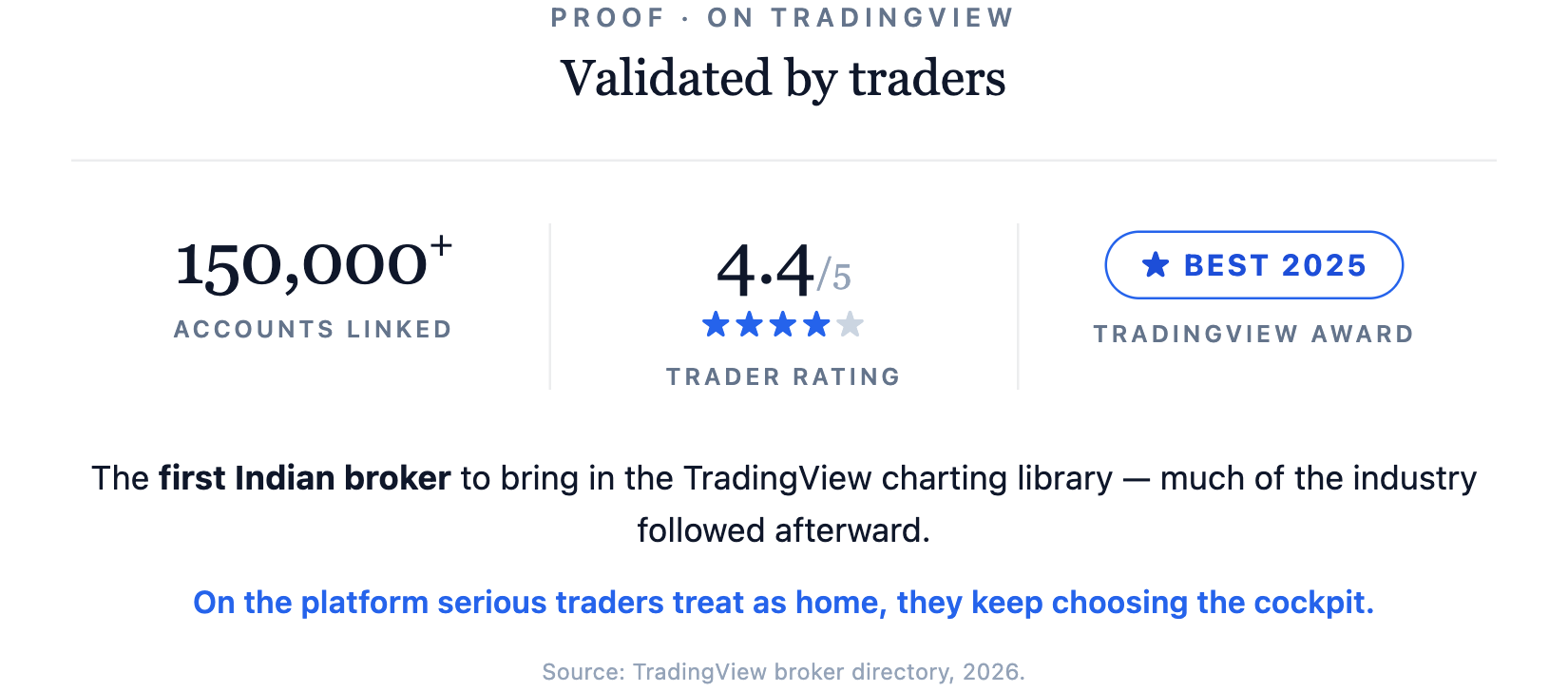
Fyers was the first broker in India to build on TradingView — and it has gone furthest with it. It has 4.4/5 from thousands of reviews and 1.50 lakh+ TradingView accounts linked to their respective Fyers accounts — more than 15% of their total user base, and more than half of the highly active traders on the platform.
Rather than bolt on a charting window, Fyers wired TradingView in natively: a trader can place, modify, and manage live orders inside TradingView through their Fyers account, with Pine Script for custom indicators, a strategy tester for backtesting, and TradingView’s full surface of indicators and drawing tools.
Speed is its own discipline, and Fyers builds for it.
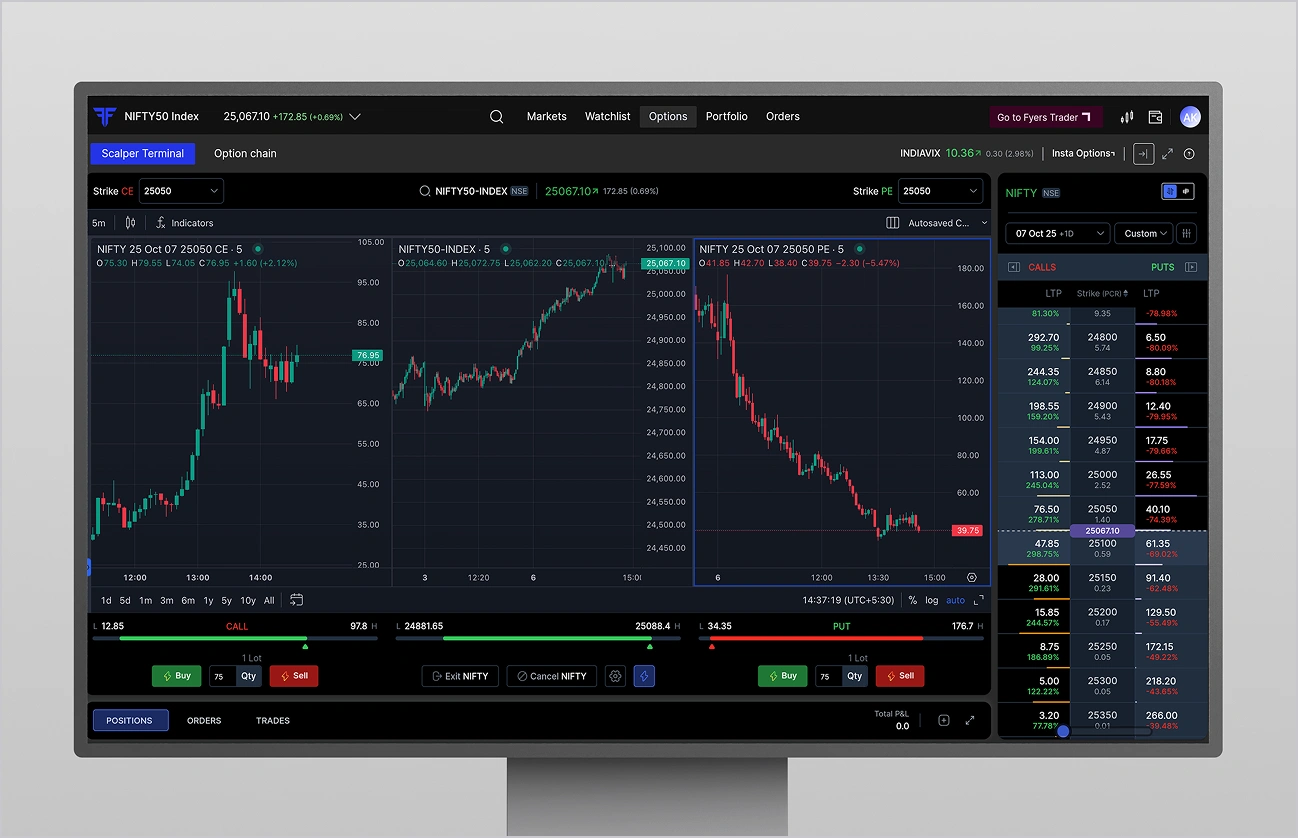
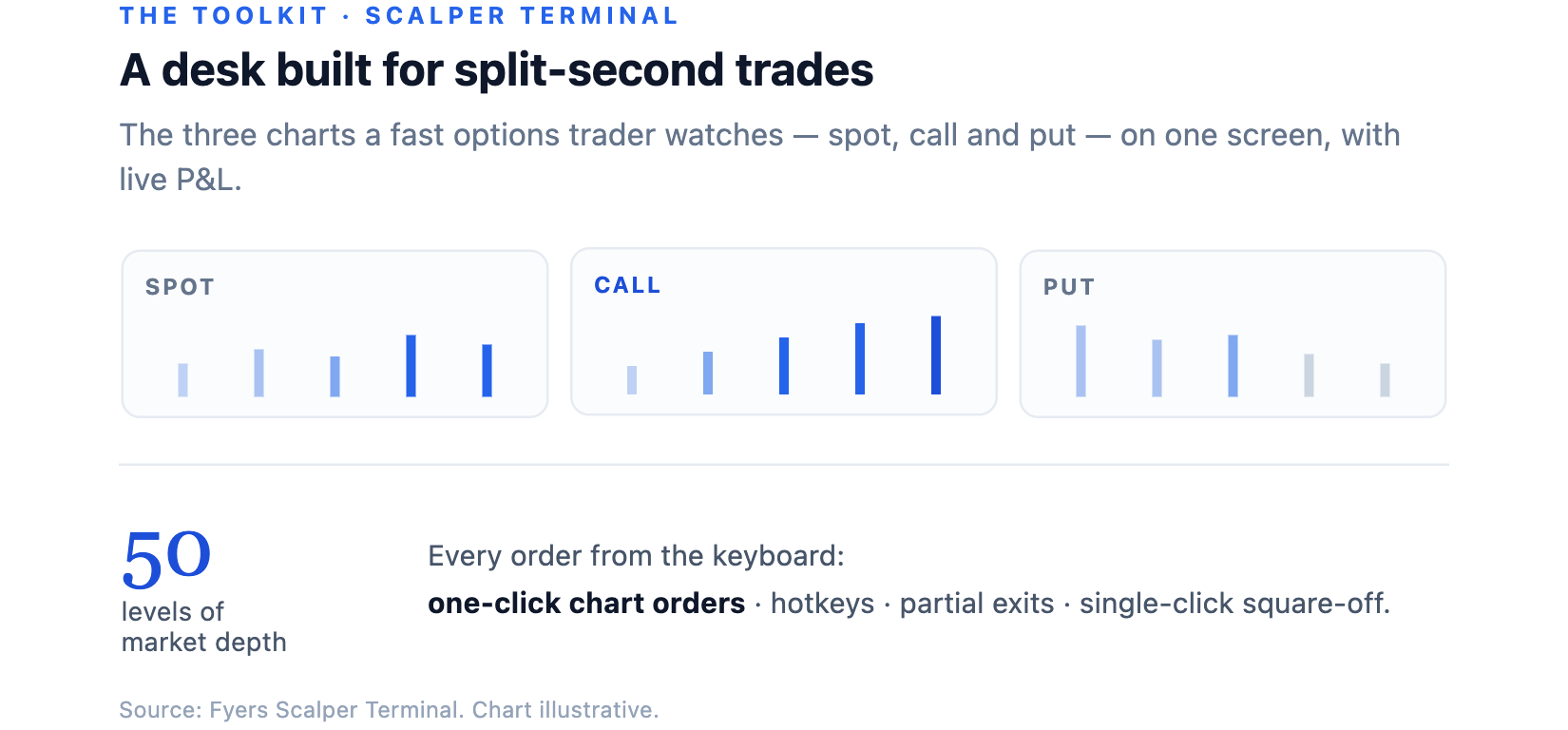
The Scalper Terminal puts the three charts a fast options trader actually watches — the spot, the call, and the put — side by side with live P&L, stacks fifty levels of market depth onto the screen, and lets every order be fired, modified and squared off from the keyboard.
It is the kind of purpose-built desk a mass-market app has no reason to construct.
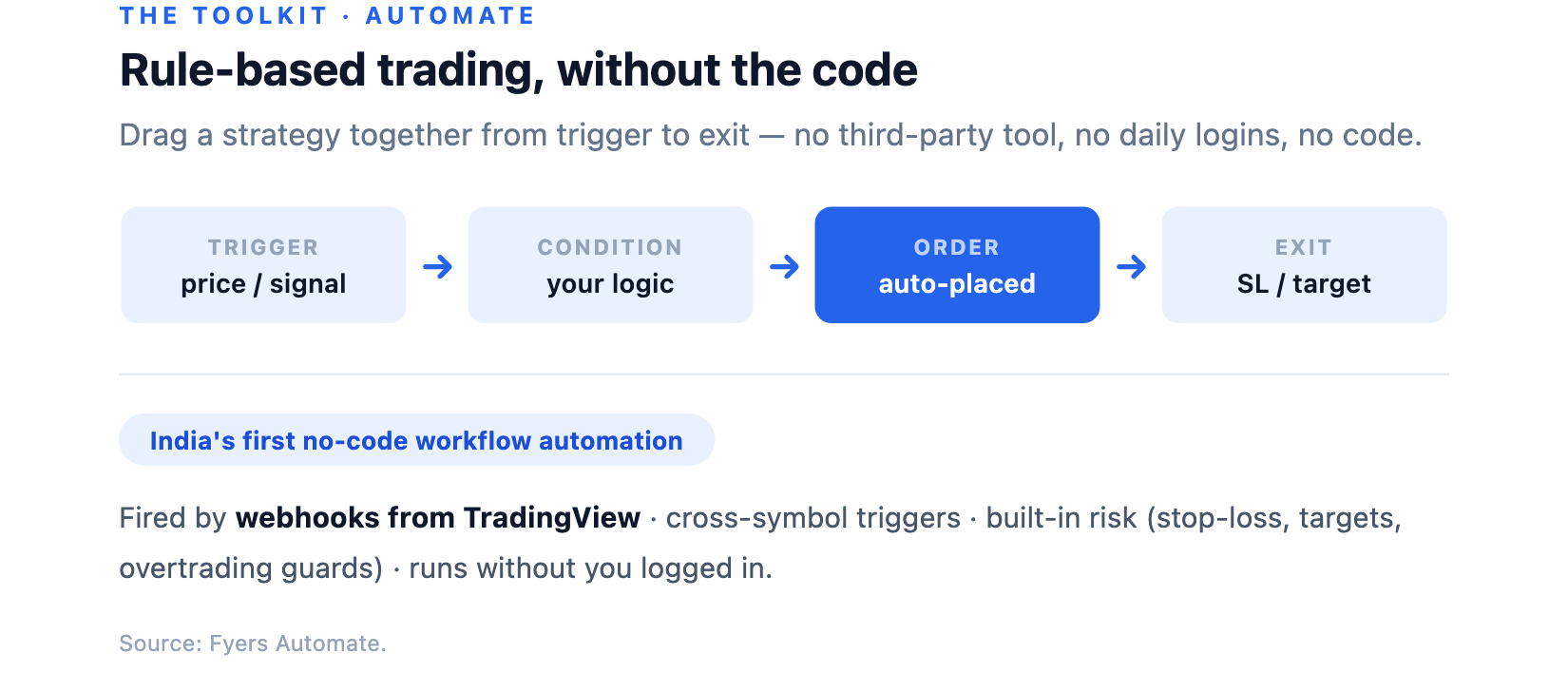
For traders who would rather follow rules than reflexes, there is Automate — India’s first no-code, workflow-based automation.
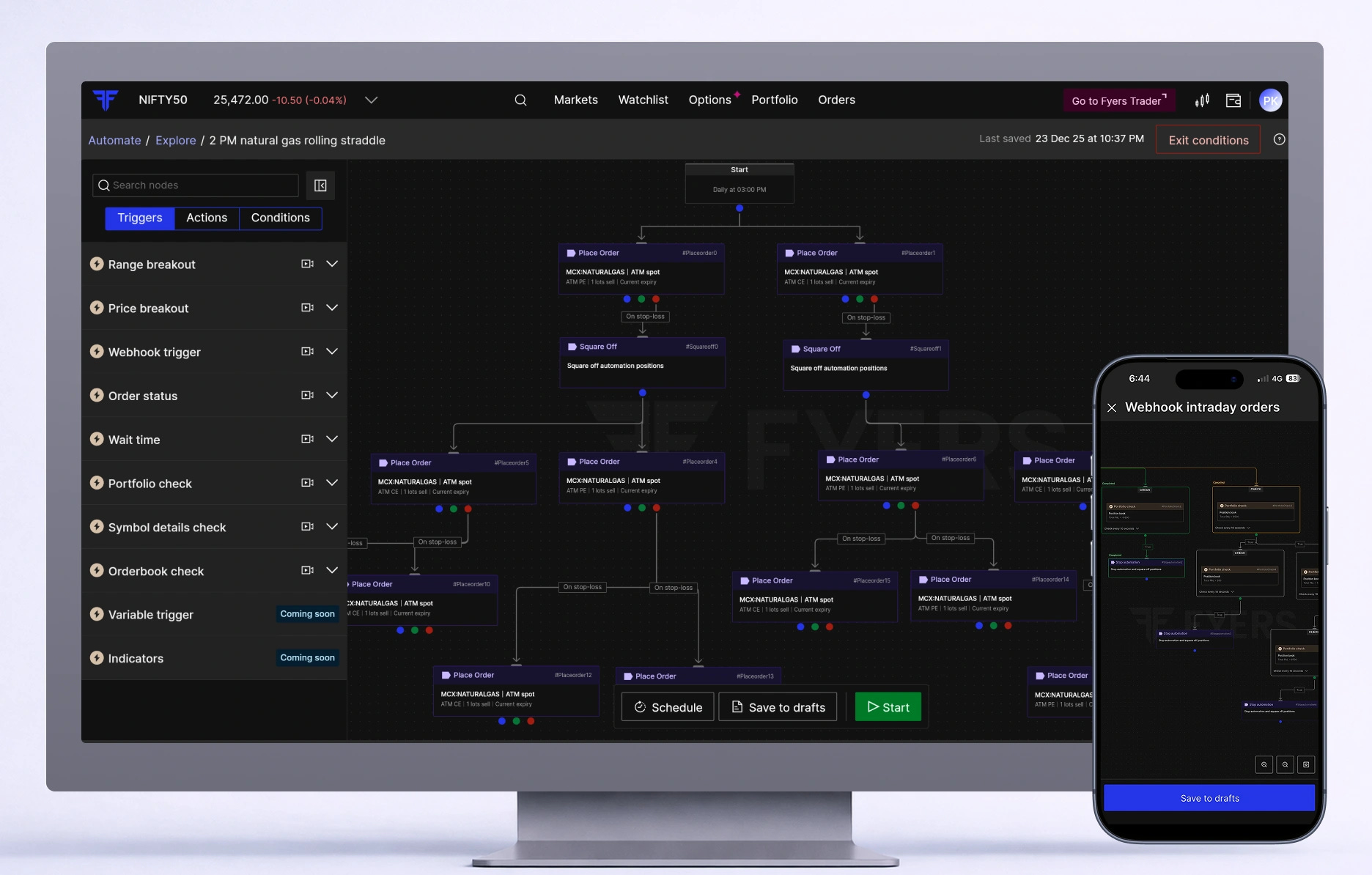
A trader drags a strategy together from trigger to exit, or fires execution from a TradingView webhook — with no third-party platform, no daily logins, and no code. Stop-losses, targets, and overtrading guards are set once and then enforced by the system, not by willpower.
Options are where the depth shows most.
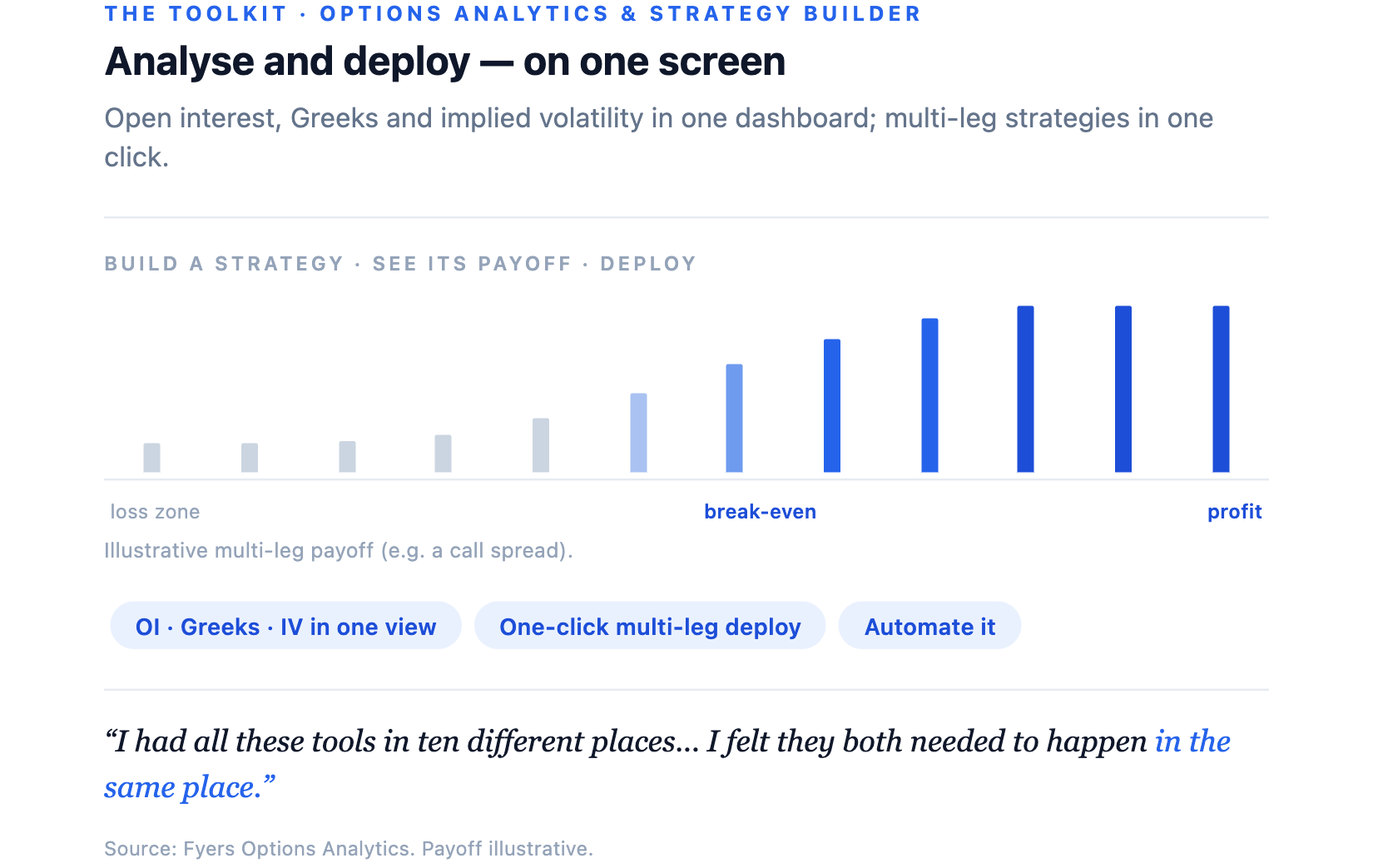
The Options Analytics & Strategy Builder collapses what used to take three or four tools into one screen: open interest, Greeks, and implied volatility in a single dashboard; a multi-leg strategy built, simulated against its payoff, and deployed in a single click.
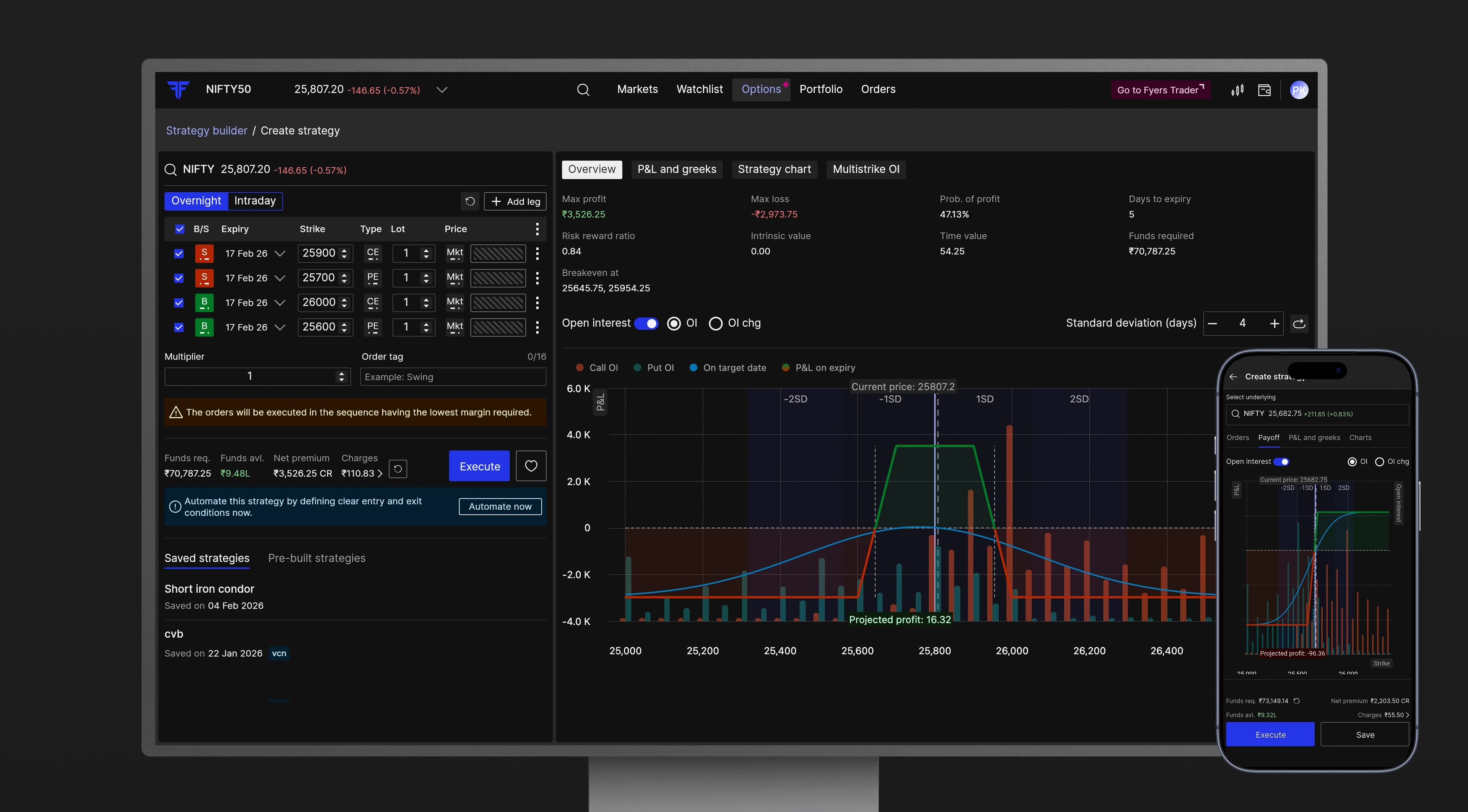
It is the clearest expression of an idea Tejas has held since the start — that analysis and execution belong in the same place.
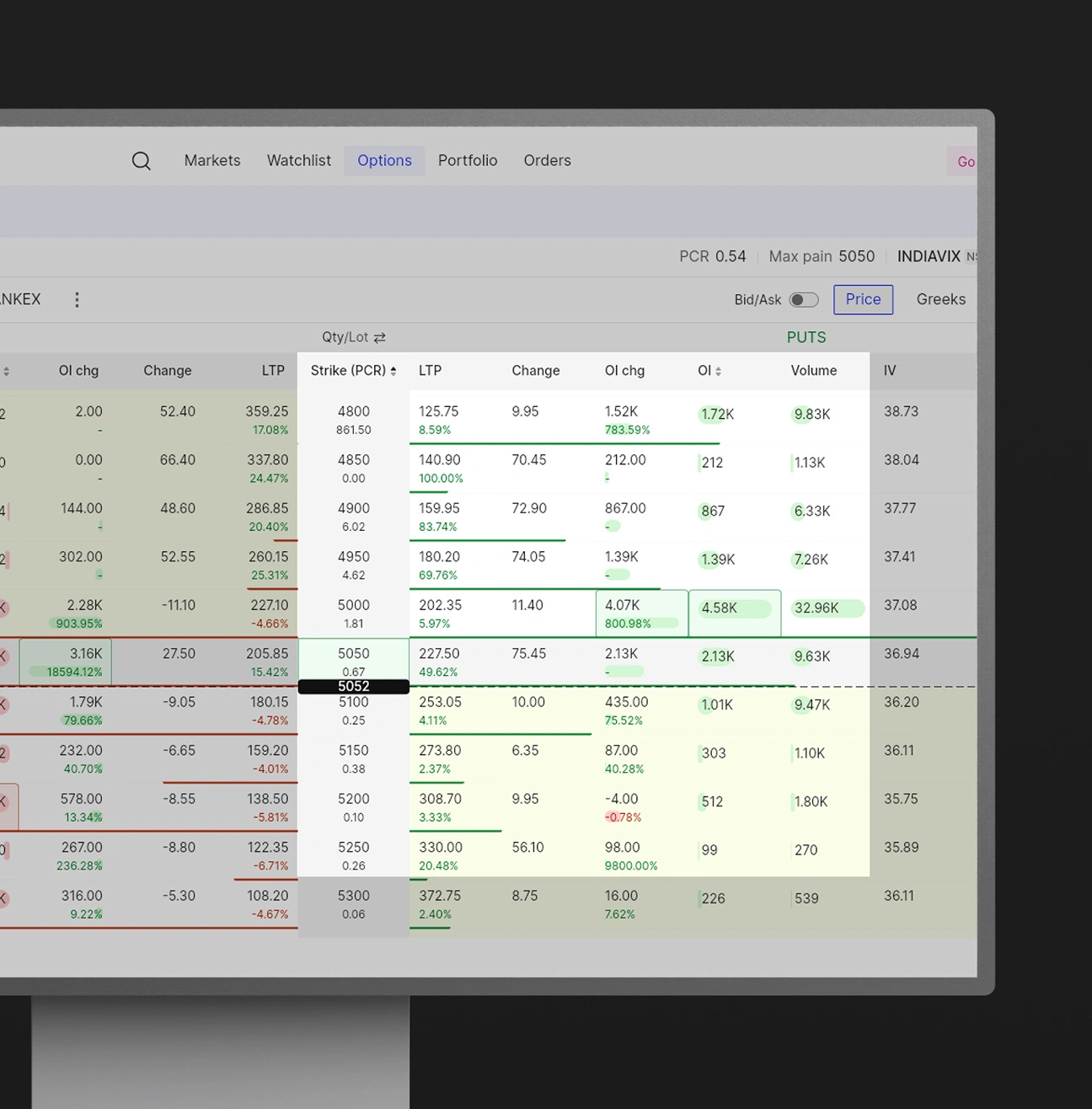
The option chain is a trader’s radar, and Fyers’ is built to be read fast. Live open interest, implied volatility and Greeks sit on every strike; build-ups and unwinding show at a glance; and orders go in straight from the chain — in price, Greek, straddle or custom views.
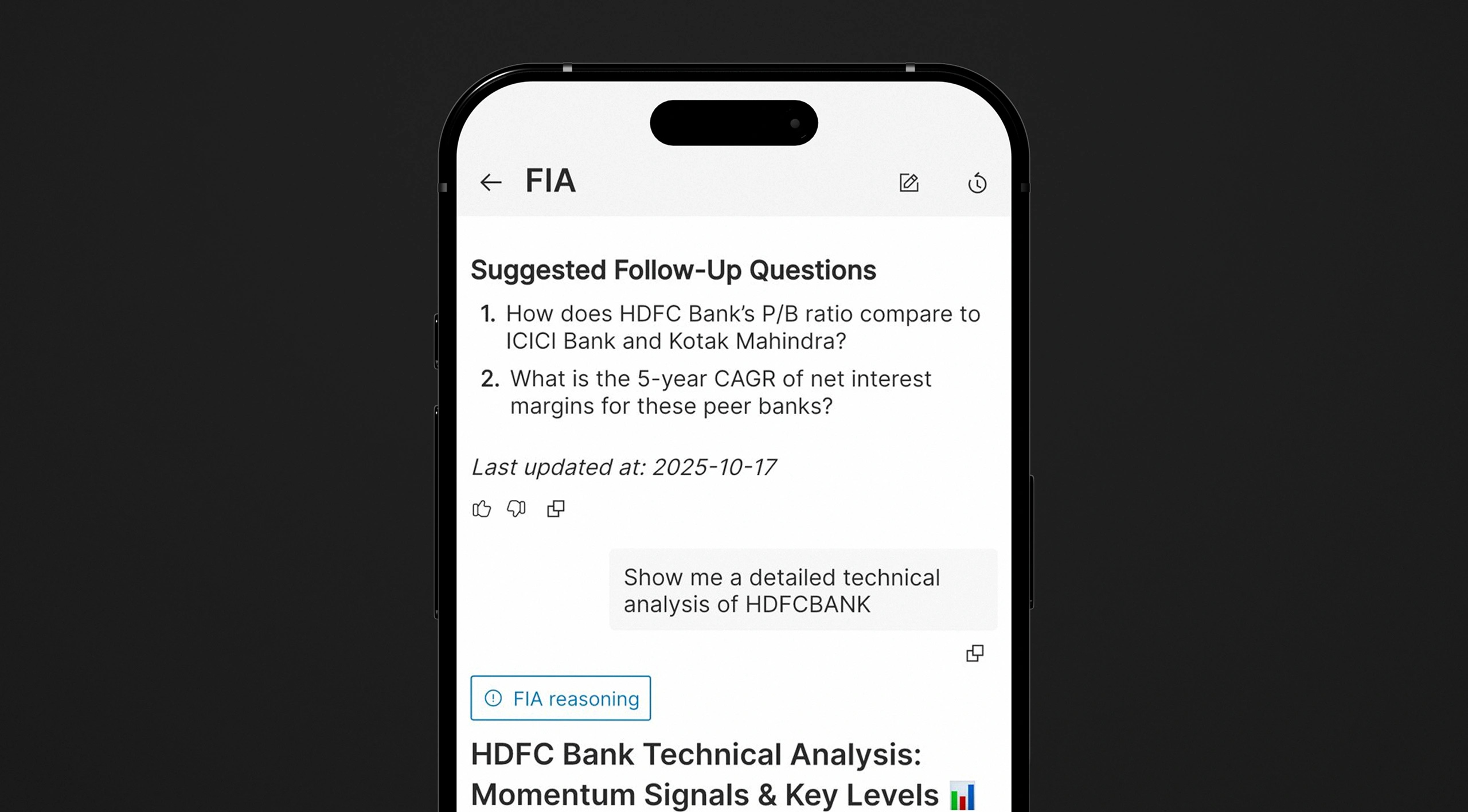
Tying the toolkit together is FIA — the Fyers Intelligence Assistant, India’s first market-AI co-pilot. A trader types what they want in plain English — a screen, a stock read, an IPO breakdown, a look at their own portfolio — and FIA does the connecting. It now reaches beyond the app, too, onto ChatGPT and a one-tap MCP.
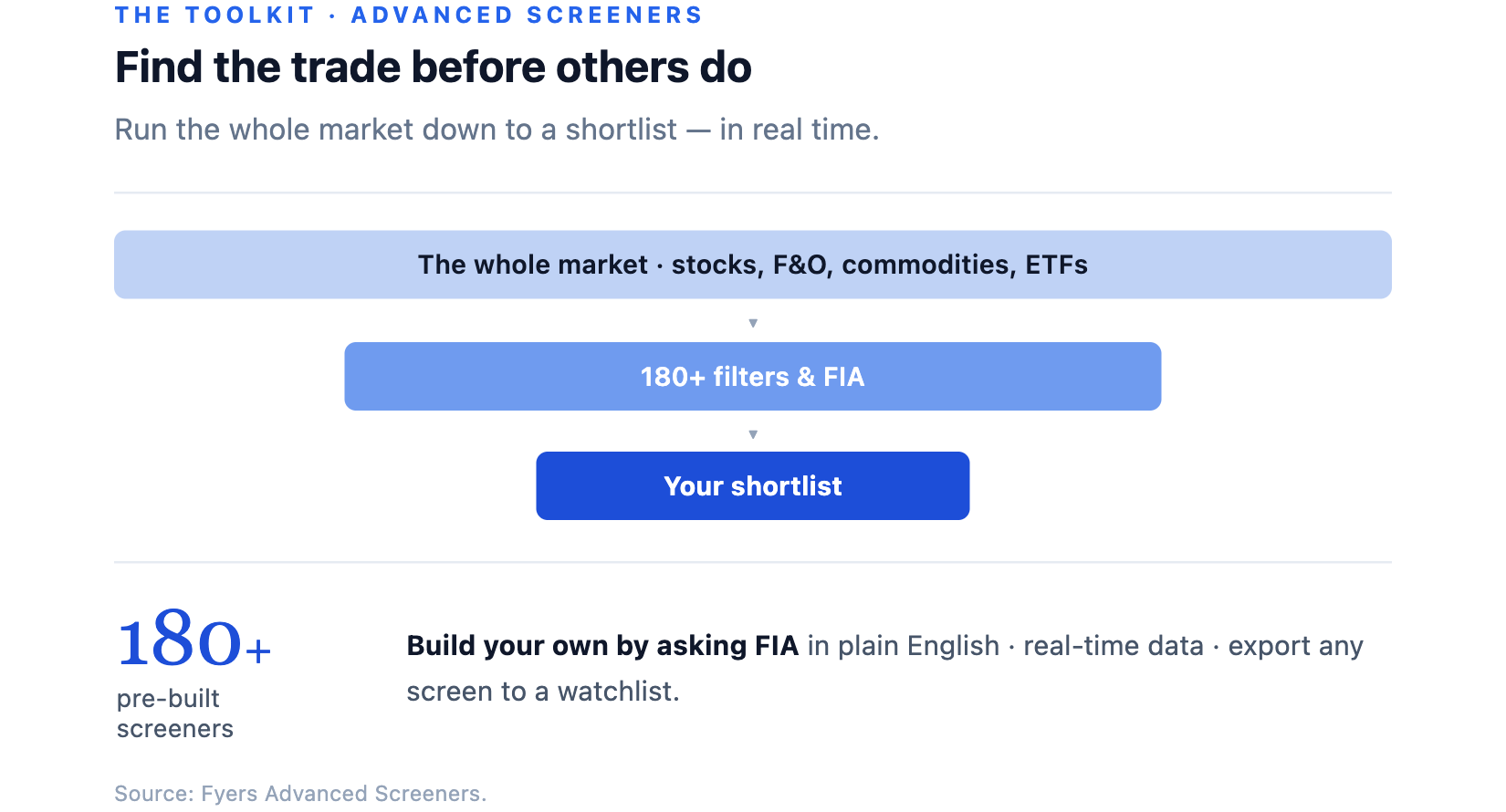
Discovery is a funnel, and Fyers hands traders 180-plus ready-made filters to run it — across stocks, F&O, commodities, and ETFs, updating in real time.
Those who’d rather not fiddle with parameters can simply ask FIA, in plain English, to build the screen for them.
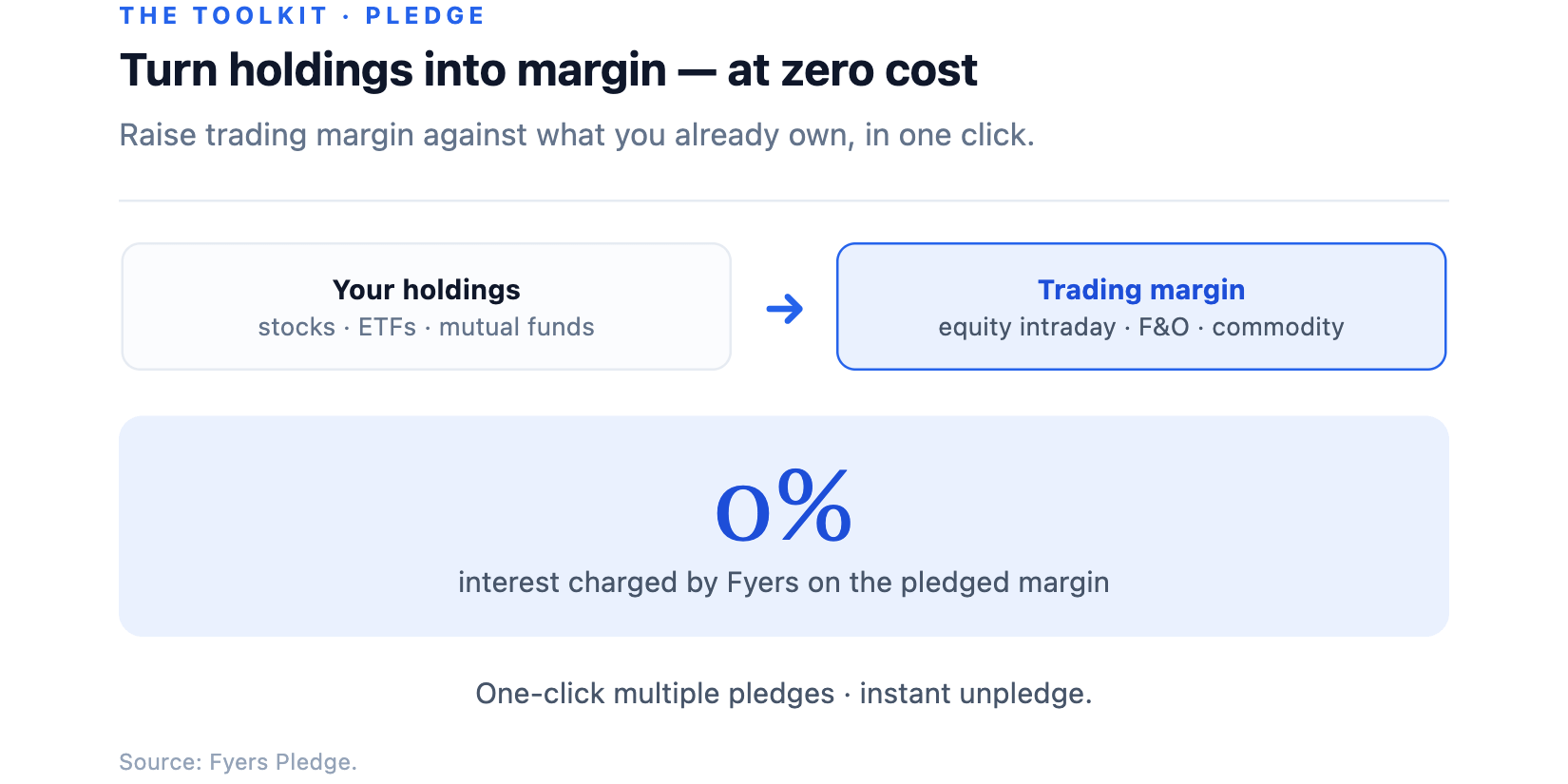
Active traders run on margin, and Fyers lets them raise it against what they already own — stocks, ETFs and mutual funds — in one click, instantly. The differentiator is the cost: Fyers charges zero interest on the pledged margin.
Underneath the new features, the core philosophy has not moved.
Tejas still talks about the customer the way he did in 2016. He still rejects the metaphor that runs most of consumer fintech.
"Most of the business world looks at customers like milking cows. Get them in, and then squeeze them out — whether over a short or long period. Essentially, they're detained. There's 'retention' — imprison them, and then extract from them. That's the model."
His own metaphor is different.
"We think of a business more like an orchard. There are fruits and flowers, different trees of different varieties. There are butterflies and bees that come and help with pollination. That's steady growth. Far more diverse. More inbound. More pull than push. And you don't hold customers hostage."
The orchard metaphor is doing real work.
"Retention has to be willful. Don't force them to be retained. At the end of the day, a customer has a choice. Beyond a point, you really can't influence them. So making superfluous, ambitious assumptions about how you can influence their behaviour is a flawed way of running things."
Most of Fyers' growth has been pull-based: a trader gets fed up with crashes on a competitor's platform, asks around, opens a Fyers account in forty seconds, and stays.
"Beyond a point, you cannot retain users — unless the product is good enough and causes repeat usage. So it's very important to focus on the product. Value delivery within the product itself. Deliver value, and people keep coming back."Yashas addressing the media on FIA, 2025.
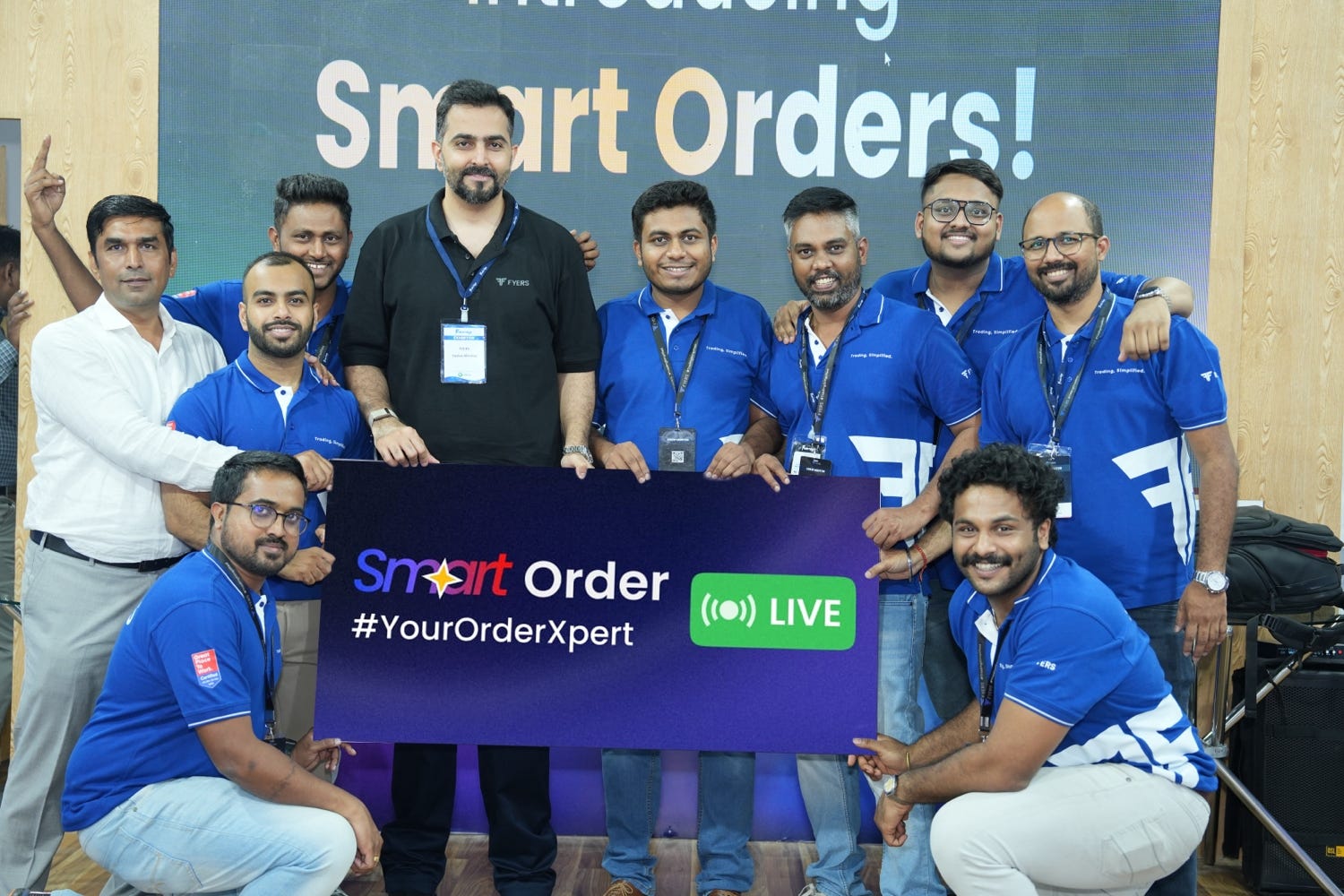
Growth Lever 01: Increase Market Share among Traders
For all the milestones — one million customers, the 25,000-square-foot HQ, the awards — the number Tejas returns to most often is the one that sounds least impressive.
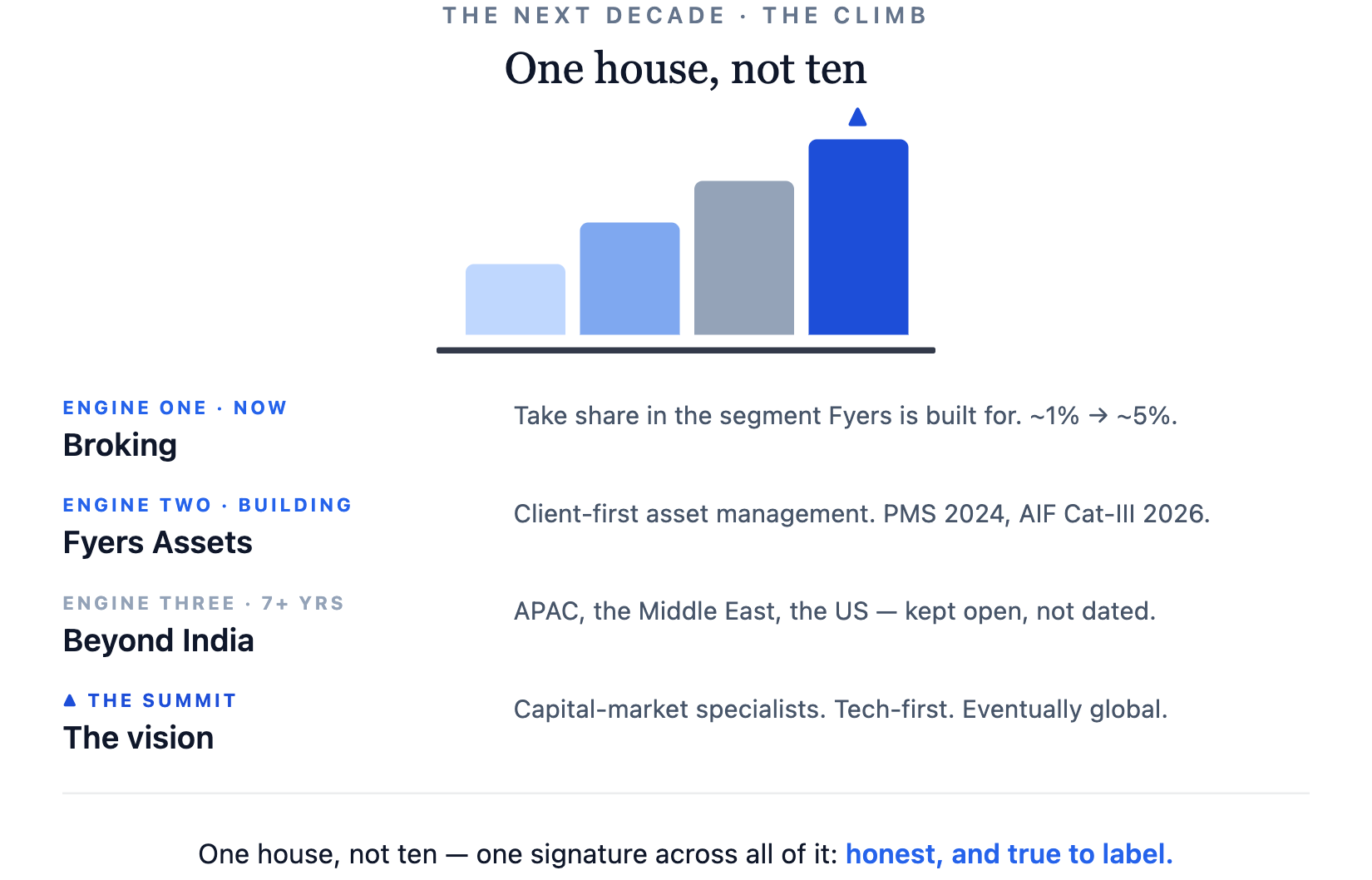
“We’ve just tried to perfect one business segment, one target audience, one pricing model. And we’re still just a 1% market share company. So we have a long way to go.”
He says it with something closer to relish than apology. A one-percent share, to Tejas, is not a ceiling reached.
It is a game that has just begun.
Tejas is not betting on creating a new market, or converting India’s next hundred million savers into traders, or any of the financialization narratives the VCs kept trying to sell him on.
The bet is to take more share in the one segment Fyers has spent a decade building specifically for: the active trader.
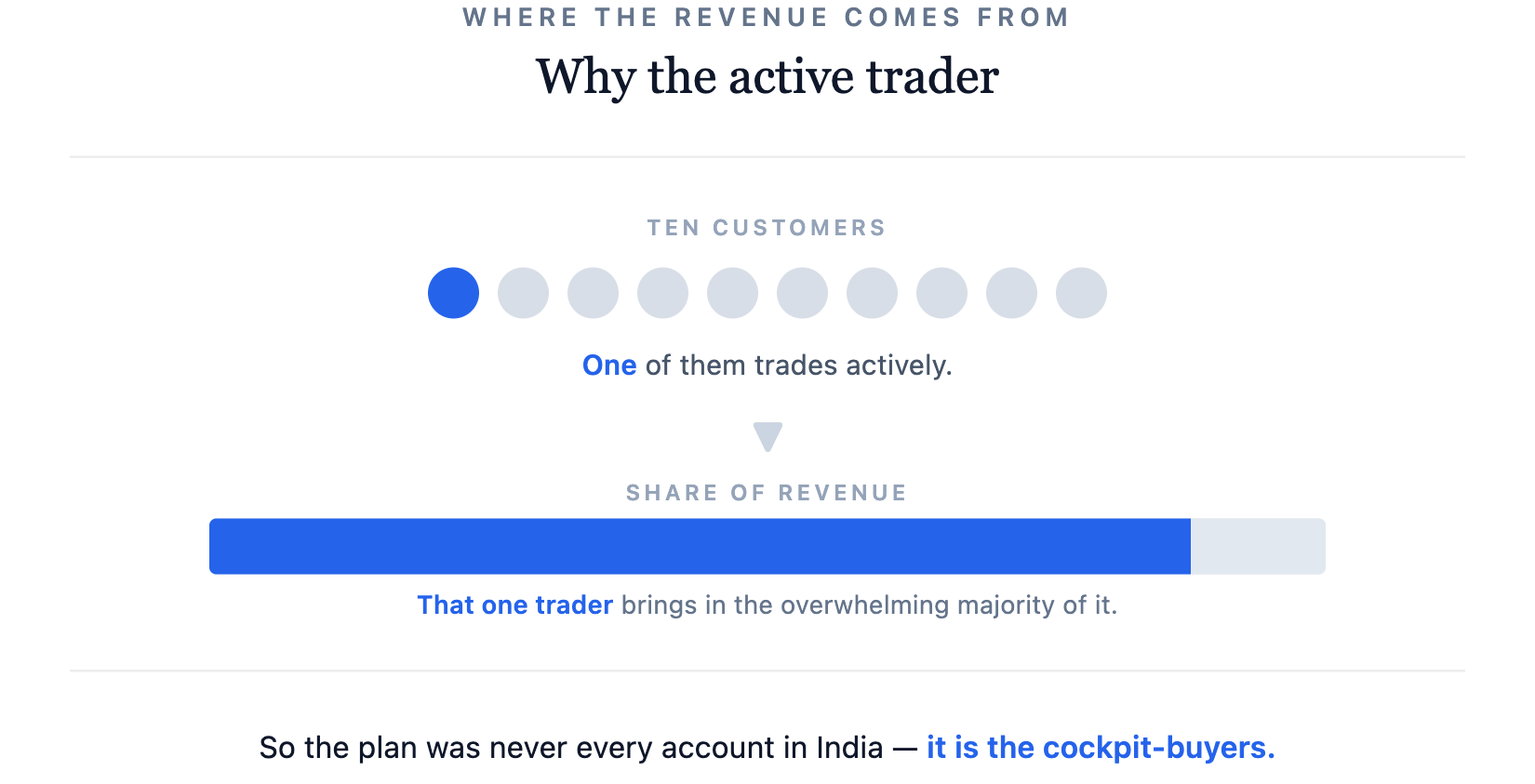
“It’s about which broker is prioritising for traders’ needs. We are always number one in that respect.”
The limiting factor now, Tejas is candid, is no longer the product.
After ten years, the platform is at parity or ahead on features, and the company is profitable and unlevered.
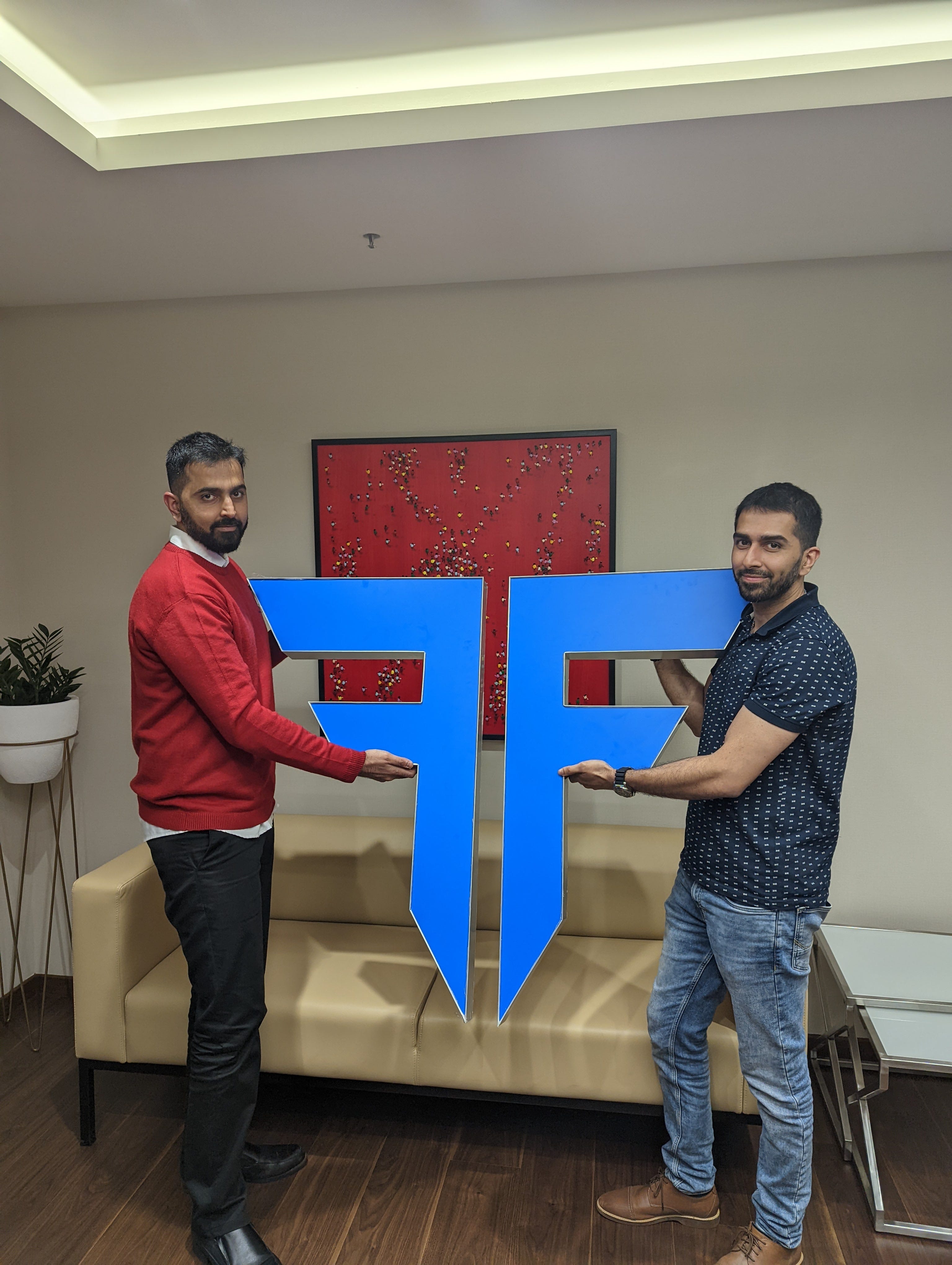
The real bottlenecks are distribution and talent — reaching the many traders who have simply never heard the name, and finding the talent to build the next layer.
“How do you compete effectively when you don’t have money?”
“We figured out ways to do it.”
The arithmetic of a multi-bagger from here, in other words, does not require a new idea.
It requires more of the same idea, executed against a market share number that has a long, long runway.
That lending book is the newest lever. In the last down market, Fyers launched a margin-trading facility — lending to clients against their securities — and it crossed ₹100 crore within months, with no advertising at all.
“Building a 100-crore loan book in a matter of months, without any advertising whatsoever, is another sign of latent demand — and shows what kind of users we have. Even if we do a little bit of promotion, the demand for this will easily go to 300 crores.”
The limiter there is the balance sheet, not the demand — one of the concrete reasons the company is raising now. With the broking half of the raise behind it, that book has room to scale materially over the next five years.
Growth Lever 02: Entering Asset Management
For the first ten years of its life, Fyers was a pure-play broker. The next ten will not be the same.
In 2023, with a few grey hairs starting to appear in his beard, Tejas began putting together the infrastructure for the next leg of the company’s growth — Fyers Assets, the asset-management arm.
“I’d always wanted to do asset management — I just didn’t know when. But post-lockdown, a lot of things happened. Somewhere in 2023, I started to consider it seriously — because a few grey hairs had started to pop out in my beard. And I was like, finally — this is a sign from the gods. Maybe it’s time.”
The PMS licence was applied for and, after a much longer wait than expected, was received in 2024. The AIF Category-III licence was received in 2026.
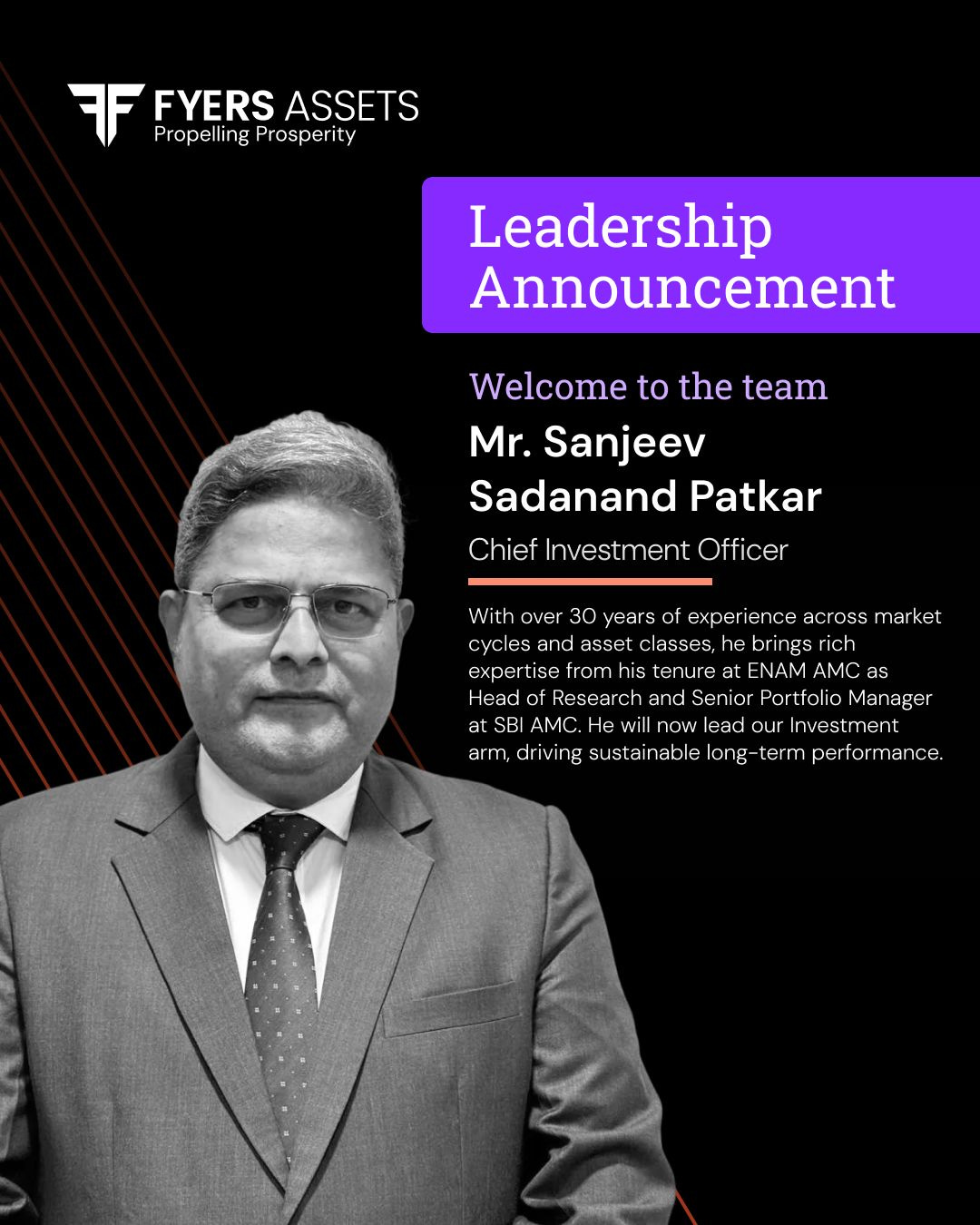
Sanjeev Patkar — older, with a deep Bombay finance background — joined recently as CIO of Fyers Assets to lead the build.
The first office in Mumbai is opening in August, 2026 — the same city where, fifteen years earlier, Tejas had walked into building after building looking for a job in institutional broking and been turned away.
“I’m back in Mumbai, with our own little venture again.”
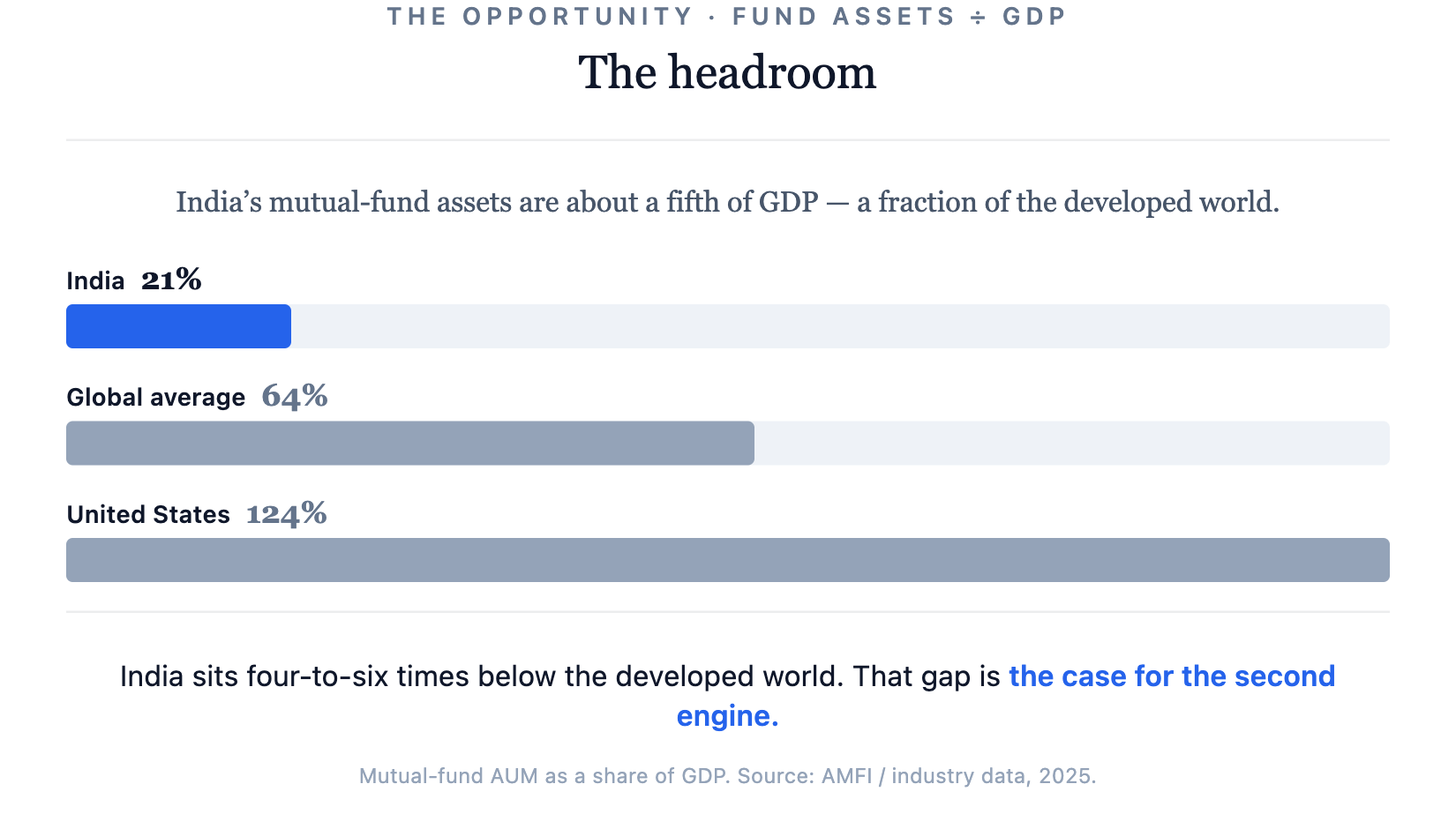
The Fyers Assets thesis is shaped by a specific structural view of the industry. Tejas has spent considerable time mapping the value chain of capital.
“AMC is one such market — where the natural ROCE of the industry is high, by the nature of the market itself. Now, the problem in a place like that is — how do you build an edge? A moat. A competitive edge. That’s the challenge. And we have a few pieces to play with.”
The first piece is fees.
“The manager should get compensated only if the investor makes money. Today, 100% of managers get compensated when the investors don’t make any money. So we want to change that — and build a business on client alignment.”
The second is honesty of labelling — what he calls being “true to label.”
“You’ll see many small-cap funds. They’ll call themselves small-cap and charge small-cap rates, but the majority of the portfolio will be in large-cap. How can a mid-cap fund own ICICI Bank? You see a lot of that happening, because there’s no oversight, and the managers are great at rationalising their decisions.”
He extends the same logic to hurdle rates — the return a fund must clear before it can charge a performance fee.
“At least you should have a hurdle rate which is reasonably high, so that the manager is incentivised to deliver higher returns than the hurdle. But nobody does that. Everyone’s hurdle rate is 8%, 9%.”
In Fyers Assets’ own funds, he says, the hurdle is being set far higher — around 15%, against the 8-10% that is standard — and the fees beneath it lower across the board, so more of every good year stays with the investor.
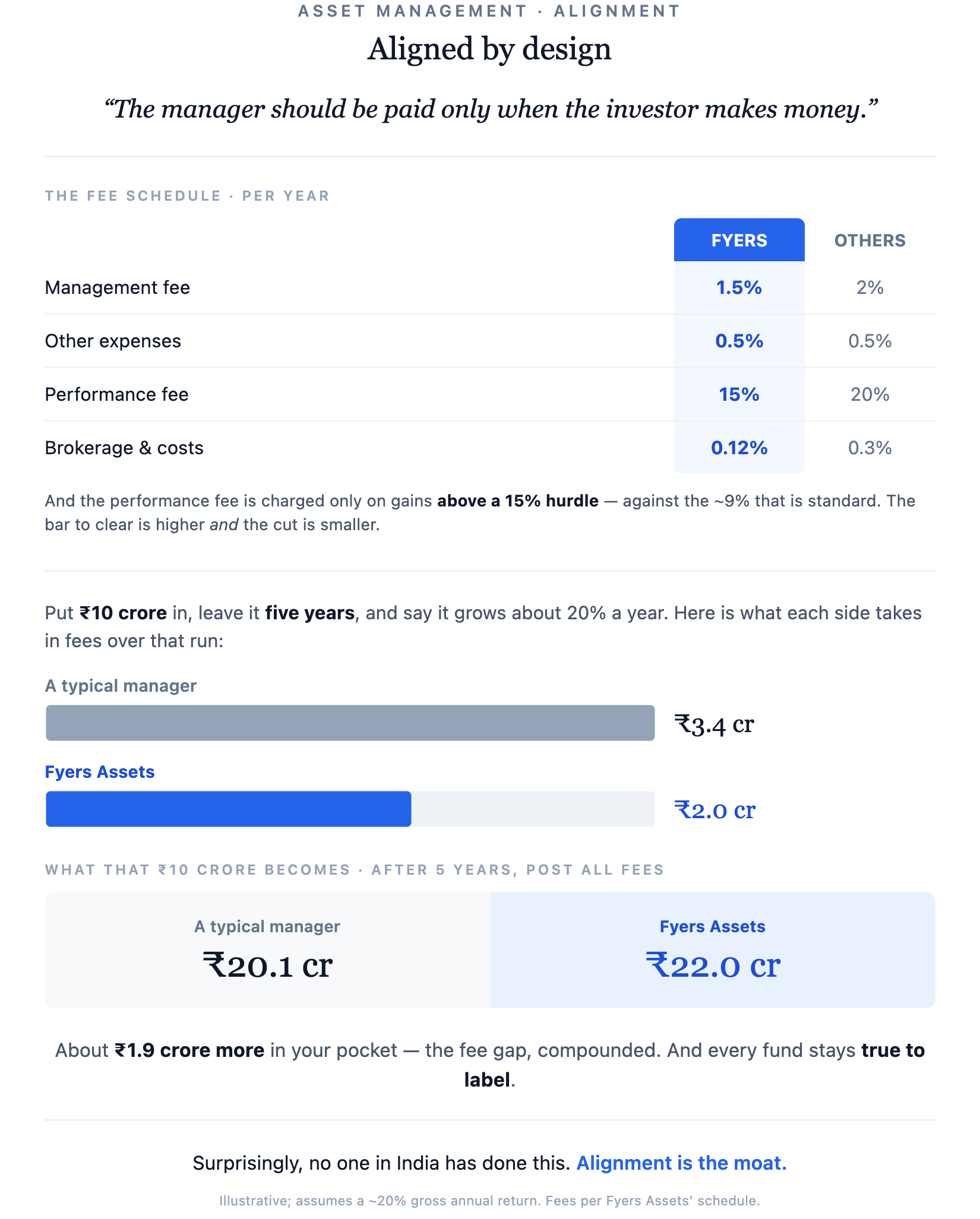
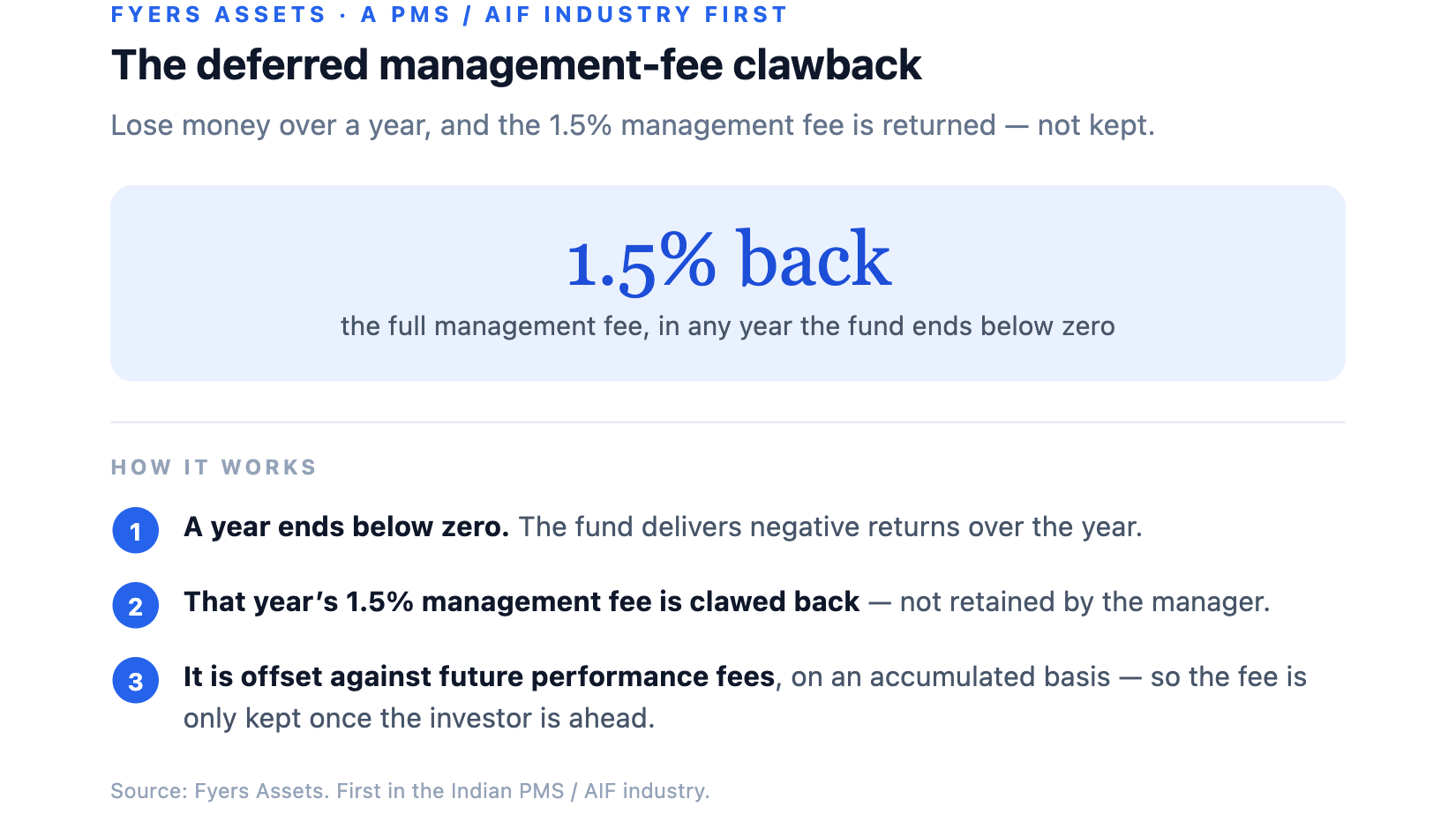
“If we lose money, we don’t even make a management fee. If there are negative returns, we make nothing. And surprisingly, nobody has done this in India.”
It is also the first house in India’s PMS and AIF industry to put that promise into a written mechanism — a deferred management-fee clawback.
In any year the fund performance finishes below zero (negative performance), that year’s 1.5% management fee is not pocketed; it is carried forward and offset against the performance fees Fyers Assets would otherwise earn in later years, on an accumulated basis.
The management fee, in other words, is only truly kept once the investor is ahead.
The contested call inside that thesis is the one he has the strongest view on — wealth management.
The Indian wealth-management industry, as currently constructed, separates the wealth manager (relationship and sales) from the asset manager (research and portfolio construction). Tejas argues the two should fuse.
“I feel a wealth manager’s role should be not just to sell funds, but to manage them too. The level of expertise of wealth managers needs to be much higher — to the extent that they do their own research, buy their own stock, build their own portfolios, and then market relevant portfolios to relevant investors. Currently, they don’t do any of that.”
Fyers Assets, in his telling, will be an asset manager first, with a wealth layer built around that competence rather than the other way around.
“We’ll be an asset manager first. And then we’ll look to build our own customer base around it. This will involve RMs going to the market — educated, trained, with relevant experience.”
This is, in his telling, an asset manager first — research, portfolio construction, and a wealth layer built around that competence — run with the same depth-over-breadth discipline that built the broking business.
The people, process, and product have to be in place quickly, but not so quickly that the stability that took ten years to earn gets upset on the way.
The Fuel
For ten years, Fyers refused outside capital. Now, for the first time, the company is raising — and Tejas is precise about what the money is and isn’t.
It is fuel for growth.
Fyers built its position on product rather than on a marketing budget; the raise is meant to increase its reach
He has signalled to investors that he intends to roughly 10x revenue from here
The base today is on the order of ₹300 crore — the bulk of it brokerage, with interest earned on client float contributing most of the balance, and a tail of clearing, depository, and IPO-related fees making up the rest.
The dominant cost is the thing the company actually sells: technology and the team that builds it.
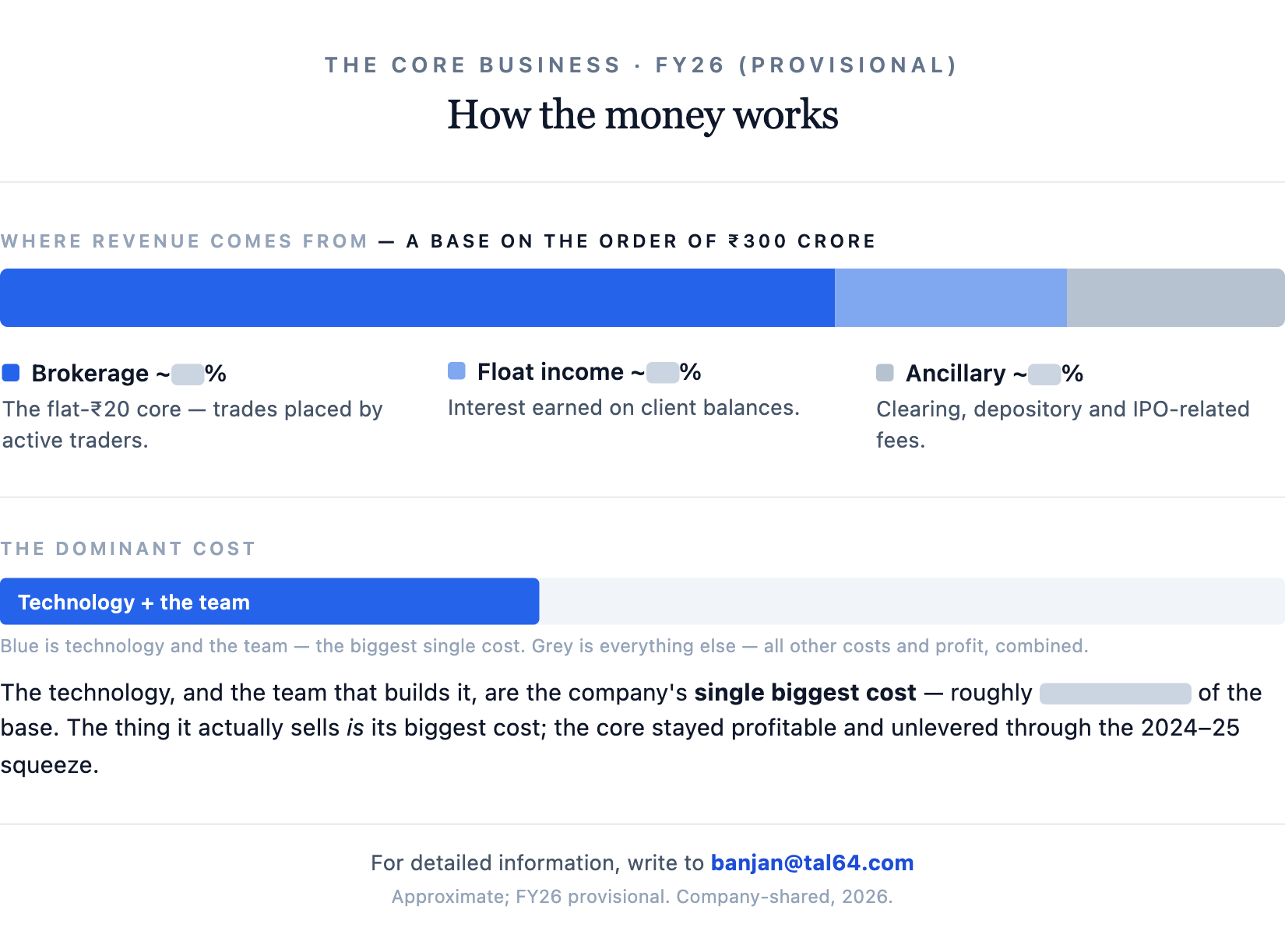
The raise would split roughly in half — one part scaling the core broking business, the other building out Fyers Assets, the asset-management arm.
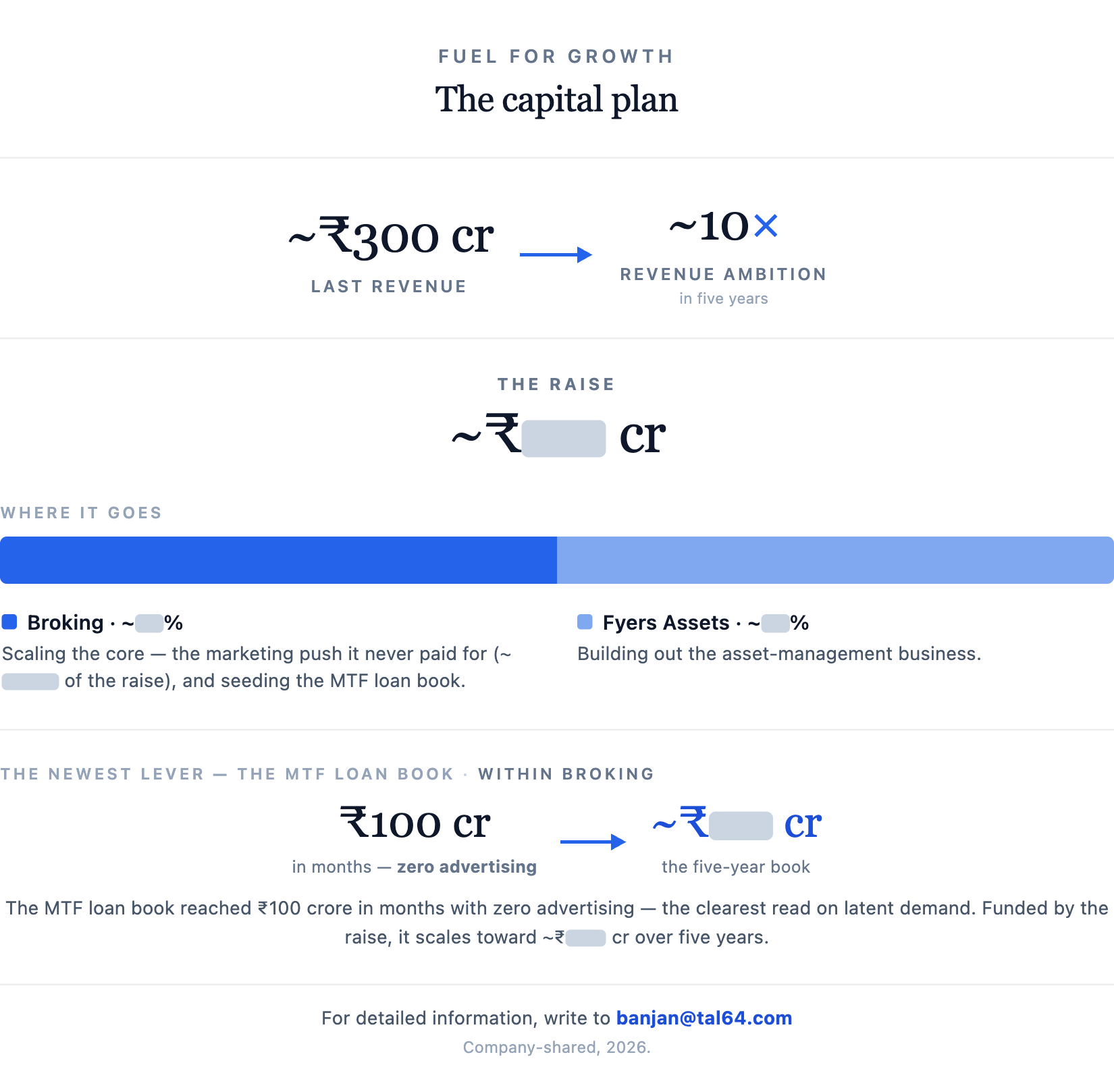
Much of the broking side is the marketing push the firm never paid for — roughly a third to forty percent of the whole raise — with the remainder seeding the margin-lending book that sits within broking.
“I’ve been super picky about who invests in us. More often than not, I’m saying no. That’s the ground reality.”
“I’m not a broker, really, at heart. I’m an entrepreneur. Everything we do will be like this — we do something different, and we try to align interests. We really want to be the future of India’s capital markets. That’s how I’d like to visualise Fyers.”
Anti-fragility
The way Tejas talks about the next ten years is not in terms of outcomes. It is in terms of optionality.
"We're trying to become more and more anti-fragile. The focus is on achieving long-term anti-fragility."
His own answer to that question is the banyan tree.
"If the vision is to be a banyan tree and not a coconut tree — if the vision is to create something more, something that can operate across market cycles — then the more segments you operate, the better. In capital markets, there are many hops, and money hops multiple times. There are synergies across different verticals. So we're setting up to become like that."
He is explicit about the timing of entry mattering less than the quality of entry.
"Competence is not built on day one. People ask me what is our right to win. I hadn't trained for that question. But when you believe in yourself, you believe in yourself. And then you go in there to fight it out. It's the conviction in yourself that matters. I believe that has been true of us for the longest time."
The way the next decade actually gets won, in his framing, is by being committed to the game in a way most other players aren’t.
"How do you build durable competitive advantage if you're not committed to a specific customer-base? That's a very basic question. If you're committed to something, you stand a better chance. That's the first step. Many think that growth capital will replace or supersede long-term commitment. It doesn't apply as much to a business like ours, in my opinion."
When he talks about the speed of the next move, he is also explicit about what he won't trade for it.
"Going forward, it has to be done a little faster. Not too fast — because if it goes too fast, you compromise on stability."
The right pace, he argues, is the one that keeps both the speed and the spine intact.
Team
The number Tejas keeps coming back to, when he is asked what the company actually feels like, is the floor space — today, more than 50,000 square feet, including a Mumbai office.
“In 2015, we were in a tiny 200-square-foot office. By 2022, we had a sprawling 25,000 square feet — the only young startup among MNCs in that building. It felt good.”
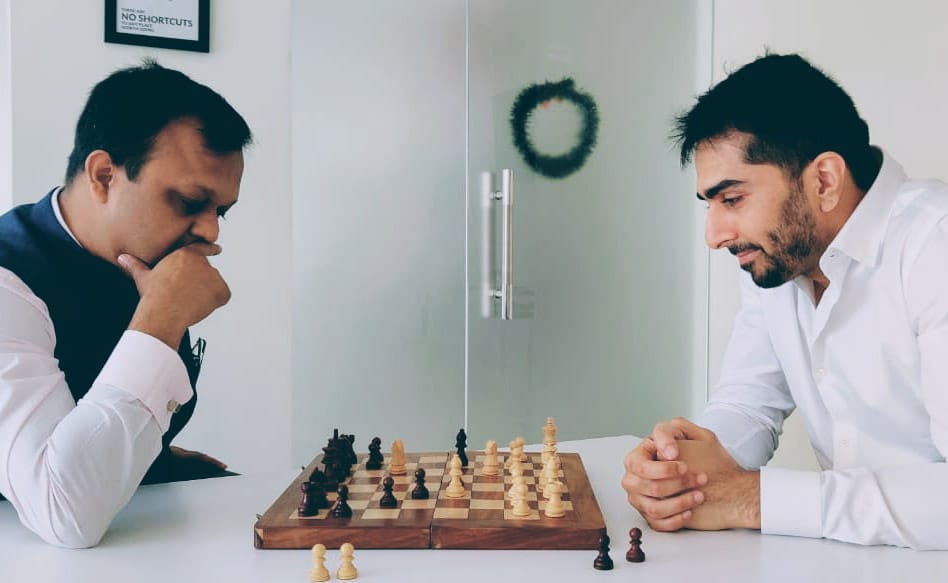
The intervening seven years are stitched together, in his telling, less by quarterly board meetings (there is no board outside the family) and more by small office traditions. There is the chess wall, which moved with them from office to office. There is a recurring photograph in the company’s archive: a group of employees crowded around a chessboard in the conference room after work hours.
“This was common practice back then. We’d play chess, discuss markets and competition. Good old days. The wall frame was something I loved — a chess version of David versus Goliath, reminding everyone that we were the white pawn against the behemoths. The odds were against us.”
When the broader industry tried to keep working from home through 2021, Tejas pulled the team back to the office.
“We were the first company in our industry to abolish work-from-home and get back to the office, after arranging a successful vaccination drive. I officially became a workaholic — juggling so many things, often coming into office before NSE opened and going home after MCX closed at midnight.”
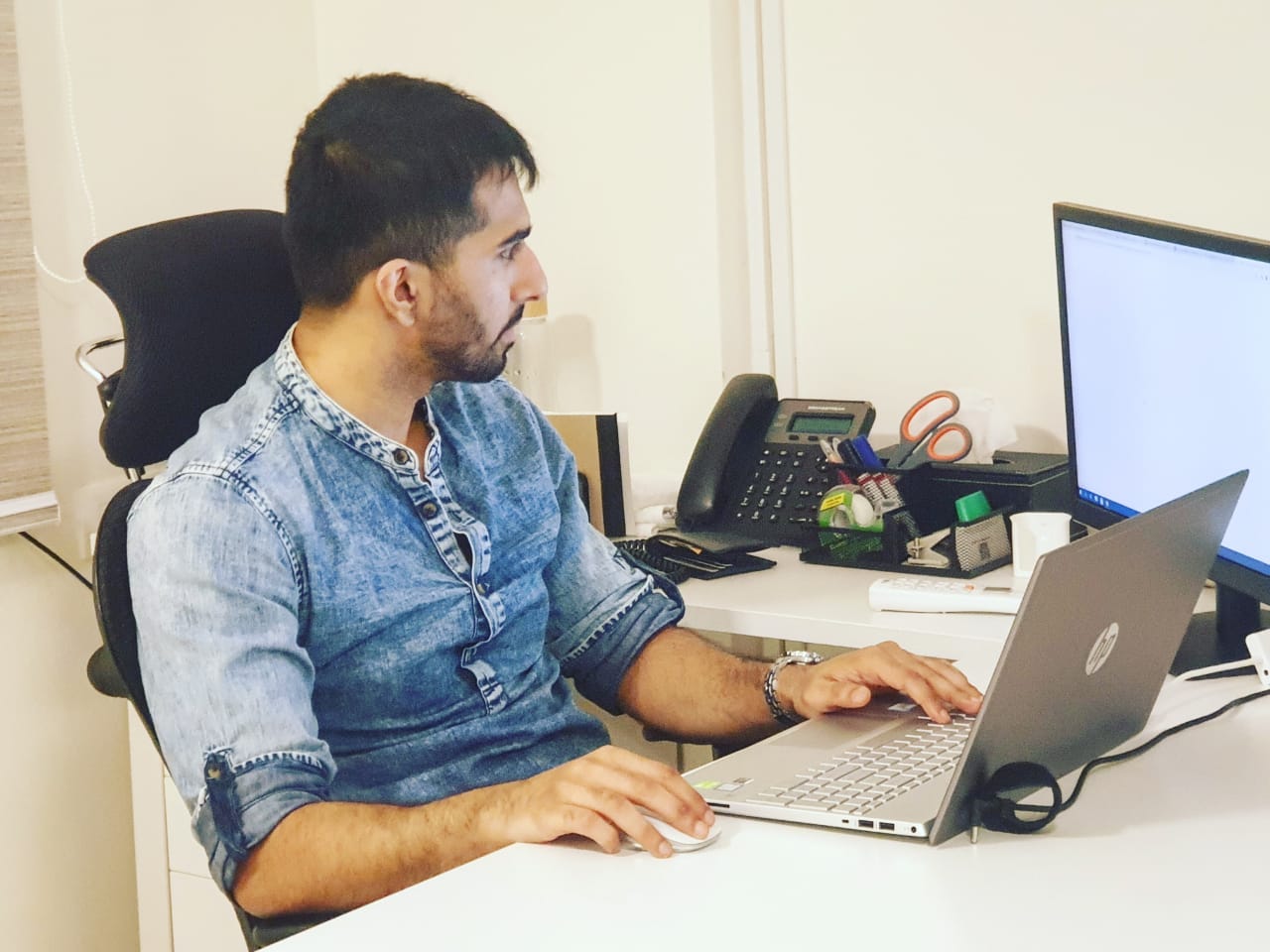
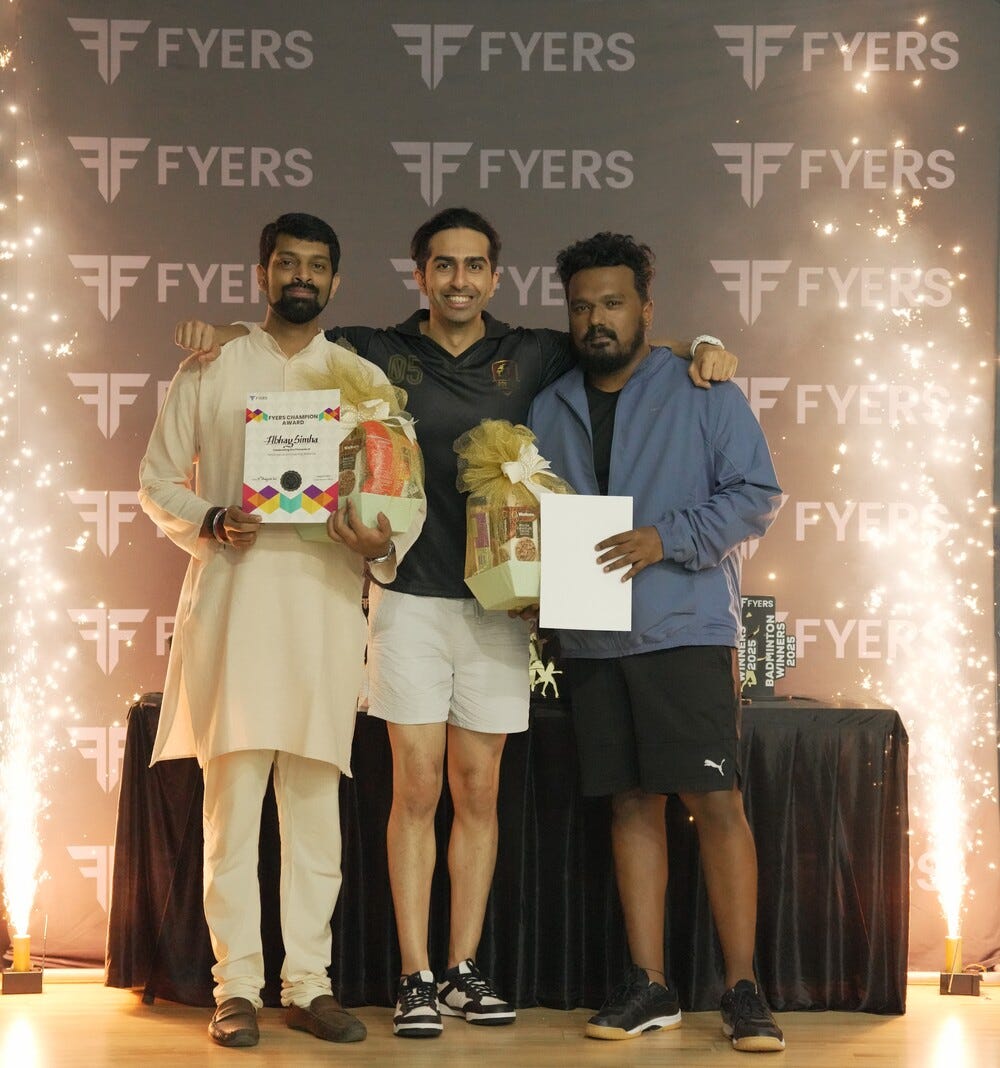
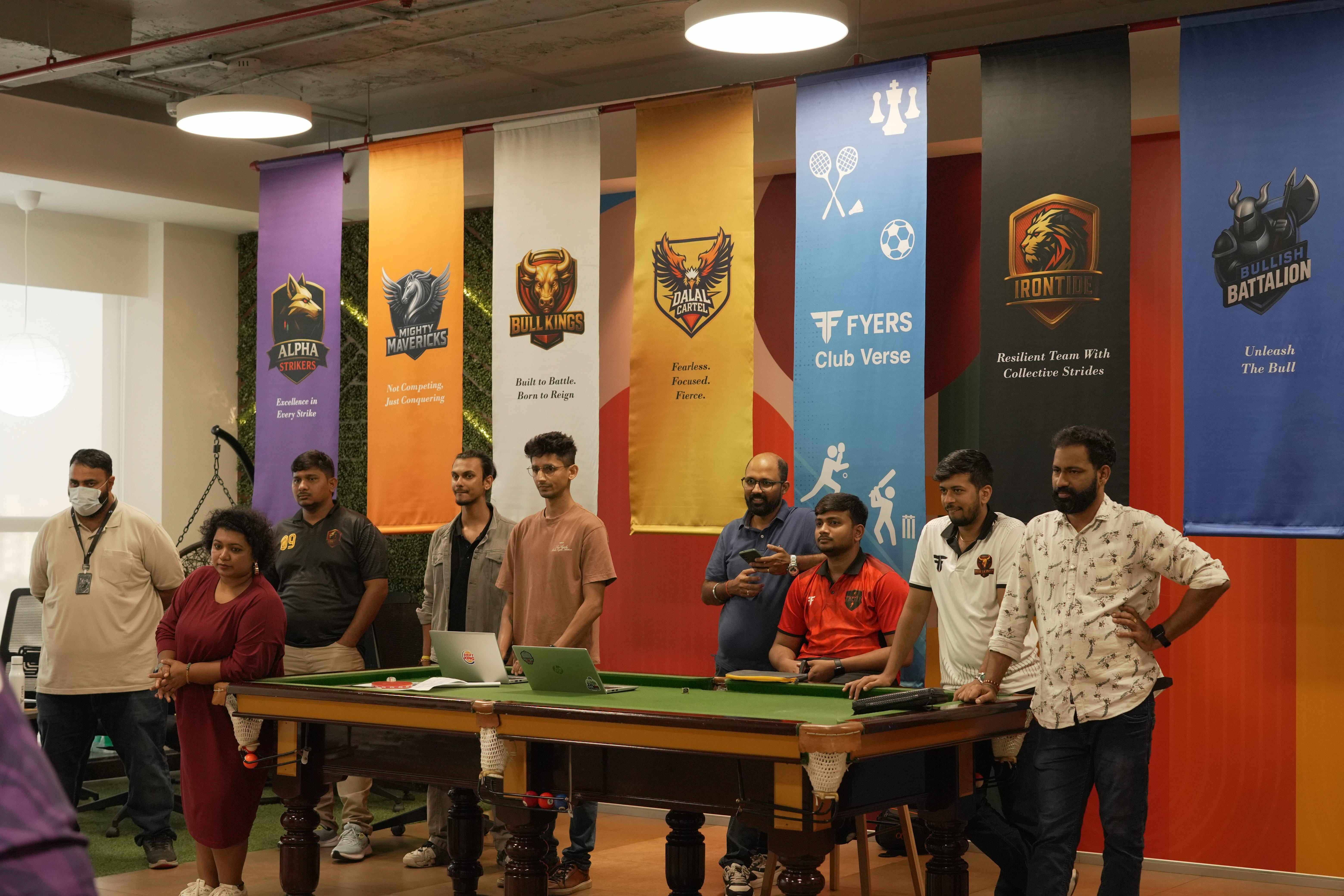
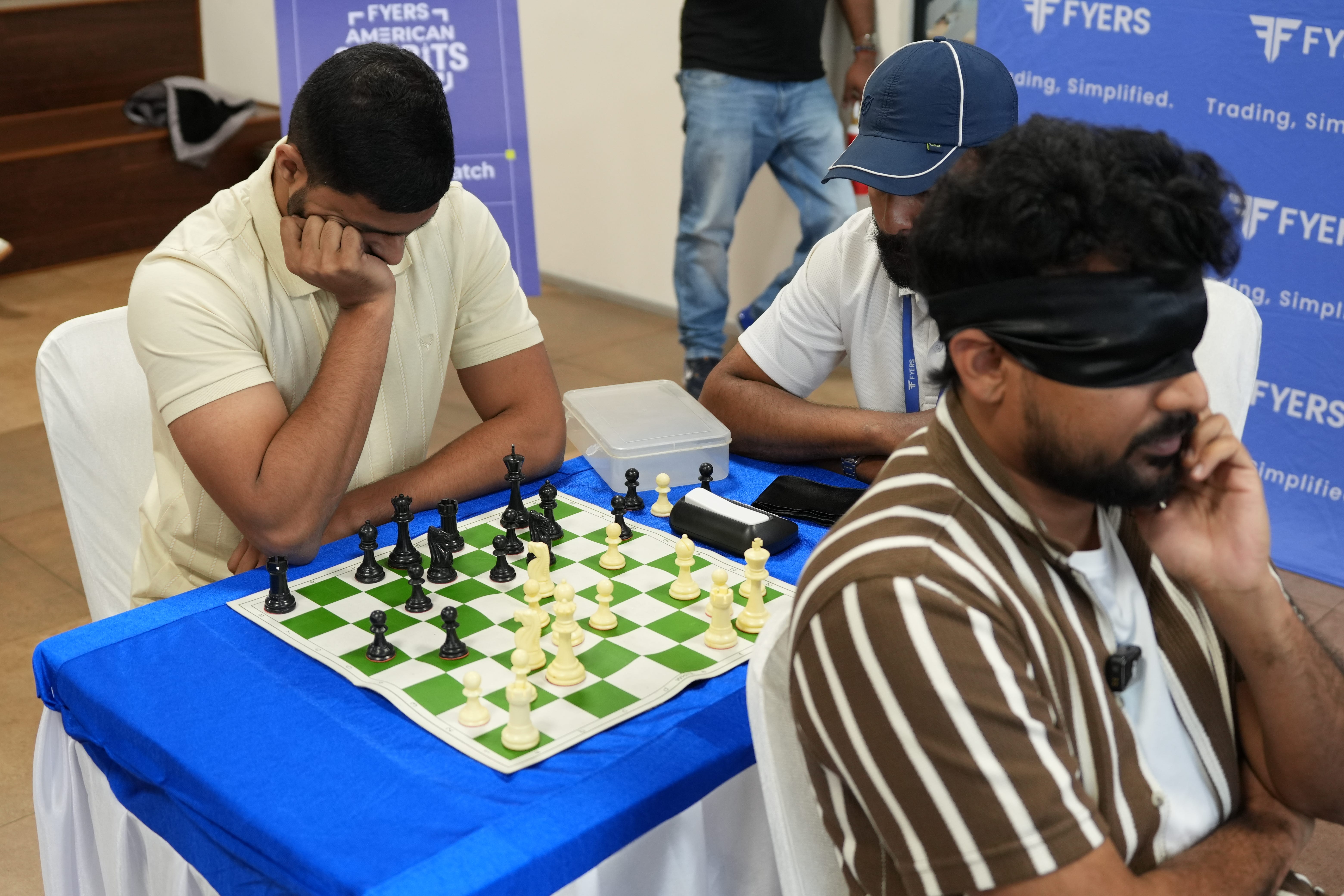
The team-culture work, in retrospect, looks like one of Fyers’ strongest moats. Internal sports leagues — they call the umbrella ClubVerse — span chess, badminton, fitness, and a few other disciplines. Fyers’ chess team, the FYERS American Gambits, plays the Indian competitive circuit.
“Winners of the FYERS Chess championship. We didn’t know there was so much enthusiasm for the game among seemingly unaware finance geeks like us.”
Then there are the apprentices.
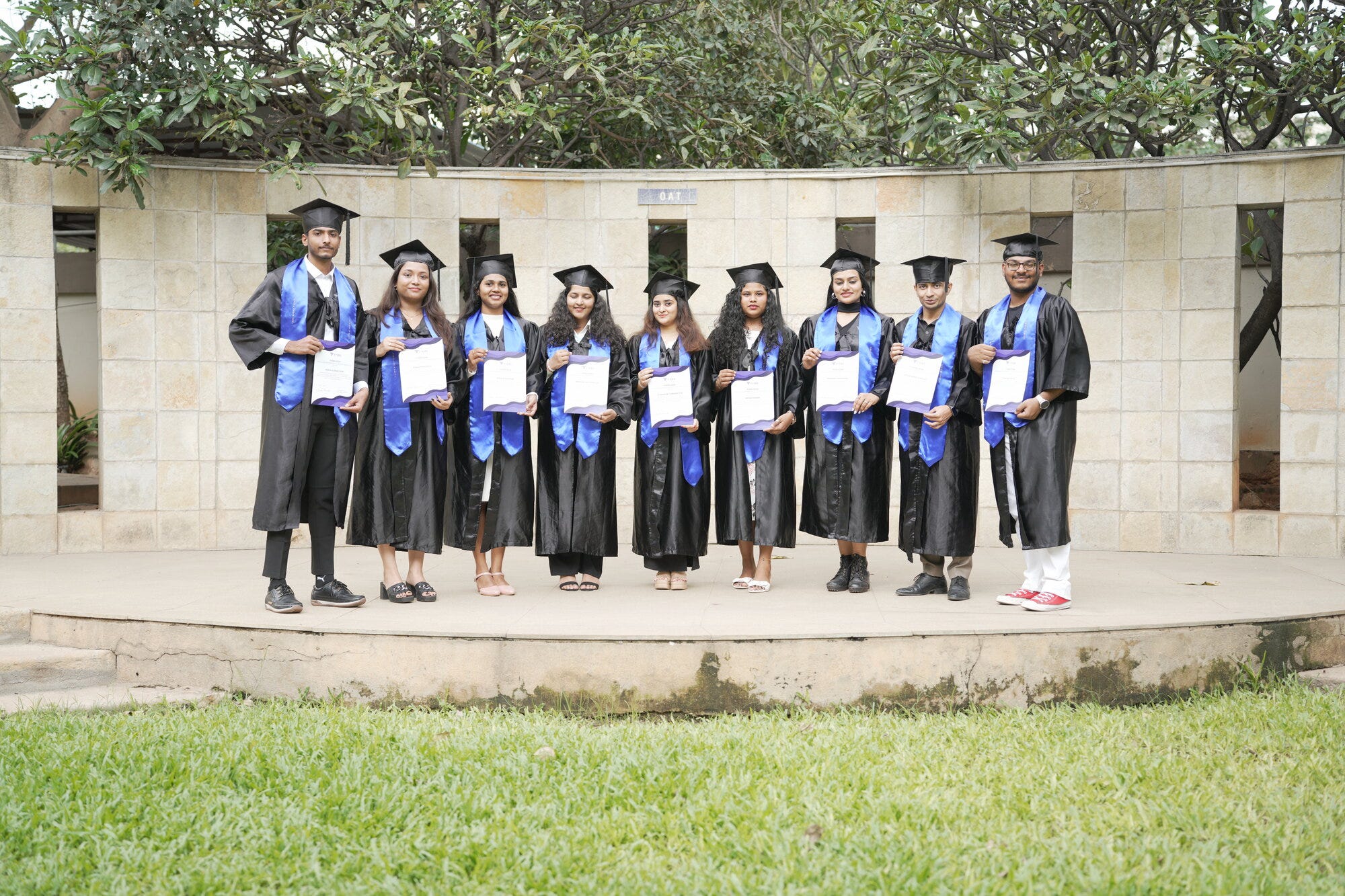
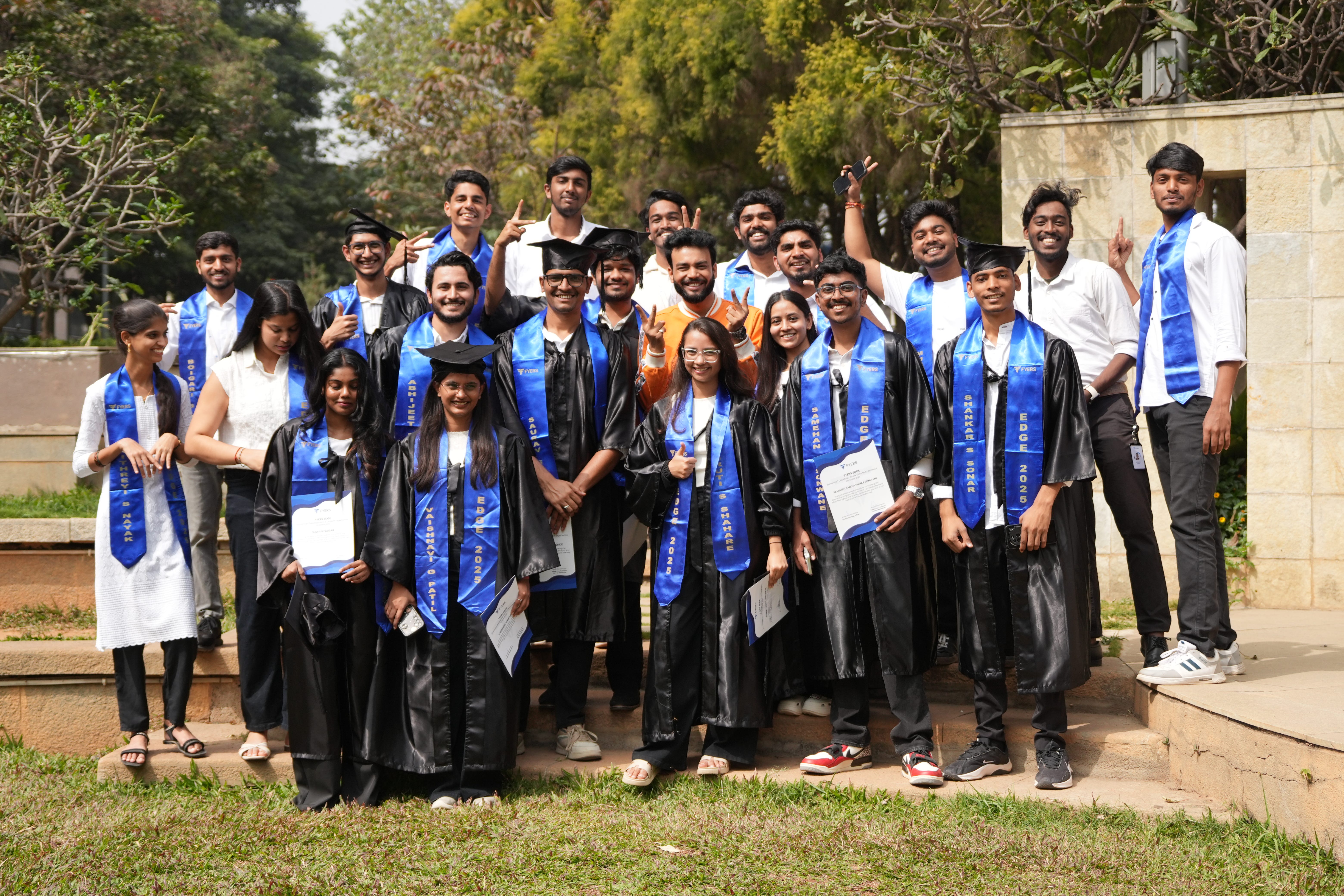
By 2024, after seven or eight years of fielding what Tejas politely calls “entitled job applicants” — graduates expecting to learn nothing and earn a lot — Fyers ran out of patience and started its own apprenticeship programme.
“After getting sick of entitled job applicants, we started an experiment — to create talent ourselves, via an apprentices programme. One of the first batches gave me real joy. Creating, or contributing to, their career potential.”
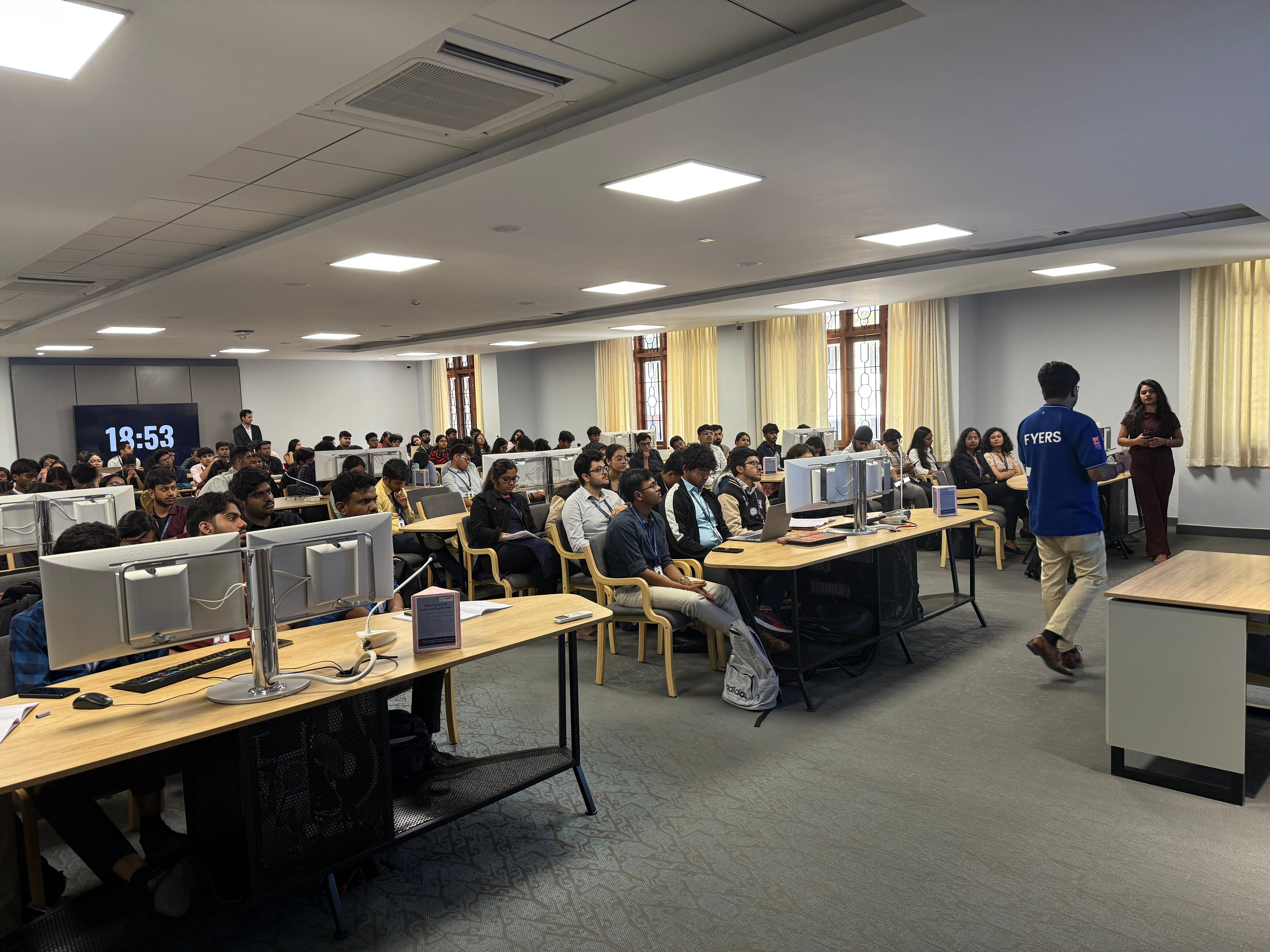
In the same vein, Tejas spent a stretch of 2021 to 2023 doing guest lectures at Bangalore colleges — MCC in 2021, Christ University in 2023. The audience was undergraduates studying economics; the speaker was a working market practitioner.
“I was active during that phase, giving financial markets context to students from the lens of a practitioner — which the professors of colleges found insightful and useful to their students.”
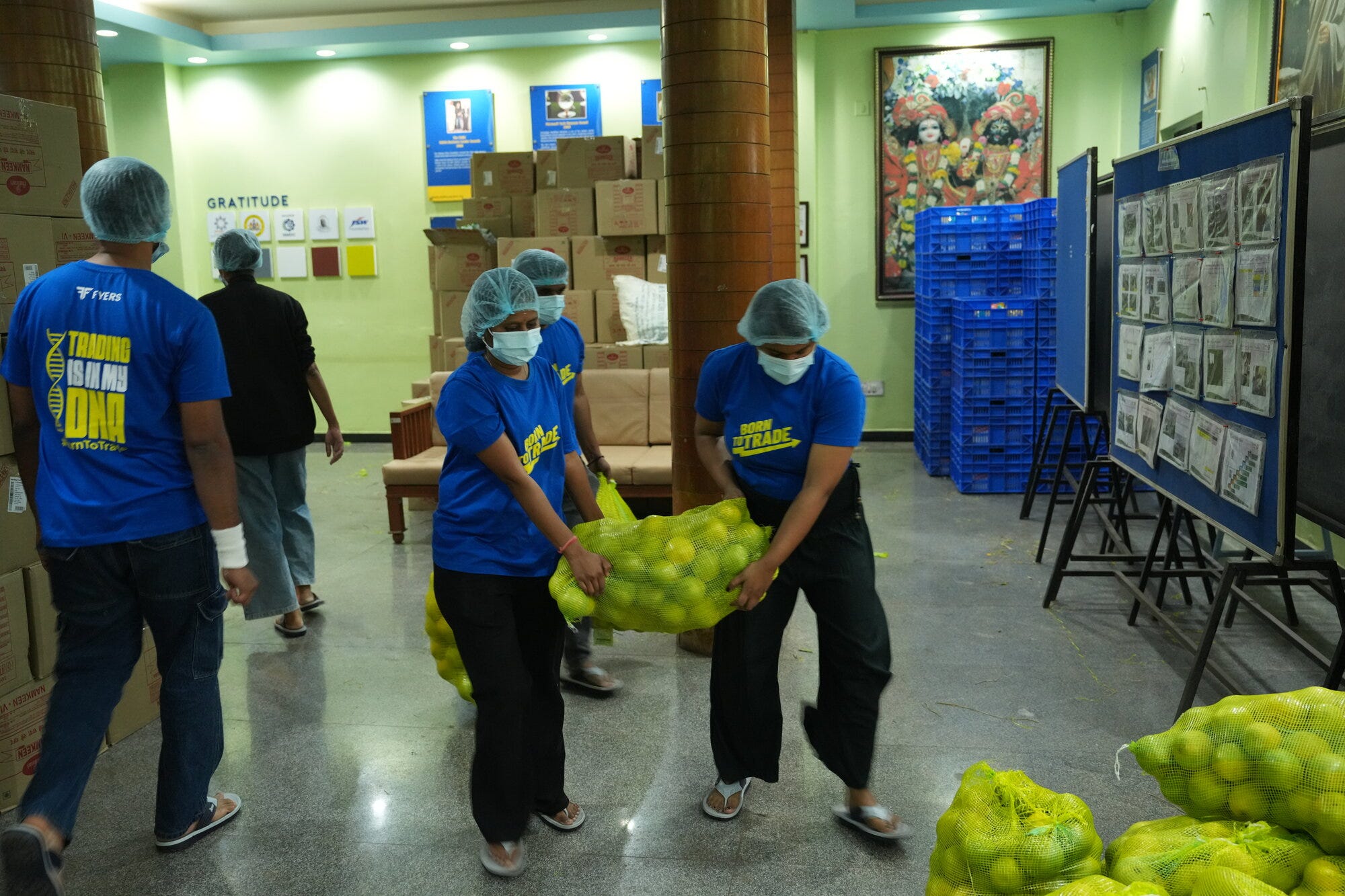
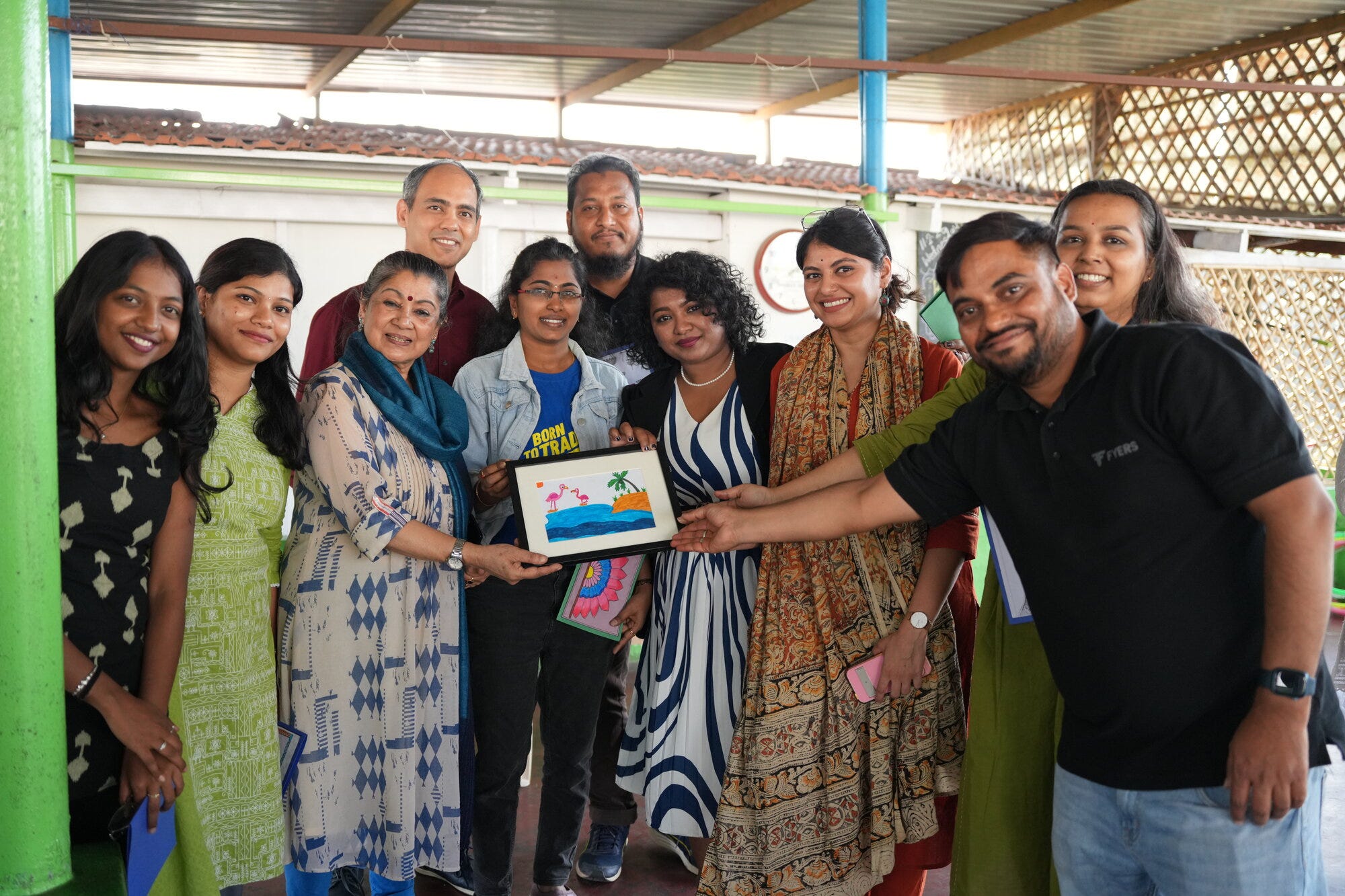
A version of the same instinct produced Fyers’ Foundation. The team funds mid-day meals via Akshaya Patra for around 5,000 children every day.
“This volunteering work in Bellary helped us learn the difficult process of food preparation, cooking, logistics, and service. Blessed to be able to contribute to such causes.”
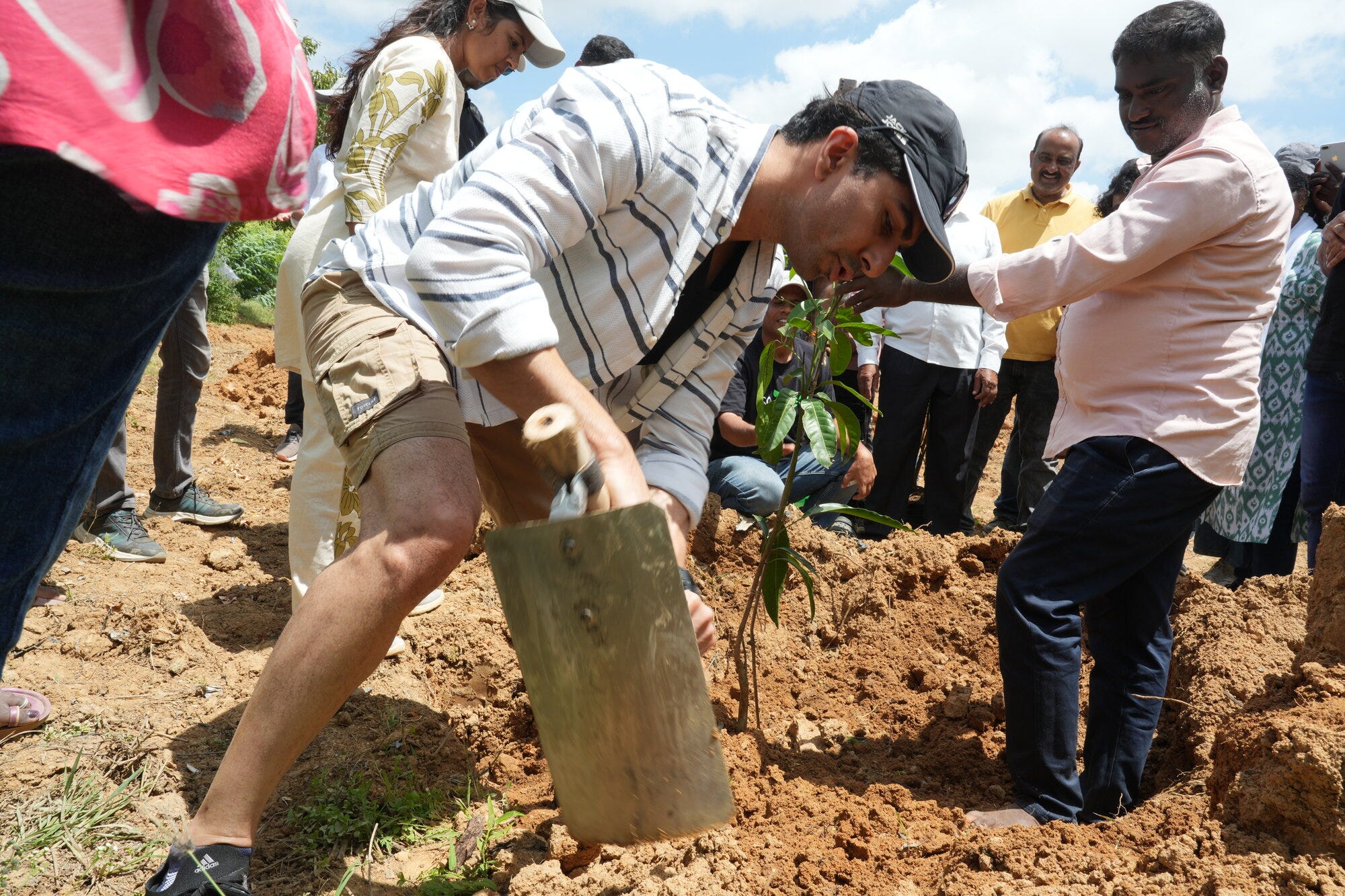
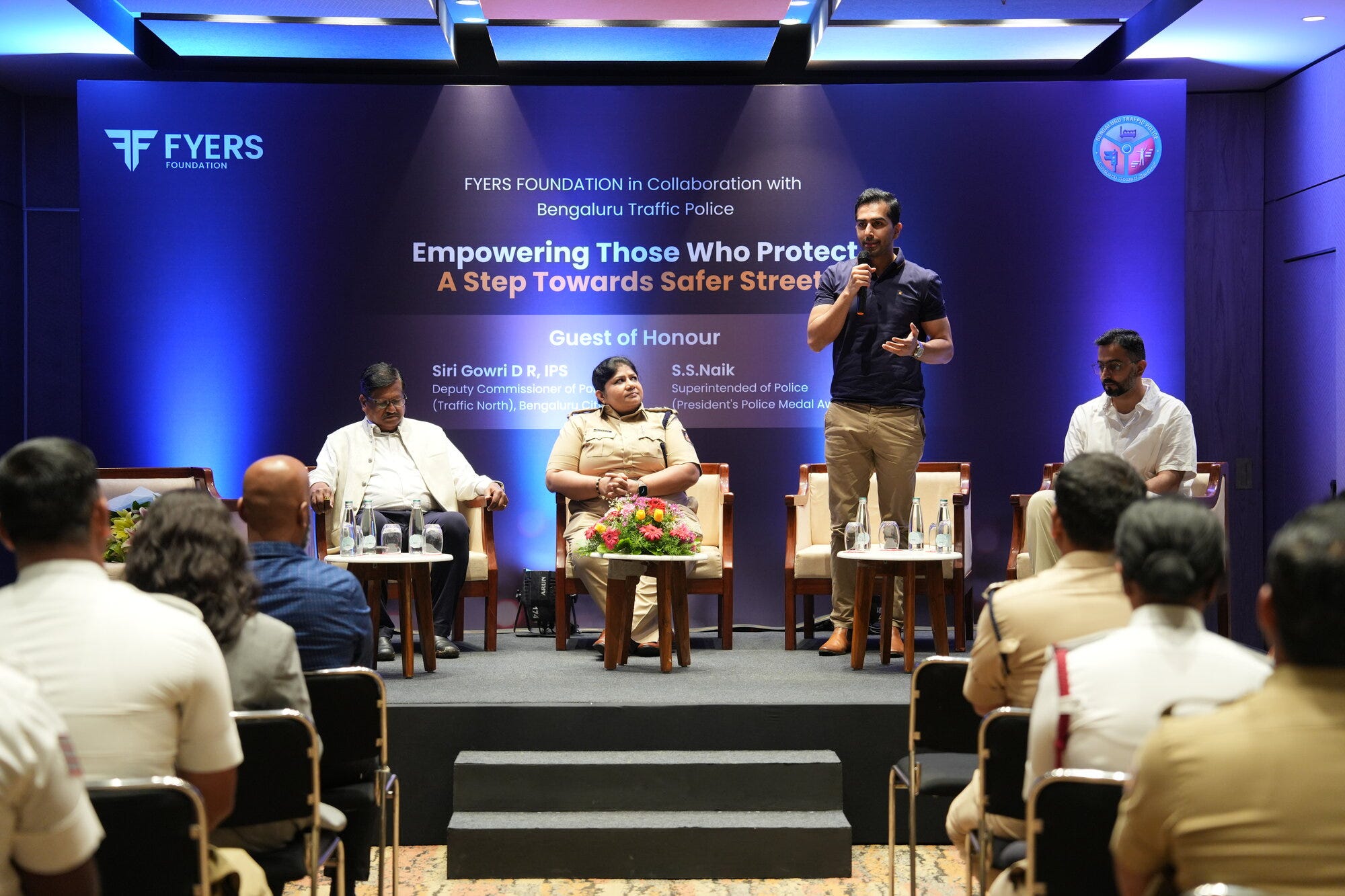
They fund education and meals at the Parikrama Foundation in Bengaluru, run by Dr Shukla Bose. They have planted trees with farmers in rural Karnataka and supported the Bengaluru police with infrastructure and equipment.
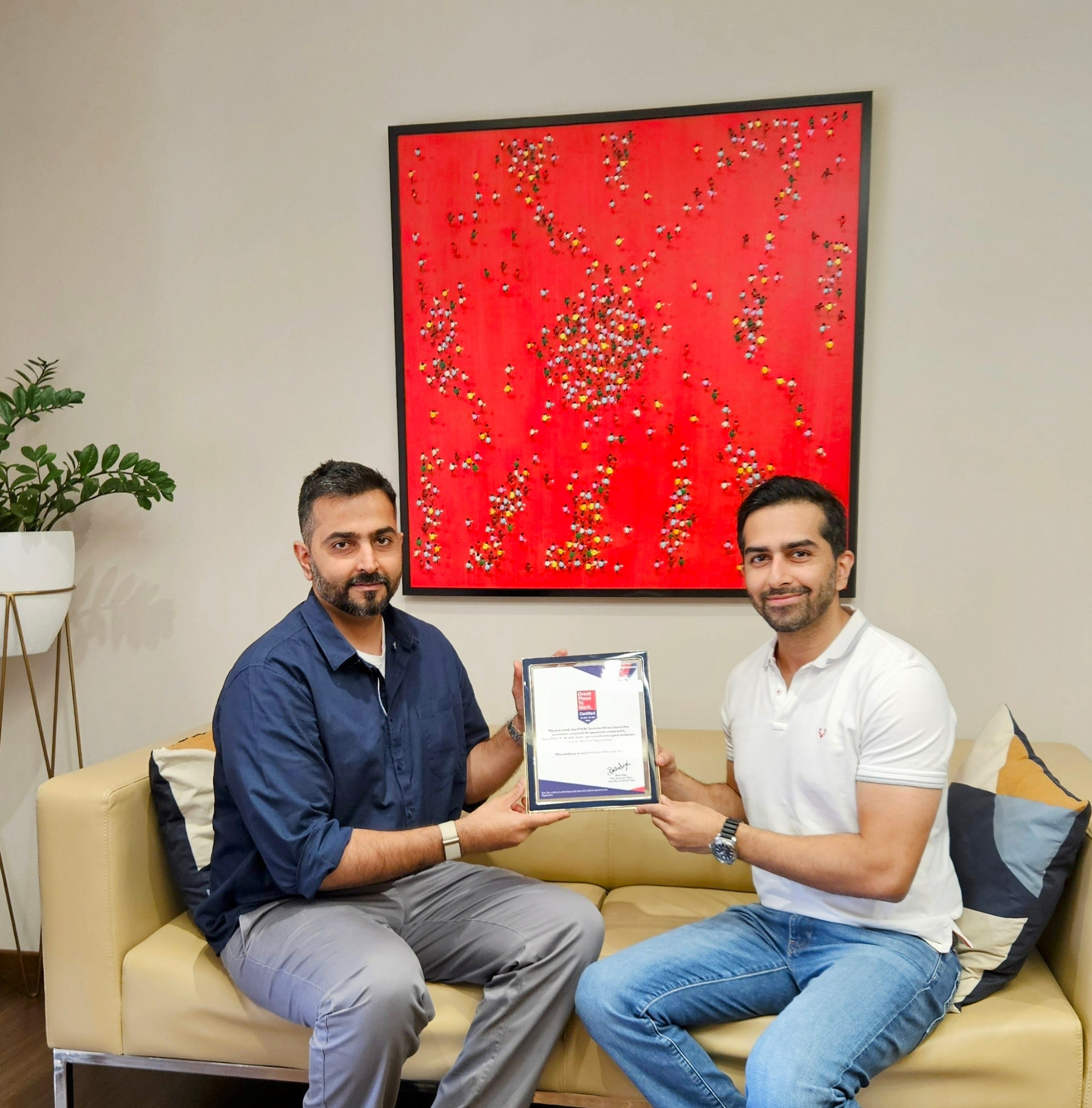
“We earned the Great Place to Work® certification on our very first attempt. I take pride in this — we did it the right way. No hacks or anything. We genuinely try to make it a great place.”
Brothers
Most stories about brother-led Indian businesses end in court.
“I’m actually very fortunate. I get along with my brothers.”
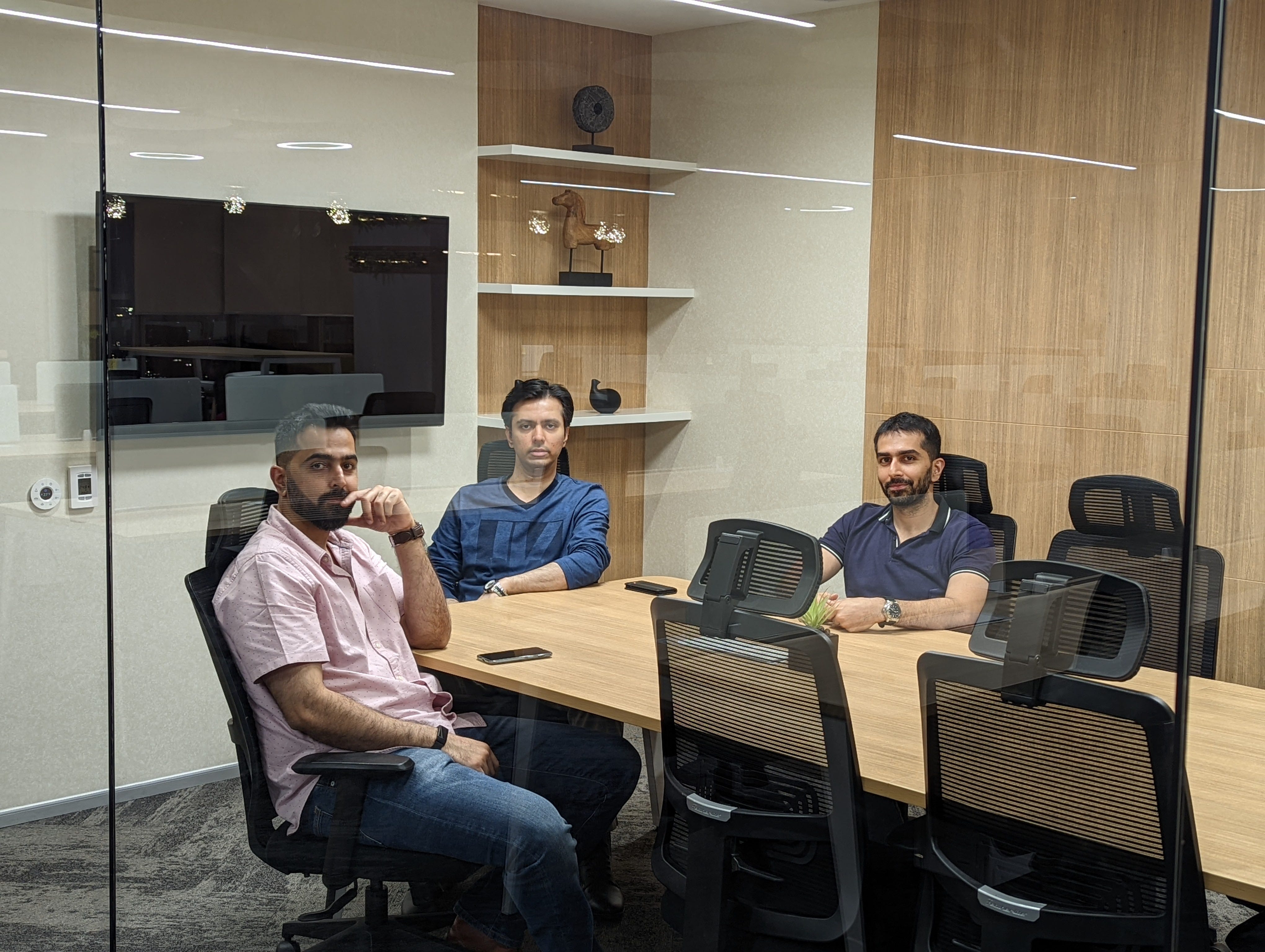
The division of labour was fluid in the early years and is now well-established.
“Earlier, everybody did everything. I did business, customer sourcing, marketing. Yashas mainly did tech and product. There was overlap as well. My elder brother was around as an advisor, helping shape strategy.”
What grew through twenty-five-plus years was a partnership shaped less by family-business logic and more by something like comradeship.
“Having people you’ve known since you were a baby — if there’s understanding, it’s all great. We’re fortunate. Most people think siblings get along, but most don’t.”
Who is Fyers?
What is the cost of focus? What does it take?
Tejas did not become a discount-broking arms dealer. He did not pivot into SaaS. He did not raise venture money at the COVID-era valuations he could have gotten. He did not list Fyers on the public markets in 2024 or 2025, which would have been the obvious play if he had been optimising for the bull-market window.
“If we had to optimise for this bull market, we would have gone public in 2024.”
He did not, when faced with an F&O regulatory crackdown that hammered the entire broking sector through 2024 and 2025, change strategy.
“Despite all of that, our revenues sustained — even though we didn’t add as many customers.”
Tejas is allergic to the kind of opportunity-seeking that requires the company to become something it is not.
“You should find your edge. And figure out — when your edge is synthesised with the existing markets, tools, and requirements — does it create a beast of some kind? You’ve got to commit yourself to that.”
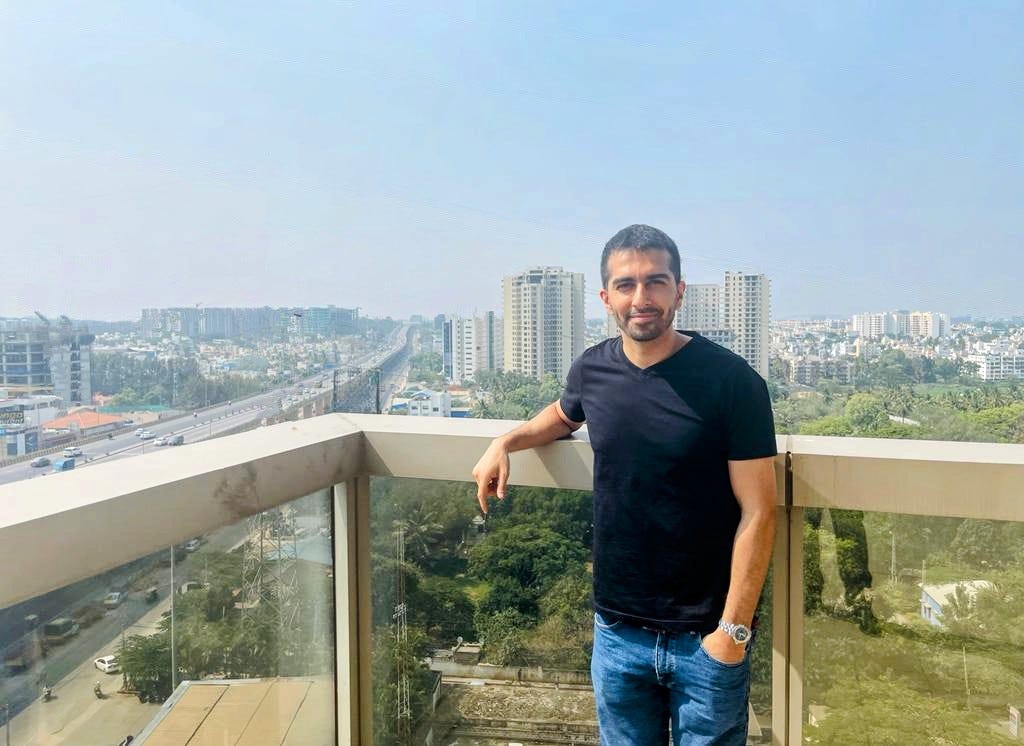
Tejas thinks of the Fyers identity — a product that values speed and precision, a capital-efficient business model, depth-over-breadth, capital-markets-only, honest and true to label — as the company’s primary asset.
He guards it.
If you want to talk to Fyers:
If you want to discuss an opportunity with Fyers — broking, institutional equities, Fyers Assets, partnership, distribution, or anything in the orbit of what Tejas and the team are building — please write to us at banjan@tal64.com, and we will route the conversation.
Safe Harbor
This article contains the personal views, recollections, and statements of Tejas Khoday, founder and CEO of Fyers Securities Pvt Ltd, as shared in interviews with tal64. Numbers, dates, and milestones are stated as recalled by the founder and corroborated where possible against company-shared materials. Forward-looking statements about Fyers, Fyers Assets, the Indian capital markets, and any third party named in this piece reflect opinions and projections as of the interview date and are not guarantees of future outcomes. Nothing in this article is investment advice, a solicitation to invest, or a recommendation to transact in any security or product. Readers should consult their own advisors before making any financial decision. Mentions of competitors, peers, and other companies are made for context and do not imply endorsement or affiliation.
Methodology
This story is based on extensive interviews with Tejas Khoday, CEO and co-founder of Fyers, conducted in Bengaluru in early 2026, with subsequent inputs from Tejas. Additional context was supplied by Tejas via a curated photo archive with timeline annotations. Quotations are reproduced from the interview transcript with minor edits for grammar and clarity, preserving the speaker’s voice. This is NOT a paid article. No part of this piece has been commissioned, reviewed for promotional purposes, or compensated by Fyers or any related party.