

For about a year and a half, by Jerin Venad’s account, a rival ran buses on Cityflo’s best route in Mumbai and priced the ride at zero.
Thane to the Bandra Kurla Complex, air-conditioned, free. Cityflo charged ₹180 a seat on the same road — about ₹6,000 a month for a commuter on a daily pass.
The customers stayed with Cityflo.
“Tomorrow, if a cab service is zero rupees, you’ll take it. But in a bus, the other zero-rupee customers also come. So as a customer you say — no, I’ll stick to Cityflo. That has never happened anywhere else in mobility which is usually cabs today. People didn’t have that perspective.”
A cab at zero rupees is still a cab.
A bus at zero rupees is a bus everybody wants at eight in the morning — a different product from the one advertised. The fare on a shared service decides whether the seat exists tomorrow. Jerin, the chief executive of Cityflo, took years to understand this. The people who funded his competitors never did.
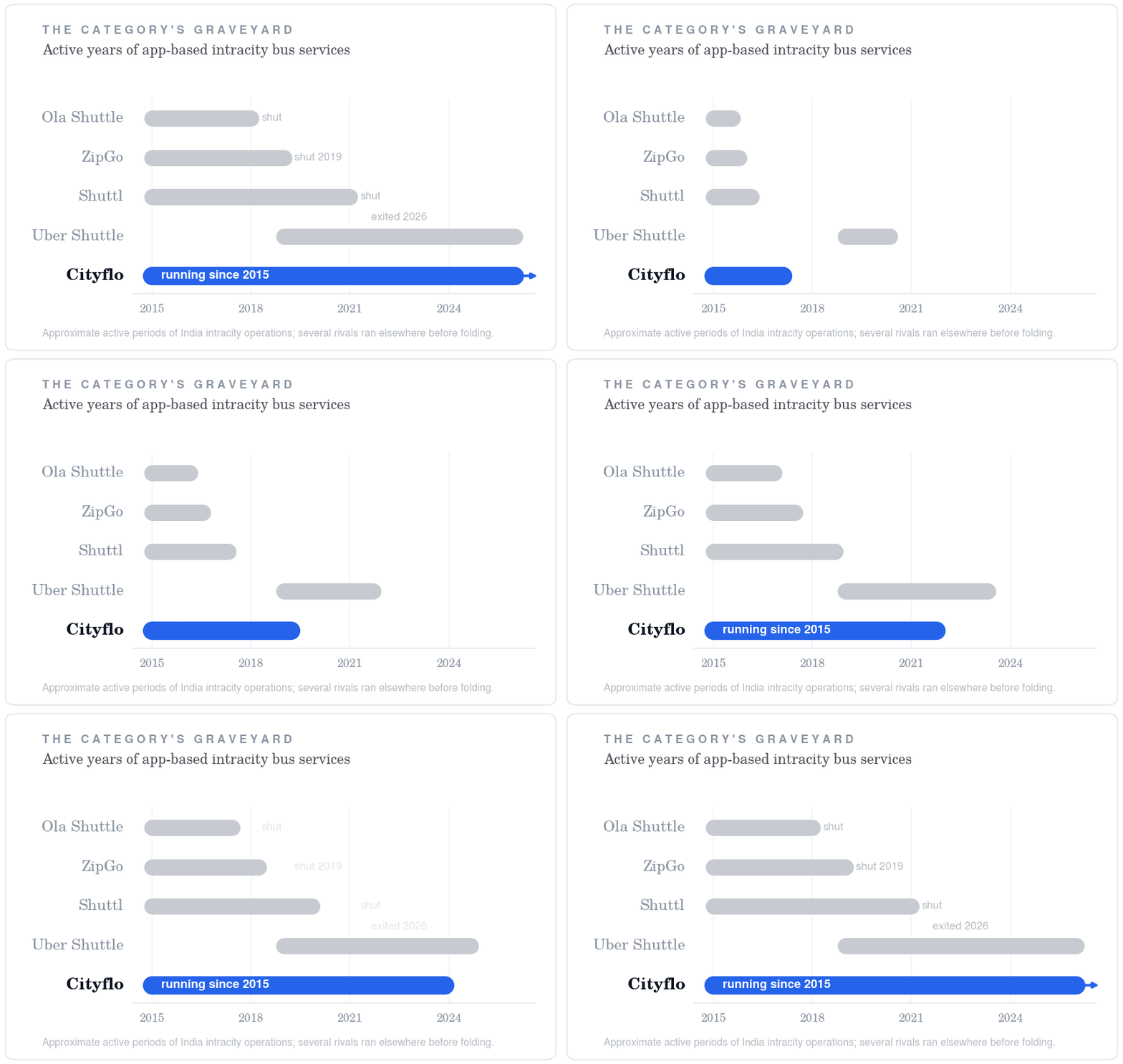
Shuttl raised more than $100 million from Sequoia, Lightspeed and Amazon and was sold in distress in 2021. ZipGo won a ₹300-crore commitment from the Essel Group and was gone within a year of the group’s own crisis. Uber wound down its Indian bus service city by city and left its last market in March 2026.
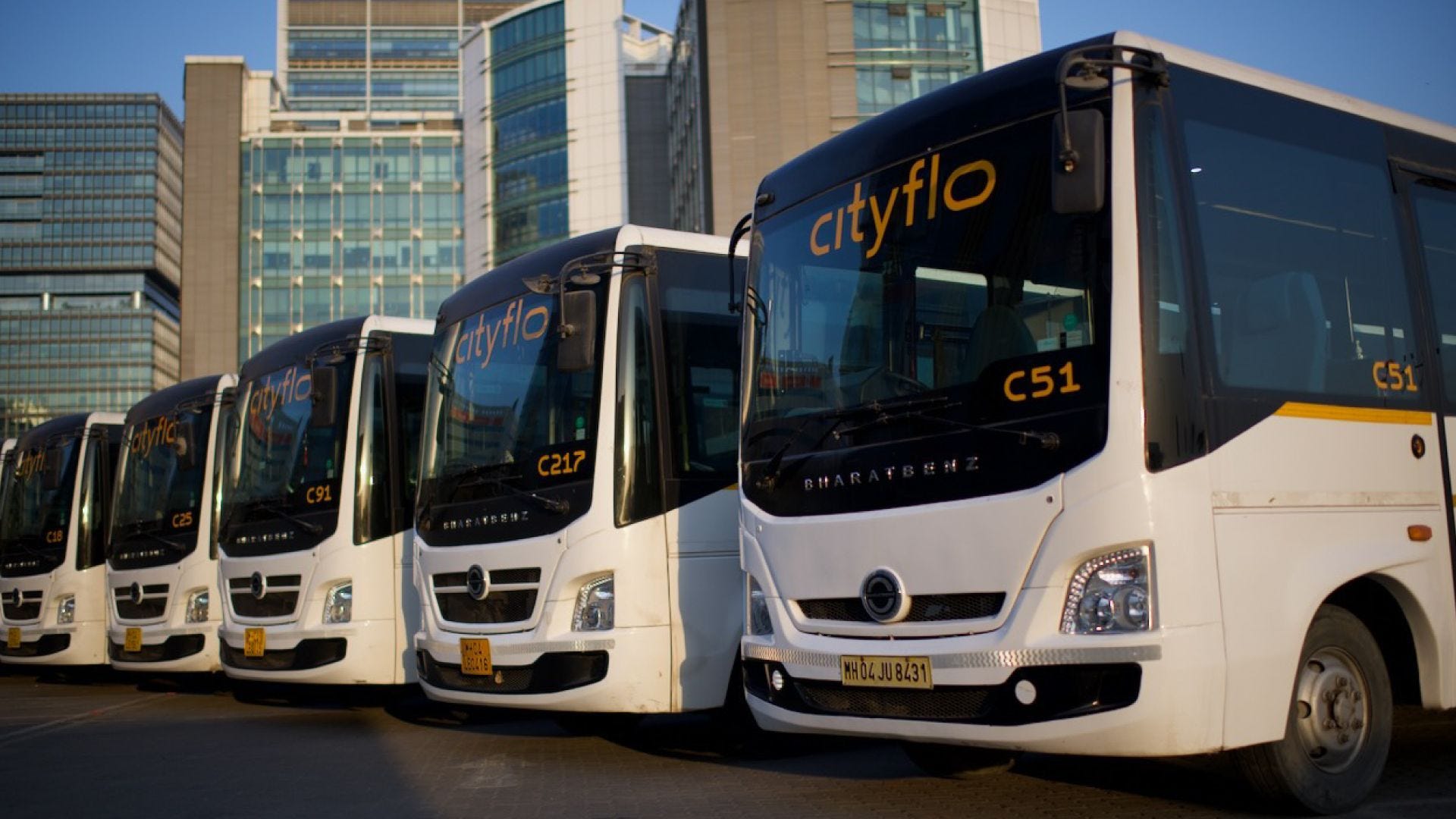
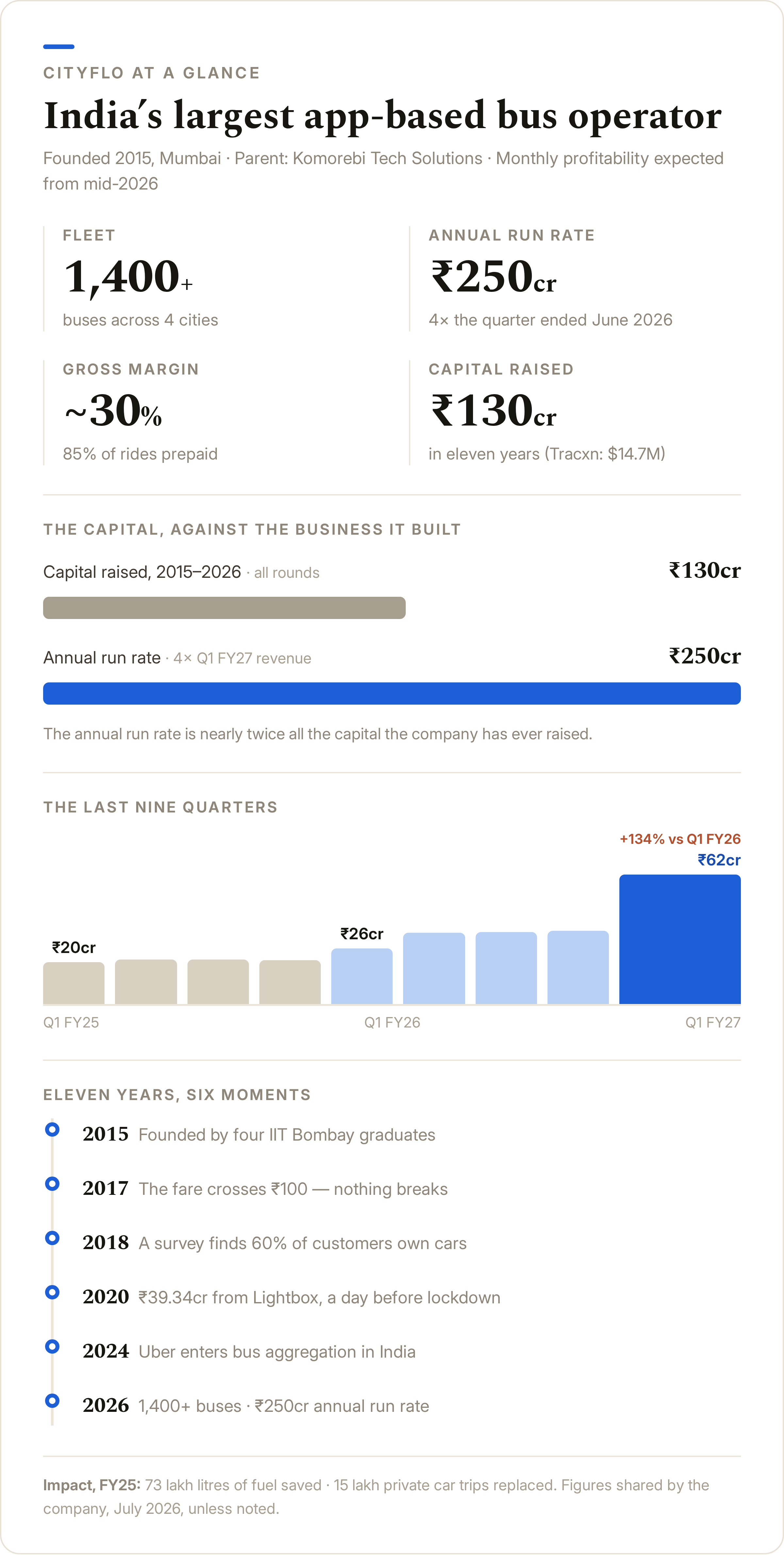
Cityflo raised about ₹130 crore in eleven years. It now runs more than 1,400 buses across Mumbai, Delhi NCR, Hyderabad and Kolkata — the largest fleet of its kind in the country — and its founders expect to turn a monthly profit from the middle of 2026.
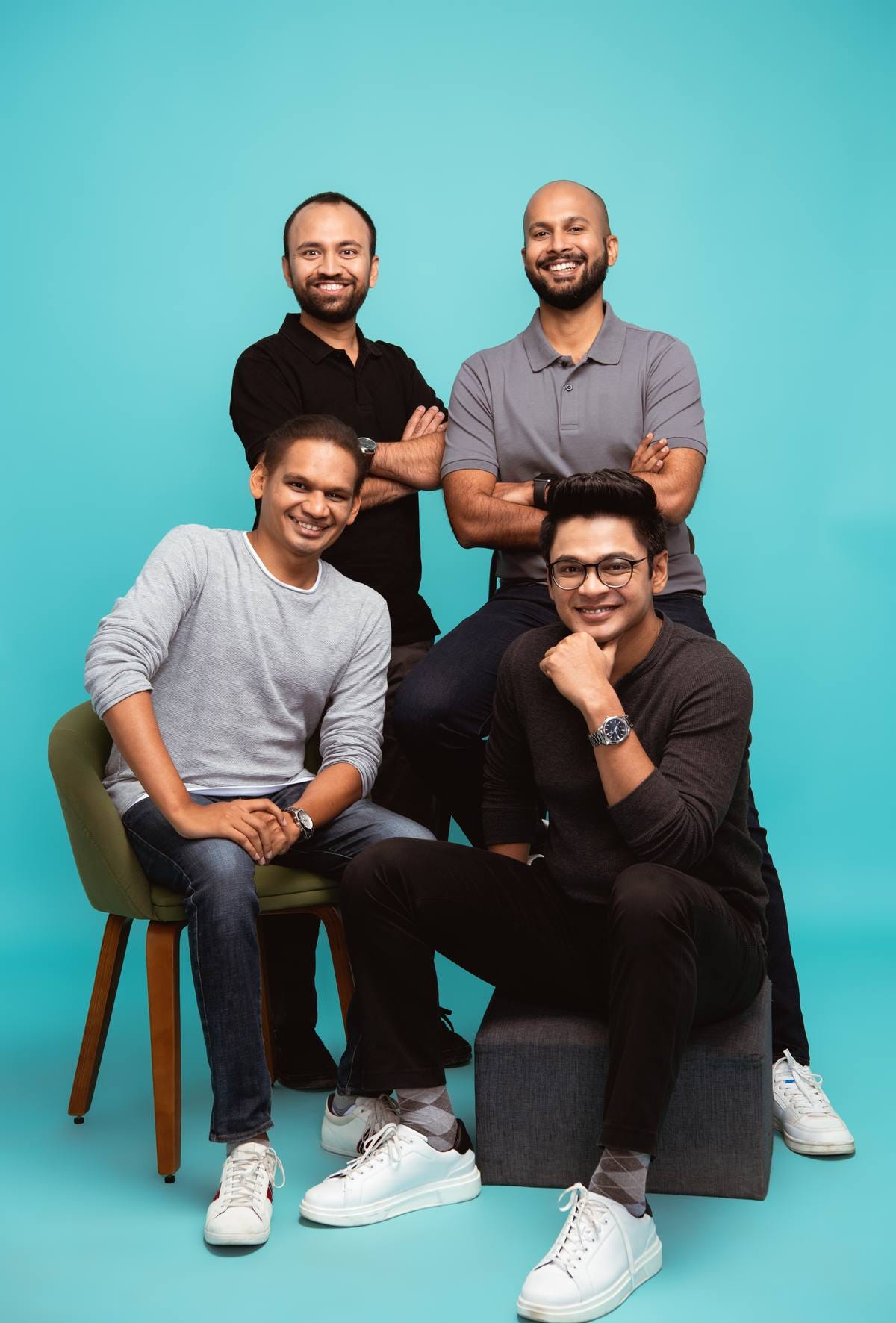
This is the story of how four IIT Bombay graduates — a nuclear engineer’s son from the BARC township, a jeweller’s son from a Dadar one-bedroom, the son of two Thane doctors, and a dal-mill owner’s son from Akola — spent eleven years learning the bus business one mistake at a time.
Almost everything they now know sounds obvious: charge what the seat is worth, clean the bus, keep the driver happy, own the route.
In 2015, none of it was.
Four houses
Jerin Venad grew up inside the Bhabha Atomic Research Centre township in Bombay, where his father, Jolly, ran reactor operations — the first engineer from his village in Kerala, a man who read every evening for the worlds it opened rather than anything he set out to retain.
His mother was a civil engineer who ran her own small practice designing homes, then built a coaching institute. The township was a sealed world: schools inside, hospitals inside, a park for every building, summer holidays on the Pamba river in Kerala, where the family house had terracotta tiles and banana trees.
“It wasn’t really Bombay. No one commutes. The schools are there, the offices are there. Everyone was an engineer, and even the ones who weren’t wanted their kids to be engineers, because their bosses were engineers. Academics was the pop culture. So I studied.”
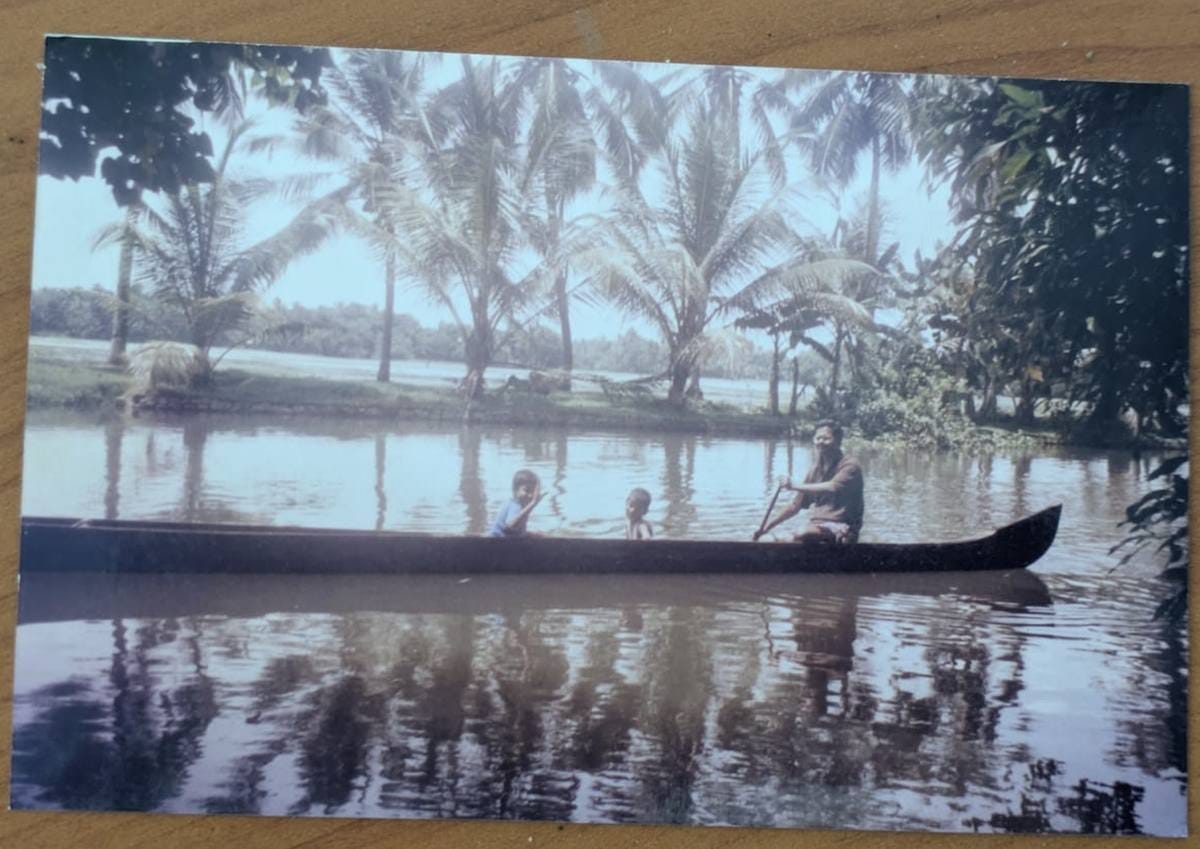
He was a church choirboy who learned Carnatic music, and a National Talent Search scholar. For the JEE he worked hardest at chemistry, the paper most candidates neglected — not because it was harder than the others, but because physics and maths were more interesting to them. He did not expect to clear the exam, and then ranked 207th in the country. He got there by spending the last week before it working on his temperament rather than the syllabus.
“Within an hour, I had seen all sixty-six questions. If a difficult question comes in the first five and you can’t solve it, people get nervous, and then the mind loses control. I was very clear about what my strengths were. So — go through the paper quickly, get what you know done first, and everything after that is bonus. It wasn’t just about physics, math and chemistry. It was about taking the exam.”
Rushabh Shah grew up in a one-bedroom flat in Dadar that doubled as his father’s office. The business was made-to-order diamond jewellery: a jhola of designs carried to the homes of Gujarati and Kutchi industrialist families, karigars managing the making, no showroom, very little inventory, everything resting on a reputation for honesty. The negotiations happened at the dining table, in front of the boys.
“My dad used to have a jhola of designs. He would go to people’s houses, show them, and if they liked something, it was made to order. No inventory. He was known for his honesty — that was the business.”

Rushabh read everything in the small English section of the local Marathi library, wanted to be a lawyer, and was taken at fifteen to a career counsellor who charged ₹2,000 a session and told him to attempt the IIT first — adding that it was difficult, and he might not manage it. The sentence lodged.
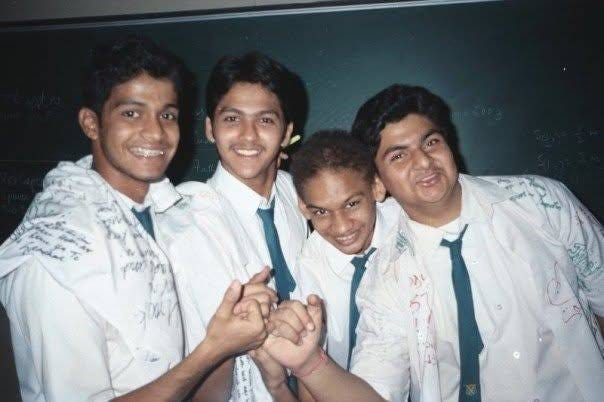
On the day of the JEE, he forgot to bring a watch, sat through three-hour papers with no sense of time, and landed a rank near 1,700 — his worst performance in two years of test-taking. It put him in Materials Science, where he topped his department all four years.
“When I got into IIT, my brother said: seven generations of our family behind us, seven ahead — this guy will be the only one.”
Sankalp Kelshikar’s mother grew up in Parel village (Mumbai) where neighbours threw stones at the house because the three sisters in it were being educated; their mother, a teacher, ignored the stones.
His father grew up near the dockyards. Both became doctors, moved to Thane because it was what they could afford, and built the thing they had promised themselves: a hospital of their own, however small.
Sankalp’s childhood was Singhania School and the understanding that his parents’ work came first.
“They never spared any expense on health and education. Everything else was a no — I knew not to ask. I wanted an encyclopedia once, wildly expensive, and my mom just dropped the money. I didn’t understand where it came from.”
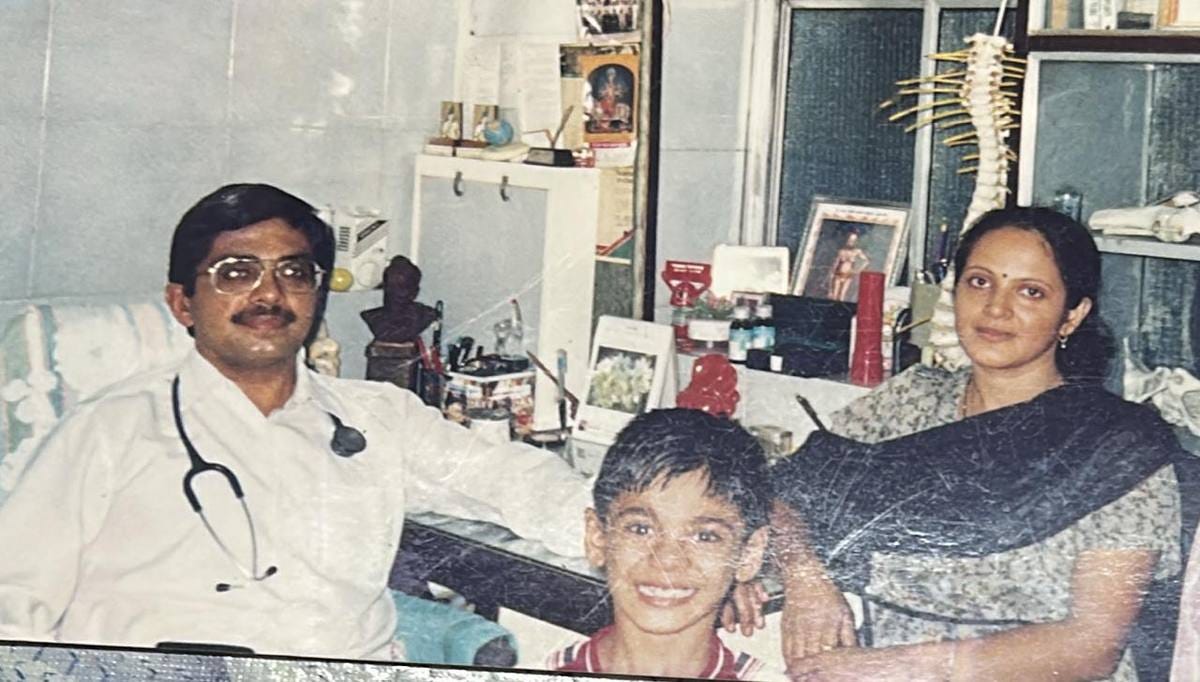
Everyone assumed he would be a doctor.
The first big decision of his life was declining, at seventeen, the life he had watched his parents live — he loved them and did not want their hours.
He was a boy who had once cried on stage as a small child until his mother pushed him back up; by school’s end he was head boy, valedictorian and outstanding student of the year.
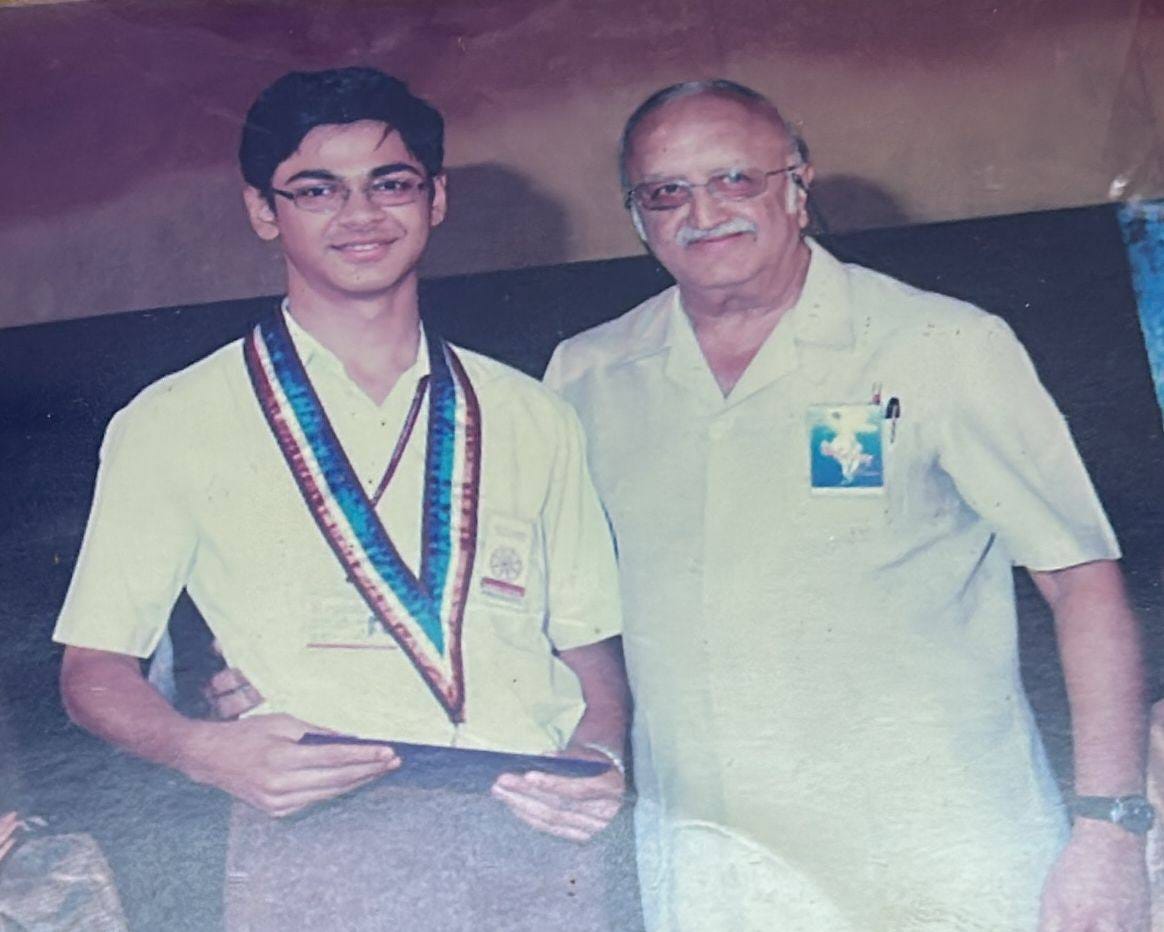
His IIT preparation went nowhere for a year, until a physics teacher named Pranay Kishore broke away from a big coaching factory with fifteen students, Sankalp among them. Ten of the fifteen made it to the IITs.
Ankit Agrawal was born in Nagpur and spent his first six years in Raipur, where his father practised civil engineering and earned ₹2,500 a month at the time of his wedding; his mother took tuition classes while pregnant with his younger brother to keep the house running.
When Ankit was six, his father moved the family to Akola in Vidarbha and built a pulses mill — designed by him, more efficient than the one it was modelled on, still running twenty-seven years later under his father and brother.
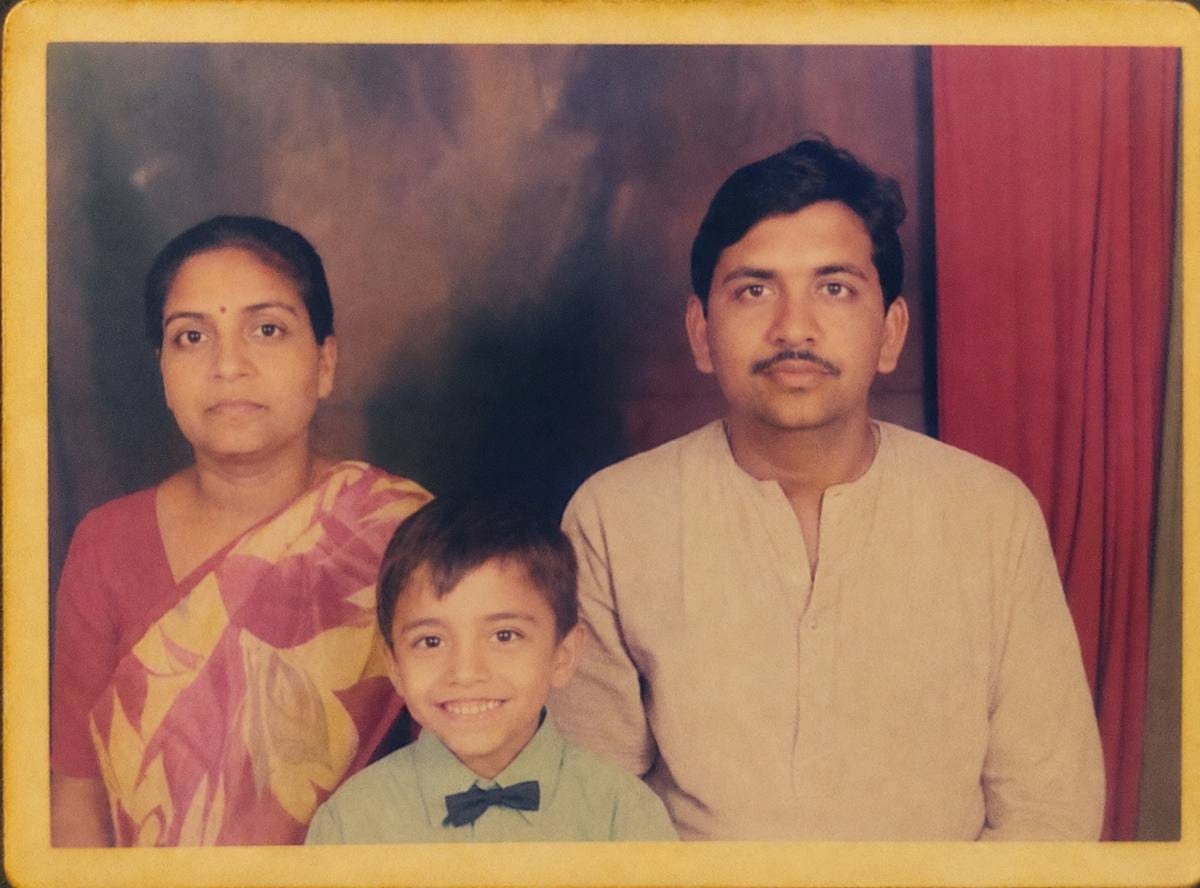
“My dad got a computer in 2003, when I was in the seventh standard. Almost none of my friends had one. He was, in that way, very forward-looking.”
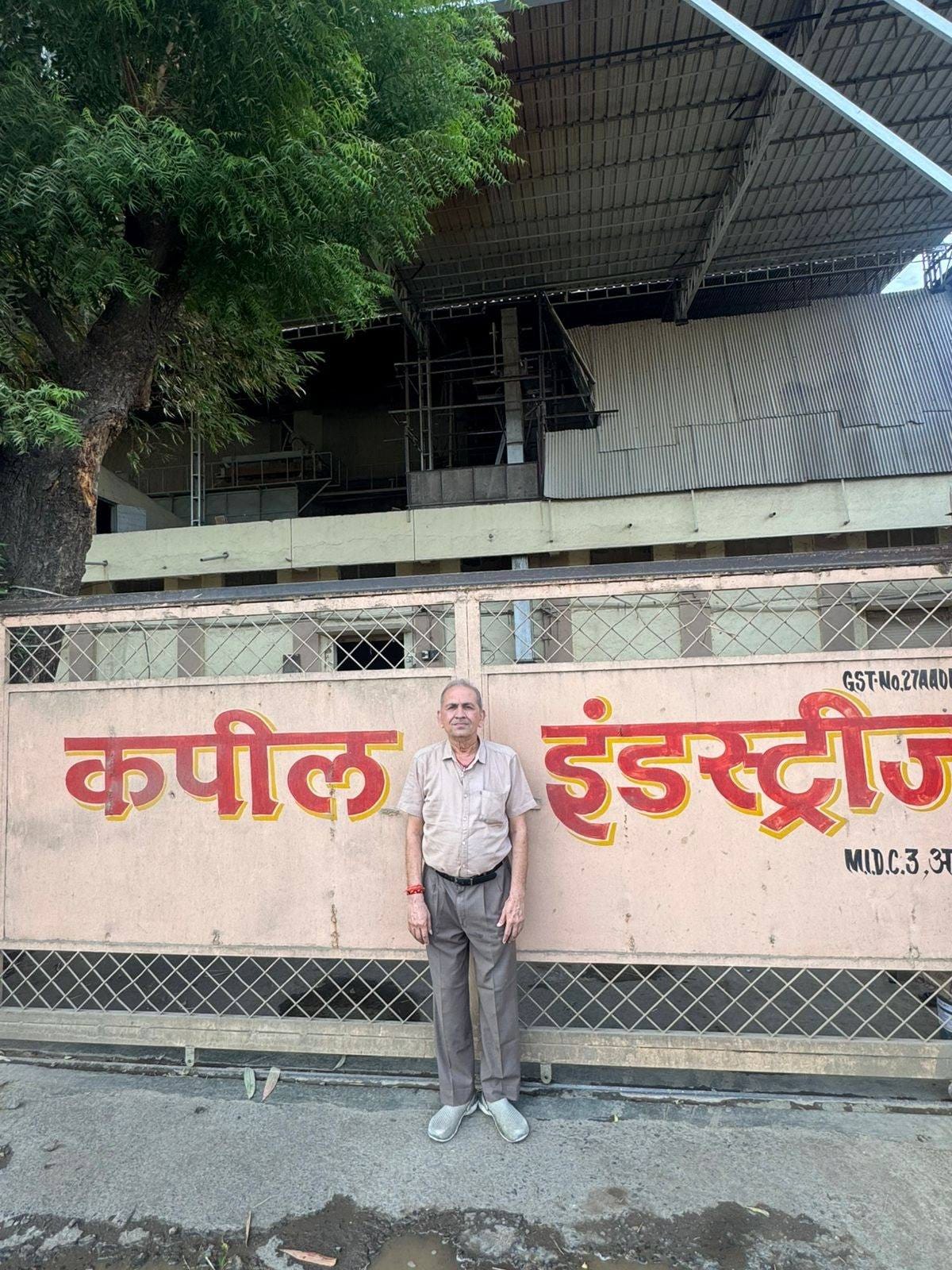
Ankit Agrawal captained the district under-14 and under-16 cricket teams, cleared the National Talent Search exam and every scholarship exam Maharashtra offered, and dreamed, for a while, of becoming a cricketer.
Once he settled on engineering and the JEE, his father visited Kota to inspect its coaching centres and refused it — sixteen hours of study a day was not a childhood — and a stint at a Pune coaching class ended after one week, when Ankit, surrounded by fluent city kids, called home feeling small.
His father heard it in one phone call and brought him back, no questions.
“I had buried the IIT dream once already. Then at the end of the eleventh standard I felt it from inside — I have to give this a shot, or I won’t be able to live with myself.”
So Ankit prepared alone in a rented flat in Akola, food coming from home, a printout of the IIT Bombay main building taped to the wall of his study room.
At the JEE, he wrote his name in the wrong order on the answer sheet, spent fifteen panicked minutes trying to get a new one, then decided it was out of his hands and wrote one of the best physics papers of his life — 80 out of 84.
His rank, 172, was the best of the four.
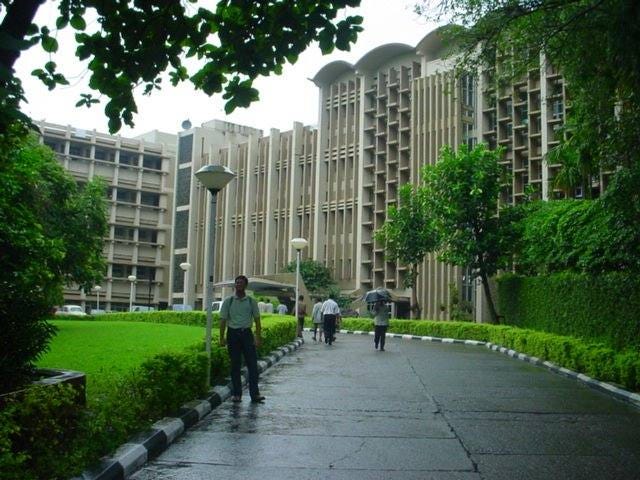
It took the four of them a decade to notice how much of the company came from those four houses.
A lizard in Hostel 2
The four met by accident, in the first week.
Rushabh was sitting in a friend’s room in Hostel 2 when Sankalp burst in from next door asking for a broom, on account of a creature in his room. Rushabh maintains it was a lizard; Sankalp maintains that it was a cockroach; the dispute is now in its seventeenth year.
Jerin was two rooms away in the same hostel. Ankit arrived a year later, a junior who kept showing up at the literary-club events Rushabh ran in the hostel mess.
None of them were there for ‘engineering’.
Rushabh had wanted law, Sankalp to run Mood Indigo — IIT Bombay’s cultural festival — Ankit did not yet know what he wanted, and Jerin, by his own admission, mostly wanted to stay in Bombay.
“You get into IIT and everyone is better than you. You go from the top one percent to average, and that is humbling. You can take it however you want — but it’s also inspiring. You could be whoever you were. I could not have imagined that my reading books would be a skill I could compete with in college.”
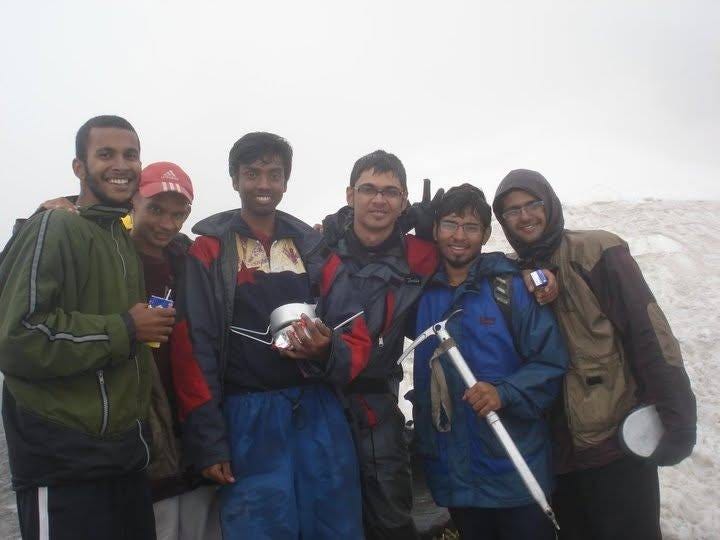
Sankalp and Rushabh entered quizzes and word games as a team. Sankalp went on to write Case Interviews Cracked with a batchmate, Saransh — a consulting-preparation guide that IIT Bombay students still use, and one Rushabh read and argued with in draft. Two recent Cityflo hires arrived having studied it, unaware they would later be interviewed by the people behind it.
Ankit found open-source software and the Google Summer of Code, and through it a BITS Goa student named Sudhanshu whose code he admired.
After one intense year of JEE preparation, Jerin stopped. He played football, made music, switched to a dual degree with vague thoughts of a PhD, and drifted.
“By the fifth year I realised — when I look back at periods where I didn’t work hard, I don’t enjoy them at all. I need to be in the middle of the action. And I learned one thing with total conviction: I cannot not do a good job. That is the core of satisfaction. Everything else came later.”
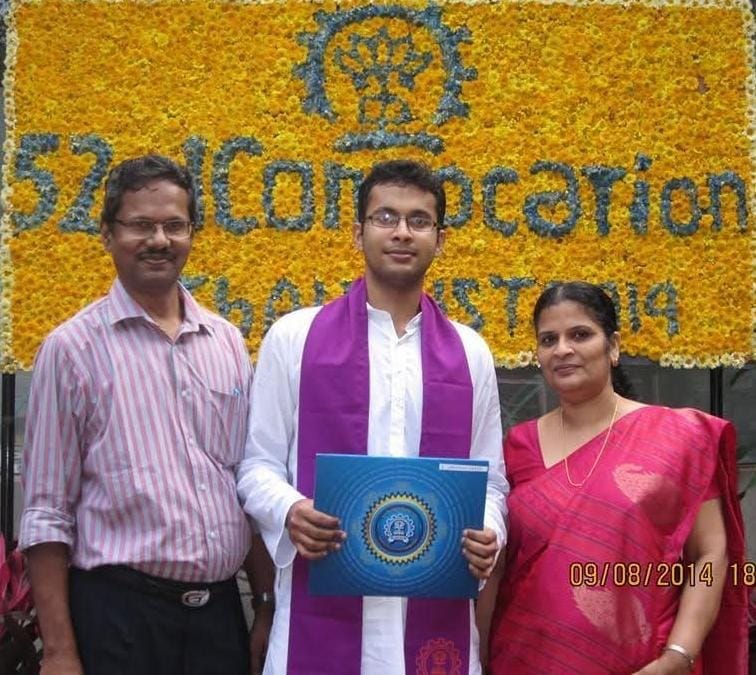
One afternoon in his third year, an alumnus who ran a career-counselling company spoke on campus. Jerin, planning an academic life, wrote to him afterwards with an honest account of himself and asked for direction. The reply said he had a great career ahead of him — in sales.
Jerin, a Kerala boy raised on a healthy suspicion of commerce, was offended for years. He now tells the story against himself.
“I never sold anything I didn’t believe in. Whatever I built or recommended, I had conviction in — and I was always happy to be challenged on it, to a fault.”
It took him about a decade to concede the point.
They graduated into consulting and finance. Rushabh went to BCG and spent six months in a spiral — a high performer performing badly for the first time — until a posting under a patient German manager in Munich, in the World Cup summer of 2014, taught him how to work.
Sankalp went to A.T. Kearney and coasted on a chartered project. Ankit turned down Goldman Sachs after the onboarding tour — he looked at the offices meant to impress him and decided the life was not his — and joined a small startup instead. Jerin lasted ten months at EY.
“I was a terrible consultant. I couldn’t do timesheets. I couldn’t make decks the way they wanted. My quarterly ratings were low because the timesheet wasn’t filled. They said — this isn’t difficult, why won’t you do it? I understand now. It wasn’t about right or wrong. It was a signal that my energy belonged in building from first principles, not inside someone else’s playbook.”
The ratings were not the real problem. Jerin says he had carried a question since childhood in the township, where everyone he knew earned a salary and no one ran a business.
“I always had this lingering question: why would someone pay me money? I couldn’t accept the status quo of do the job, get a paycheck. I wanted the underlying engine — why does money actually change hands? I didn’t know what revenue was. I didn’t know what value creation was. I’m embarrassed how late in life I learned it.”
Seven passengers
The first idea was blood. Still at EY, Jerin had found a US company running private blood banks and worked out that India’s blood supply ran at a fraction of its need — a logistics problem with a forty-day shelf life and seasonal demand.
Doctors told him charging for blood would never scale in India, and the regulators leaned the other way. He dropped it.
The second idea was his own commute. In his final year, he had taken the BEST bus out of Powai on Monday mornings, alongside batchmates heading to the TCS and Accenture offices in Andheri East — the same trip, the same hour, a crowded bus that stopped everywhere.
“Most of my commute is Monday to Friday, home to office and back. It’s structured, and it’s happening in huge volumes. For that, you should run a bus — straight there, no stops. It just came together like that.”
He was also, he admits, drawn by proximity. Friends from campus had started a home-services company and lived together in a flat in Chandivali that felt like a continuation of college.
He visited from his EY desk and wanted their life more than his own — seduced, as he puts it, by the energy, and by the real-ness of what was happening there.
The company was named at Chaitanya, a seafood restaurant near Shivaji Park, by six friends checking domain names at the table.
Rushabh had been riding an elevator branded “Peopleflow” every morning at a client’s office; he suggested Cityflow, the domain wasn’t free, so they dropped the W.
There were six founders because large founding teams were the fashion of 2015, and because, as Rushabh says, none of them knew anything and it felt safer to not know things together.
“Jerin’s idea, so Jerin is CEO. Advaith is from ITC, so Advaith will do operations. I had some digital product experience with Axis, so I’ll do product. Ankit joined as a tech cofounder, so he codes. Sankalp was on a marketing project at Kearney, so — marketing. And Subhash will do data analytics. We were twenty-three. We had no idea what we were doing, except maybe Ankit.”
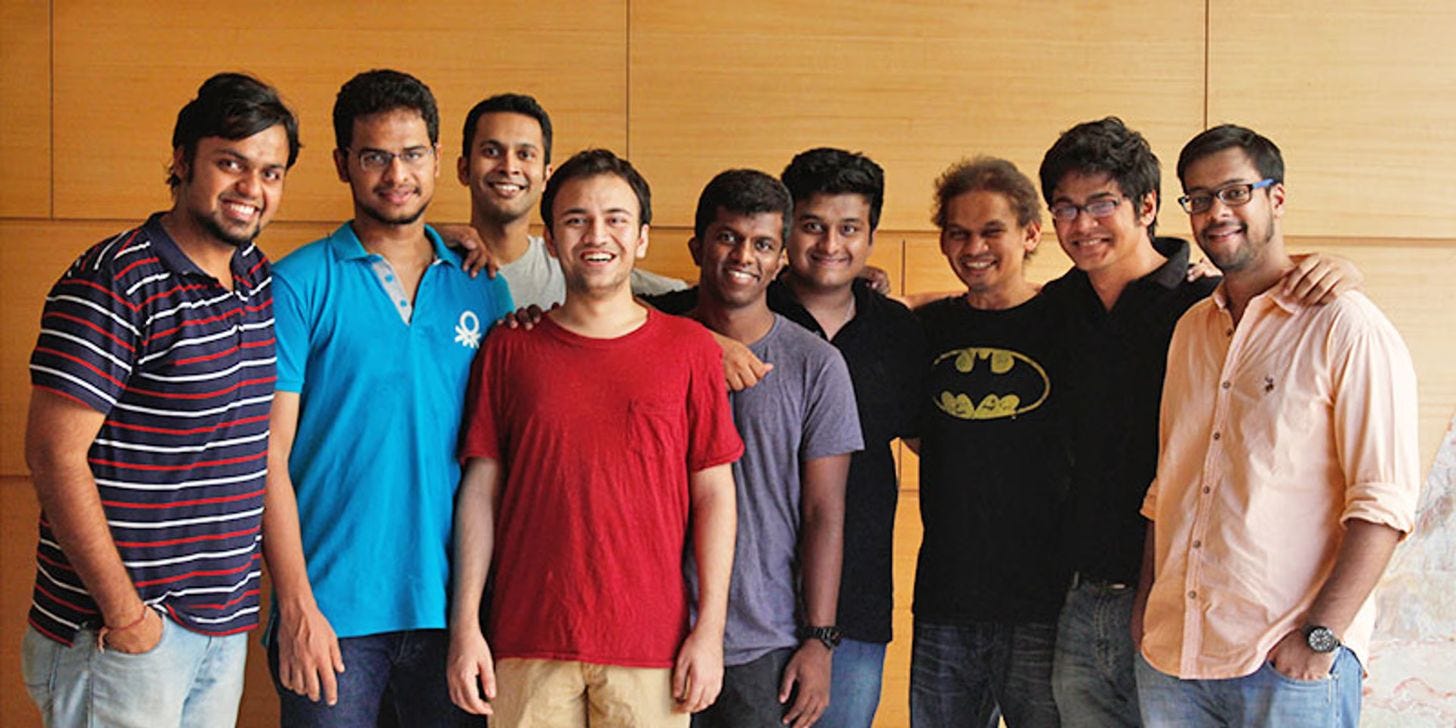
Jerin put in his savings — about ₹2 lakh — and hired a Tempo Traveler.
Rushabh’s elder brother Kunal, hearing the plan on a phone call, transferred ₹15 lakh within two hours; it was the company’s first real money.
On a June morning in 2015, the first vehicle ran from Deonar toward Andheri East with seven passengers aboard, each paying ₹70, recruited through a Facebook ad.
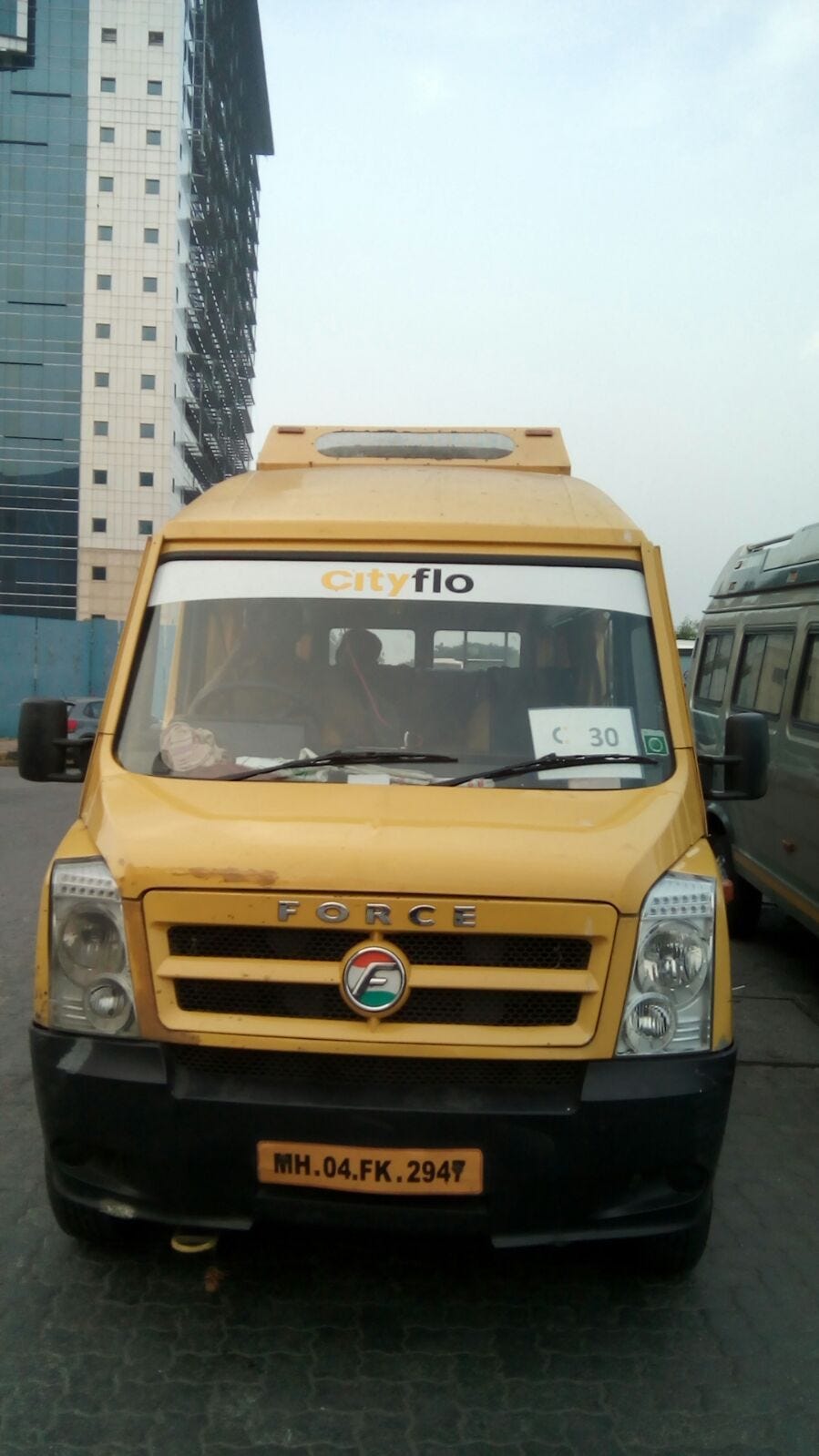
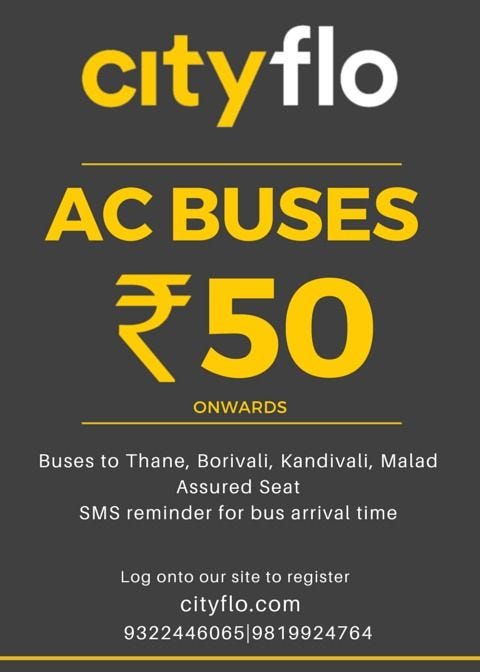
The app did not exist. A well-wisher had asked the obvious question — you’re running a bus service, why wait for an app? — so the founders printed sheets of coupons, tore them by hand into booklets, and sold twenty-ride packs for cash.
Each morning a passenger handed one coupon to the driver.
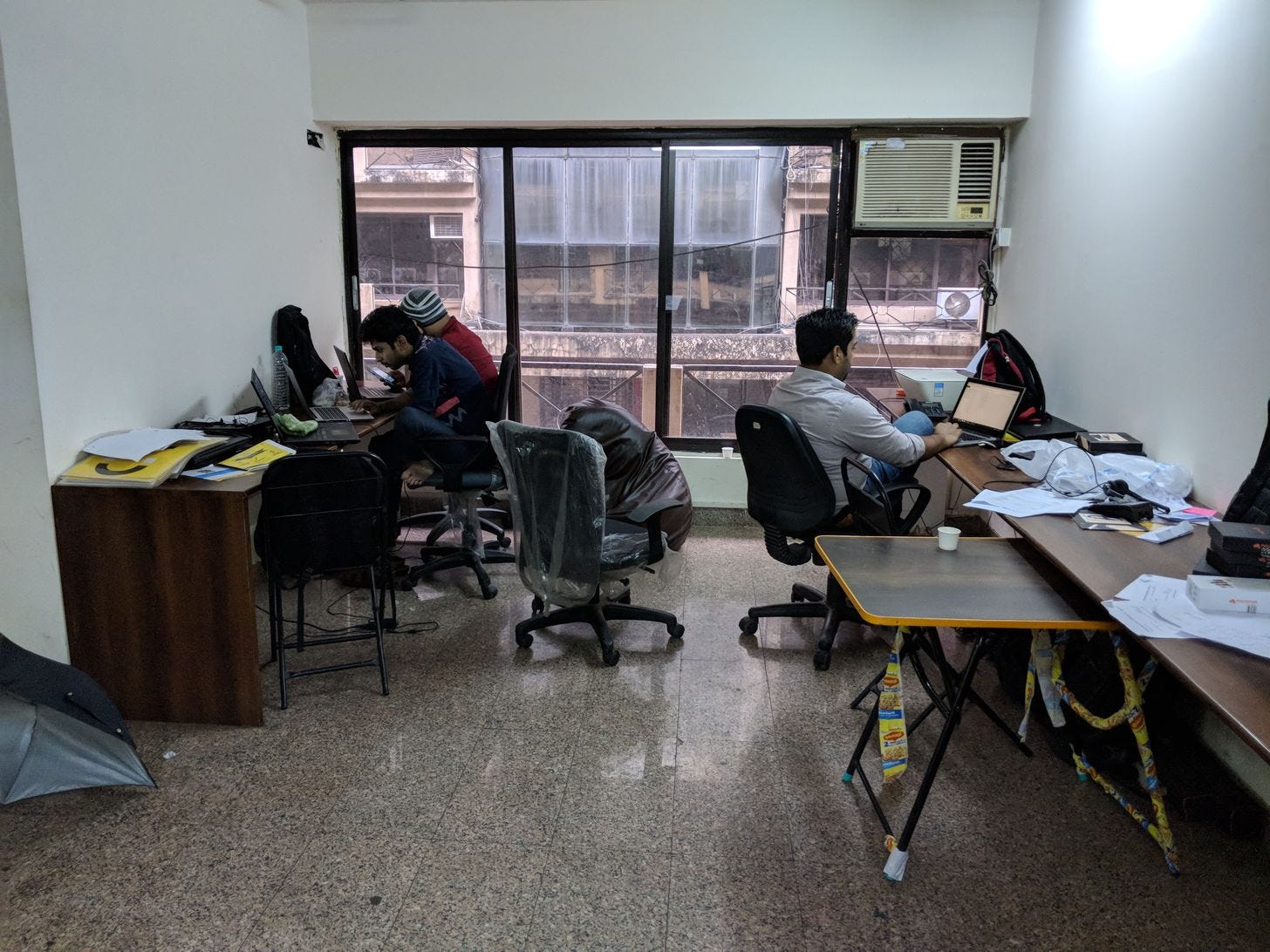
That was the machine: a rented van, paper passes, and six engineers calling every absent customer each evening to ask why they hadn’t come.
The marketing department was the founders themselves, standing outside office towers at closing time. Sankalp, the designated marketer, remembers the apprenticeship.
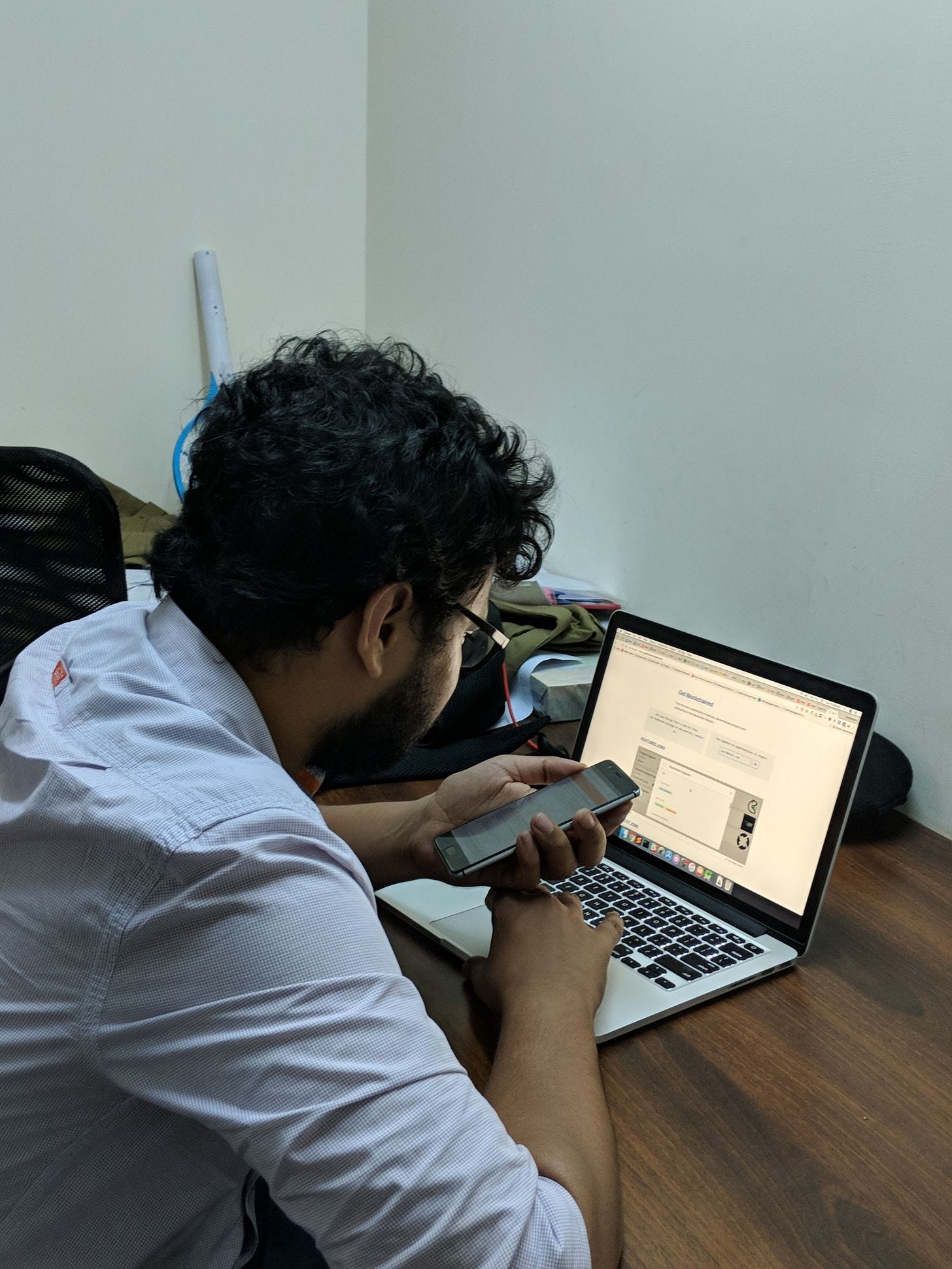
“So awkward — walking up to people going, here’s a flyer, let me tell you about this bus. For me the icebreaker was the smoking corners of BKC. Let’s smoke and talk. That’s when the conversation began to flow, and I found I loved talking to customers about their problems. I still have customers from those years with my personal number.”
“The bus cost ₹3,000 a day — a hundred rupees a seat. We were selling at seventy. And I’d think: that you can’t fill the seat is not the customer’s problem, it’s yours. It took me years to see it the other way round. If the business doesn’t make money it doesn’t survive, and then it is very much the customer’s problem. Staying profitable is something you owe the people who ride with you, not only the people who fund you.”
Money arrived fast.
A well-known early-stage firm offered around ₹2.5 crore for a fifth of a week-old company, and Jerin thought his life had changed.
A senior from campus — a Housing.com co-founder, hardened in exactly this market — told him the offer was too low and coached him through his first negotiation: text the other funds, say you have a term sheet.
IDG Ventures, later renamed Chiratae, moved within days.
Jerin and Rushabh flew to Bangalore and pitched a firm that already knew two competitors were raising. The seed round closed at ₹4.8 crore, IDG leading, at a valuation near ₹20 crore.
The deck’s proudest slide claimed forty customer rides.
“What was exciting wasn’t the paper money — it was that we were onto real consumer demand, for a simple service that felt like it should already exist everywhere. Suddenly each of us was worth four or five crores on paper, and I didn’t know what a rupee of profit was. Completely clueless.”
Seventy buses, six months of money
The app launched in September 2015 on a single corridor, Borivali to BKC, with five buses — a number chosen after the first hard lesson.
Riders had loved the early one-bus routes and then stopped coming; the daily calls revealed why.
One left work early on Tuesday, another forgot on Wednesday, and a single missed bus meant a wasted evening.
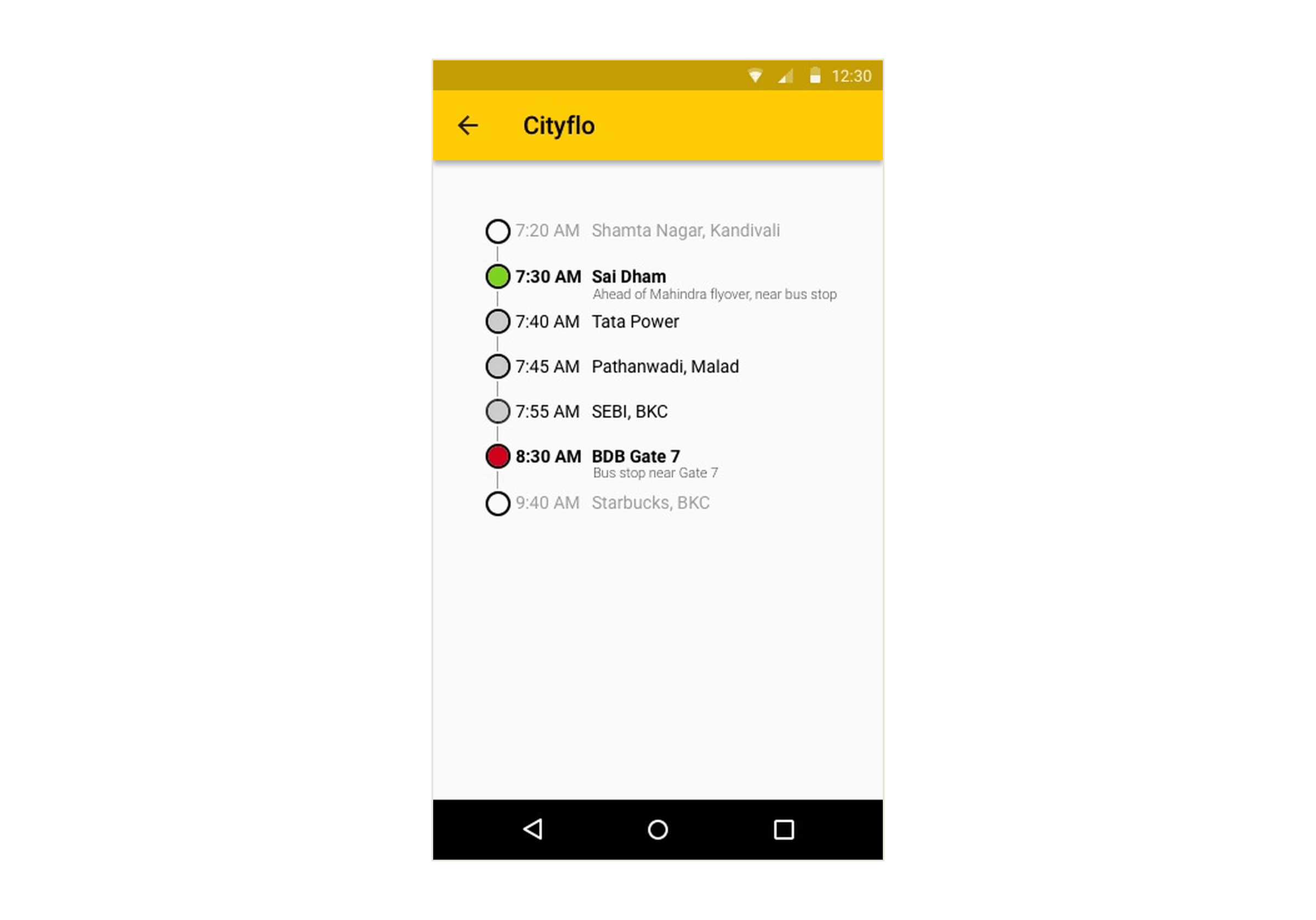
“To be someone’s daily commute, you have to be available all the time. That’s the local train — you don’t think, you go to the station, it’s there. So now you’re telling me I need to run at least five buses on a route. You can never start with one.”
That October, Mumbai’s Western Railway line failed for a day — the kind of breakdown the city suffers once in two or three years. It emptied the trains into anything that moved.
Cityflo’s buses ran full for the first time, strangers standing in the aisles.
Growth stopped being the problem. Within six months the company was running roughly seventy buses across a dozen routes.
Every seat cost about ₹100 to provide and sold for ₹70, so each new bus added losses. At peak, the company was burning ₹40–45 lakh a month against ₹4 crore in the bank.
Raising the fare felt impossible. The founders had priced against BEST’s ₹60 Volvo service and could not imagine a bus ride costing three digits.
And the competition was selling below cost: Shuttl in Delhi had raised $20 million from Sequoia and Lightspeed within months of launching; ZipGo had entered Mumbai at ₹29 a ride; some rivals ran free buses. Investors, looking at the losses everywhere, asked Cityflo why it was so expensive.
“We were never visionaries. We were engineers, looking at the sheet and saying — this ends. Everyone else was celebrating scale, and we were the ones stressed about money at seventy rupees a seat.”
In April 2016, BEST — watching private buses fill with office-goers — complained, and the transport authority ordered Cityflo’s buses stopped.
For two weeks the fleet stood still while its newer rival, unknown to the inspectors, kept running. Customers drew the obvious wrong conclusion about which company was legal.
Jerin spent the fortnight in the offices of the RTO’s prosecutors, where he learned the law was, almost by accident, on his side: every Cityflo passenger held a contract before boarding, which is exactly what a contract-carriage permit demands. A retiring senior prosecutor told him the office had studied the model and expected it to survive.
The buses were released. By then half the fleet, and many of the passengers, had leaked to the competition.
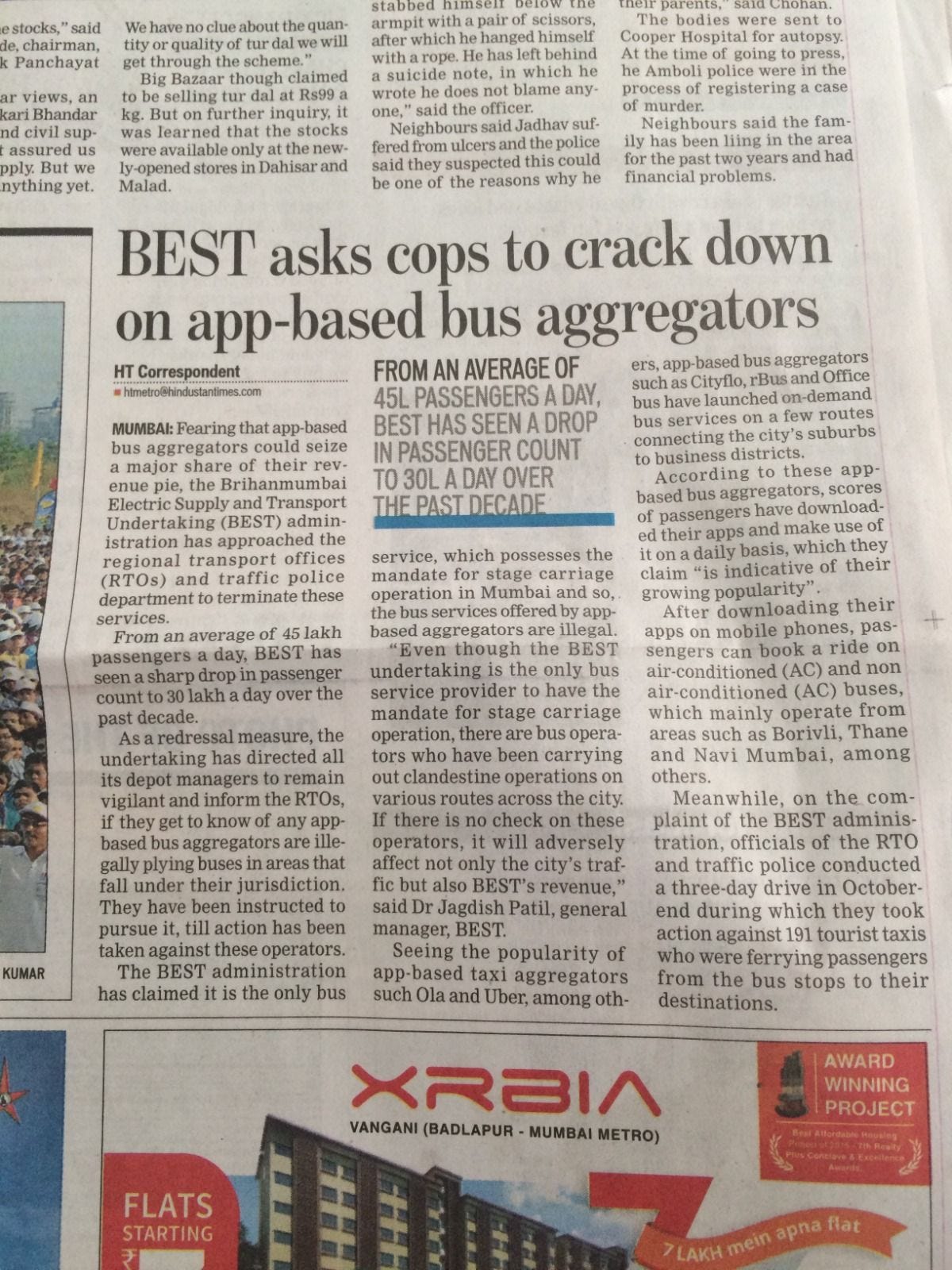
“Overnight I lost control. The customers thought we were the illegal ones. The prosecutor told me — your buses will be out in three days, why the stress? I said, sir, by then it’s finished. He didn’t understand. There was nothing to do but say: this is the new reality, we climb from here.”
Money ran down through the rest of 2016. A family office issued a term sheet and rescinded it. IDG wrote bridge cheques — about ₹1.5 crore in all — with an honest warning: they did not believe in the business and would not fund it again, though they thought well of the team.
In December, Shuttl raised another $20 million led by Sequoia India. Rushabh opened a spreadsheet and named it Cityflo Closing Plan.
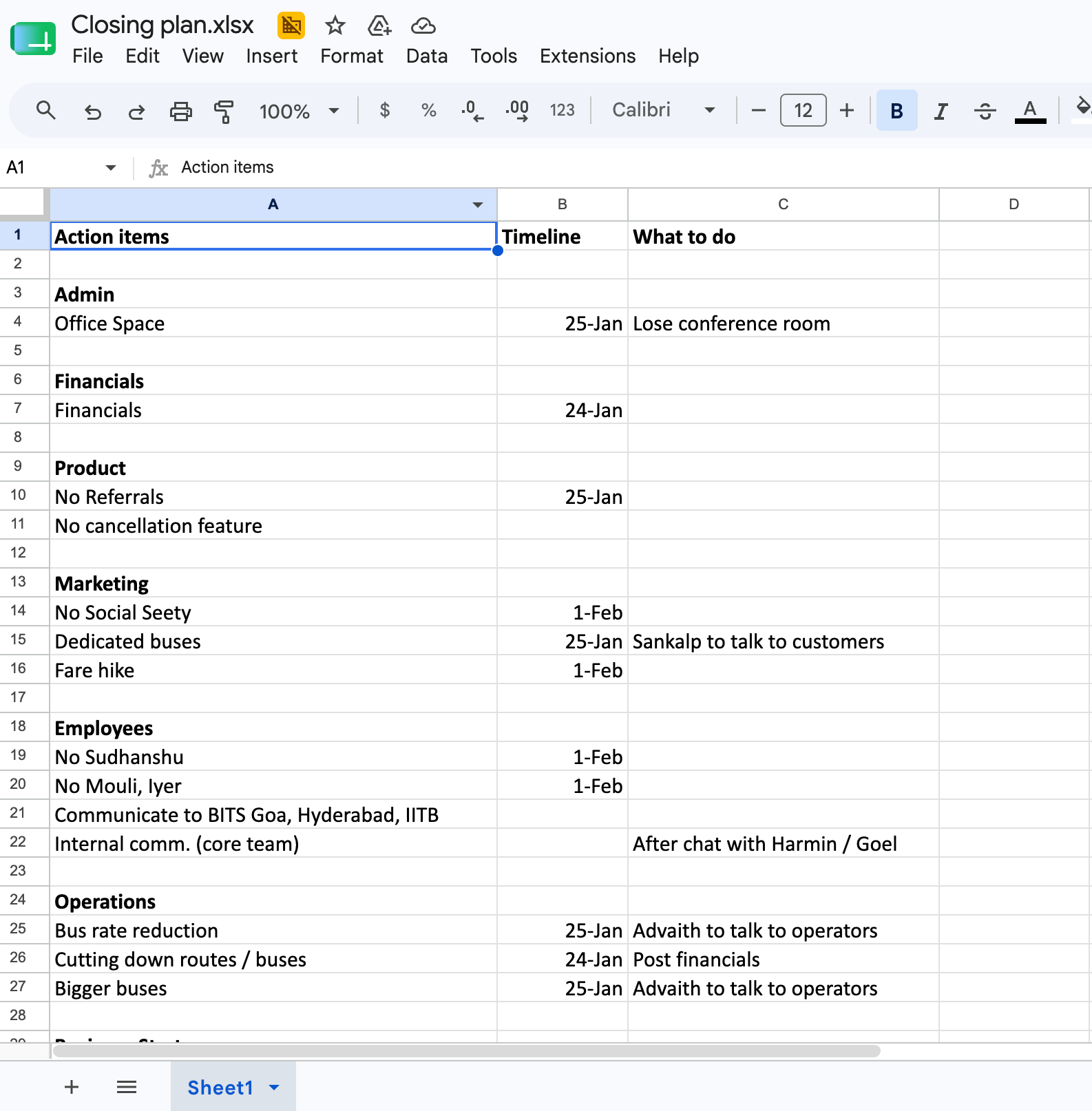
“Jerin had no math back then — pure believer. So I made the sheets. How much money is left, what severance can we give, how do we wind down. There was a V1 and a V2.”
One week before Diwali, the founders called their thirty-five employees into a room. Some walked in expecting a festival bonus. The company kept two people from the operating team and let everyone else go.
“That is the worst moment of my entire journey. I understood, in that room, the gravity of the job I was doing. You can’t just tell stories — beyond the stories, families depend on you. People are important, their children are important. A week earlier you were selling them the dream, and now they think you’re a cheat. I decided this can never happen again.”
Two of the six founders left that season.
Subhash and Advaith had carried the roughest parts of the operation and had, reasonably, run out of faith.
The remaining four judged that a founding team cannot function with half its members preparing for the end, and Jerin delivered the conversation. Everyone now agrees it was the right call, generously handled; both men remain close friends of the company.
The four who stayed were not sure of it either.
Ankit wanted out, and said so. What followed has entered company folklore as the midnight meeting: a park bench below Ankit’s building in Powai, Sankalp first — recruited first because he is the optimist — then Rushabh, then all of them, asking one another a single question.
Are you well and truly in?
Ankit called his father, the man who had built a dal mill from a civil engineer’s savings, and laid out his doubts about the whole venture-funded model of burning money.
“My father asked what my co-founders were thinking. I said they’re continuing. He said — then you continue. Don’t give up on them. If the market exists, it will work. I had no plan for what I’d do instead. So I stayed.”
Rushabh’s contribution was a line the company still uses.
“I used to say: I am a cockroach. It’s the only creature that survives a nuclear winter. We will not fake it and we will not shut down. We’ll go without salary, we’ll stay hungry — fine. The company shall not shut down.”
Two trips or nothing
What remained was almost nothing: some ₹40–50 lakh, four buses lent on trust by an early operator the founders call Boris, and ten people — the four founders, plus four employees who had refused to be laid off and instead proposed cutting their own salaries so that more of them could stay.
Two of those four, Sudhanshu and Sarwar, are still at Cityflo, now its most senior engineers. One policy dates from that winter and has never been reversed: the books stay open.
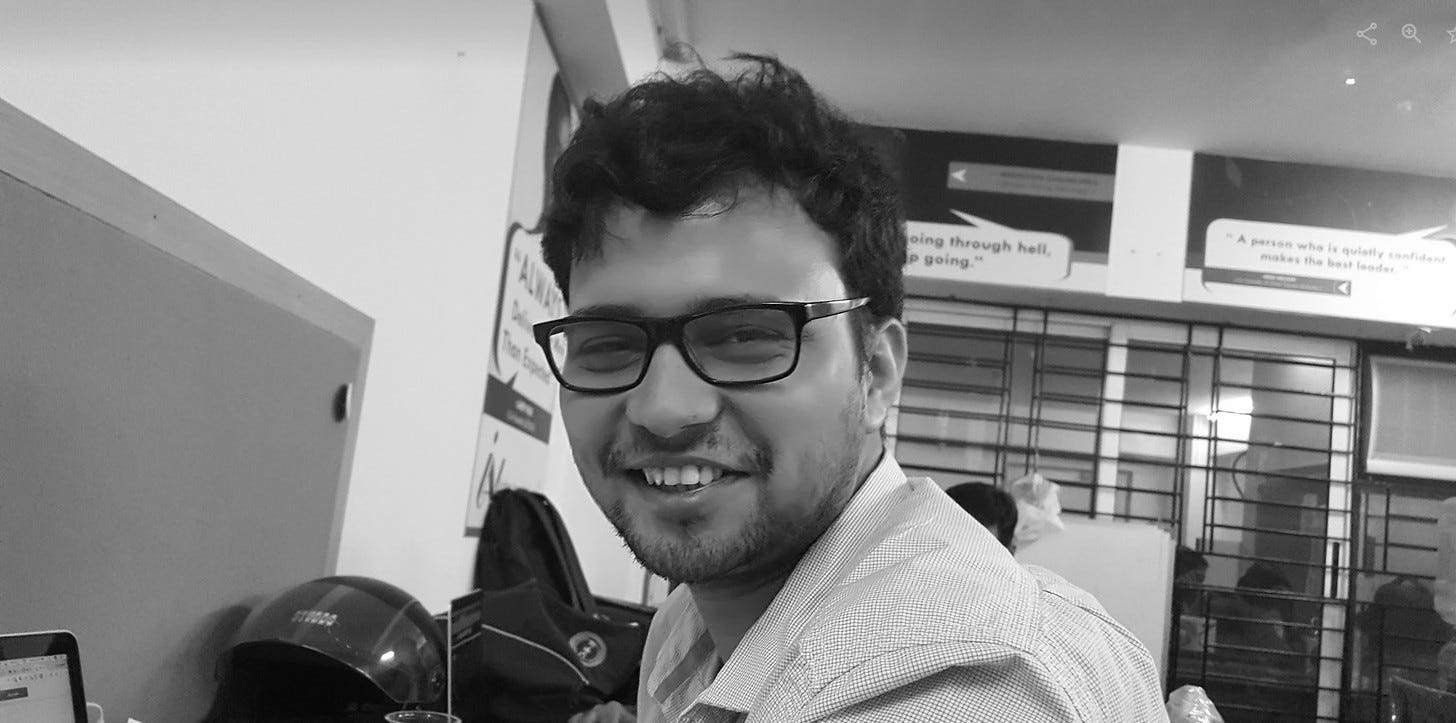
“Practically everyone in Cityflo who wants to know, knows the company’s bank balance. We decided to keep it open. If you’re staying, this is what you’re signing up for. You can join another company where you don’t know the bank balance — but know that there is a bank balance everywhere. Here, you’ll know it. I think it kept exactly the right kind of people.”
The founders stopped drawing salaries entirely and ran the four buses themselves, riding them daily and questioning their own customers.
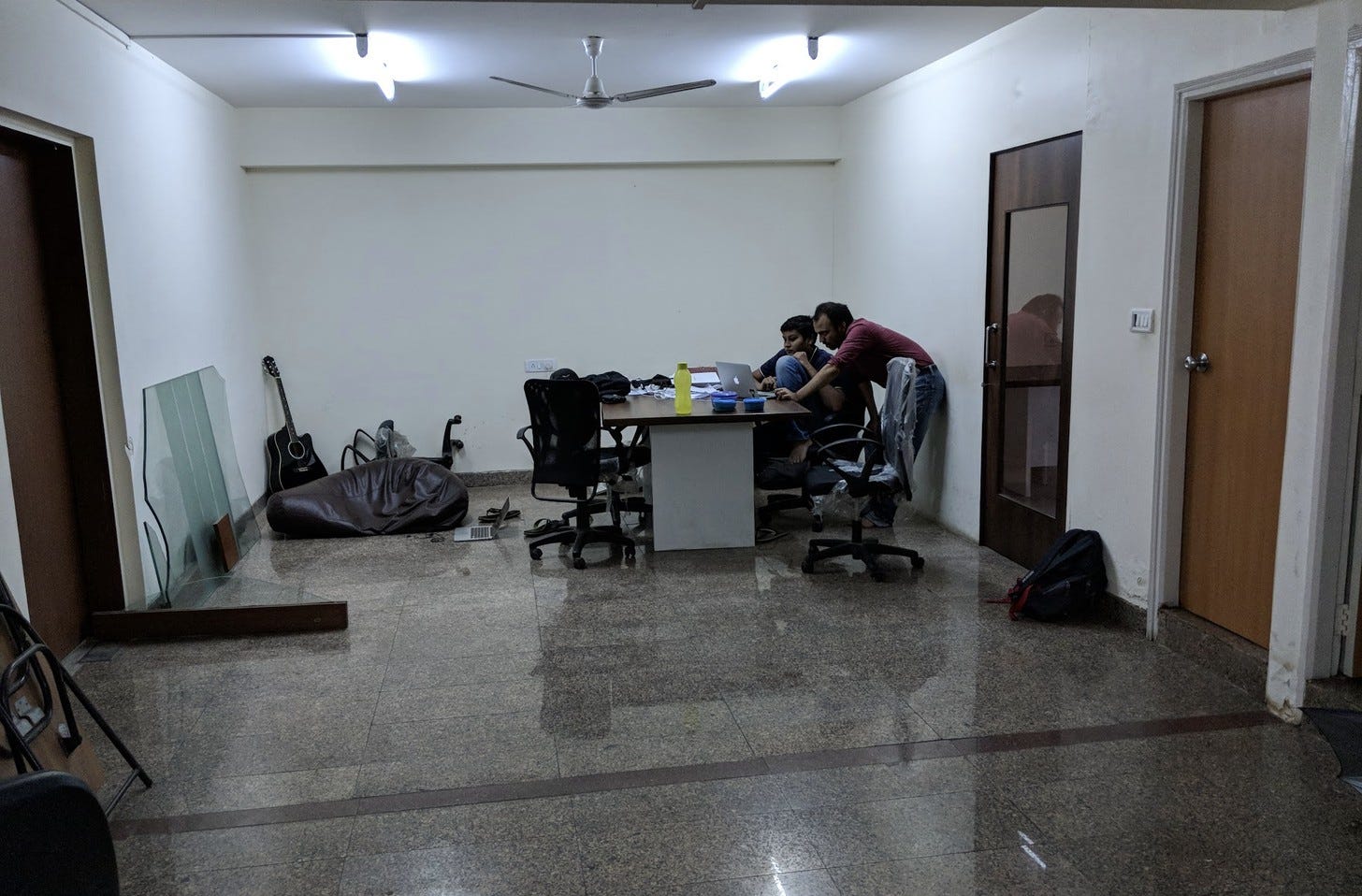
“These are savvy people — they saw the cut-down fleet and asked what’s wrong. I said, sir, the unit economics don’t work. And he said: how? Your buses are full and seventy rupees is absurdly cheap. I used to drive — my fuel and toll alone came to a hundred and fifty, and I drove three hours a day. We had never imagined people coming from cars. We had only ever expected to be better than the train.”
Two outsiders changed the company’s arithmetic. The first was Prasanna Patwardhan — chairman of Prasanna Purple, president of the Bus and Car Operators Confederation of India, a third-generation bus operator.
Jerin came to him with a pitch: your coaches earn on weekends, give them to me Monday to Friday and pay me from the profit.
Patwardhan gave the young company roughly ₹1 crore in ₹30-lakh instalments, telling Jerin he was reminded of his own younger self, and attached one condition.
“He said: if it works in two trips, it works. One morning trip, one evening trip — the bus must break even on that. Everything after is margin expansion. All your dreams about the third and fourth trip, keep them. If you lose money on the first trip, forget it.”
Patwardhan’s private-equity investor, Rajiv Agarwal of Ambit Pragma, delivered the same message with less ceremony, in a line the founders still quote to each other. (Agarwal has since passed away; they speak of him with affection.)
“He told us, without sarcasm: you raised five crores. If all of you had gone to Europe for six months, had a wonderful holiday and come back, it would have been a better use of the money. If you don’t make money doing this, do not do it.”
The second outsider was Vishal Dixit, a former venture investor introduced by a friend, who took five percent of the company in exchange for advice that the founders say was worth far more.
His first contribution: he read their numbers and told them something they did not know about their own company.
“He said — you’re a negative working capital business. We said, what the f*** does that mean? He explained: you take the money first and pay later. Your inventory is zero. The more you grow, the more the customers fund you. We had been running the company three years without knowing this.”
His second contribution fixed the cap table.
IDG, through seed and bridges, held about forty percent of a company it had written off — enough to kill any future fundraise. Dixit told the founders to buy it back. The founders went to their families.
Rushabh says:
“He said: you give IDG some amount and they’ll sell, because they’ve written it off. We said — we can scrounge up ten lakhs each. I borrowed from my brother, Sankalp and Ankit from their parents, Jerin mostly from his father with a friend adding the rest. Forty lakhs, for four crores’ worth of equity. And IDG were very gracious. They said: we don’t believe in this business, but if you want to continue, we won’t stand in the way.”
Four boys with borrowed money owned their company again. Dixit’s third contribution was a shouting match: when the founders wobbled once more, he told them they were idiots with nothing left to lose.
Then they raised the price, because there was no one left to copy and no money left to burn.
Seventy became eighty, became ninety-nine, and there the company stalled — a genuine internal war over whether a Mumbai bus ride could cost three digits.
“Pricing has all these scientific studies, but in the end it’s guts. The customer doesn’t negotiate — they just stop coming. Every increase, you live in that fear. And the customers were telling us something we refused to hear: if the customer says you’re cheap and you weren’t planning to be cheap, you are very wrong somewhere.”
The fare crossed ₹100 in 2017, and nothing broke. Buses began paying for themselves on two trips.
Then a survey of about six hundred riders in 2018 returned the number that would define the company: roughly sixty percent of Cityflo’s customers owned cars, and nearly half had driven to work before switching.
The company had spent two years believing it was a premium version of the train. It was a replacement for the car — a fact its own investors could not absorb.
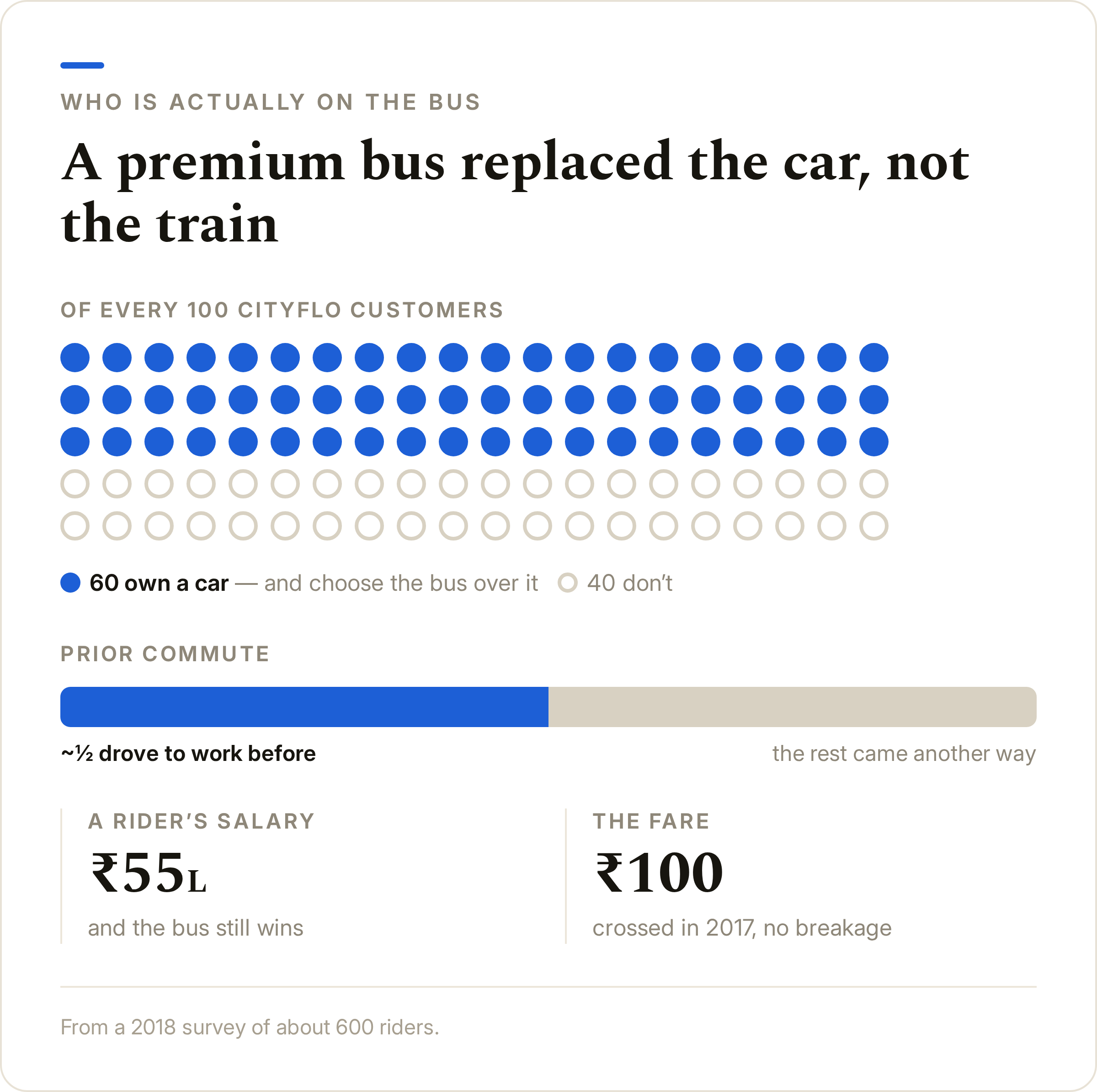
“I told investors: sixty percent of my customers are car owners. They could not internalise it. You have to stand in the bus and watch a forty-two-year-old man with a fifty-five-lakh salary choose it every morning. You can hand an investor the data point; the feeling doesn’t come.”
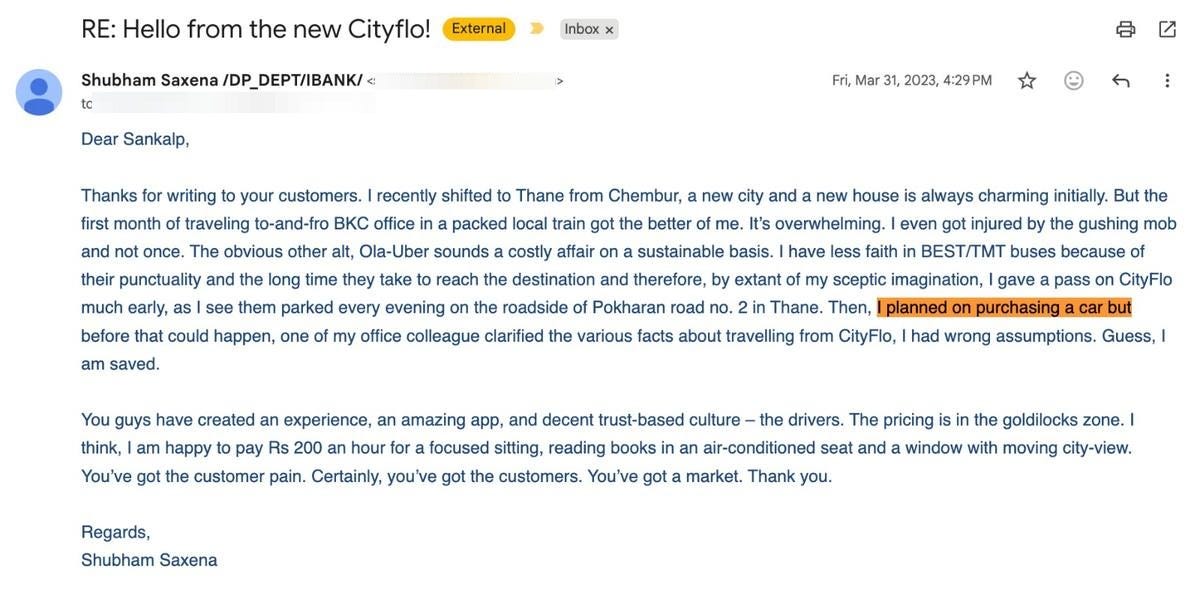
One rider proved the point himself: he wrote in to say he had been about to buy a car, and decided against it.
The letters
In 2017, with the buses breaking even, Jerin went looking for what a good business actually was.
He typed the question into a search engine and landed on a compilation of lessons from Warren Buffett’s shareholder letters. He still has the screenshot, star-marked.
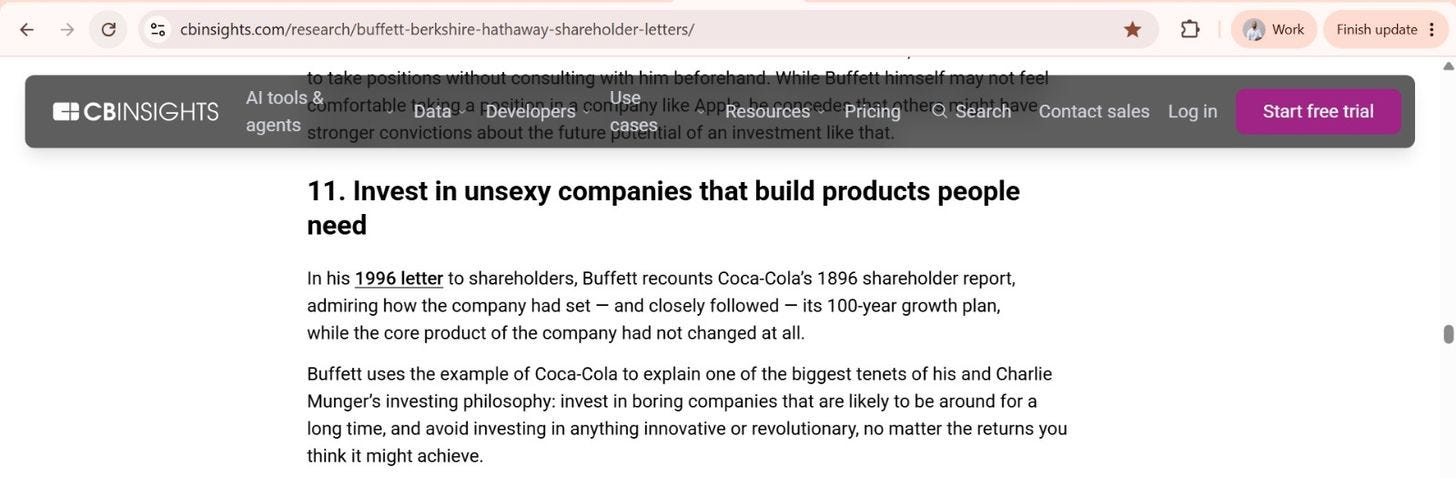
“It just opened my eyes. A good business and a big business don’t have to be the same thing. You can be small and terrific. And I started thinking about the idli chain near us — how do you displace them? You can’t. That’s what a franchise is.”
The letters gave him a vocabulary for things he had half-noticed: why See’s Candies failed whenever it expanded east; why Coca-Cola’s genius was a taste you never tire of; why the customer never asks whether the ₹140 ride is twice as good as the ₹70 one, only what the best thing at his budget is.
One of Buffett’s warnings stayed with him: when a management with a reputation for brilliance meets a business with a reputation for bad economics, it is the business whose reputation survives.
“I read that and thought: we’re in logistics. Best management, bad business — not going to work. How do you get out of this? I was too stubborn to pack up and leave. That was a long stalemate in my life.”
The exit came from the riders.
They spent two hundred and fifty days a year, twice a day, in the same seats with the same twenty-five strangers. The crowd, the driver’s manner, the smell of the upholstery were the product.
A customer would later put the same point in his own words.
A senior pharmaceutical executive told Sankalp the service had made him a better father: he now leaves the office at five to catch his bus, and reaches home calm.
His favourite lesson from that period is from McDonald’s: the restaurants won on American highways because the toilets were clean. Everyone knew it; almost no one was willing to do it.
“Others wanted to do the pricing, the tech, the scale. We said: clean the bus, keep the driver happy, get the driver to look good. That’s the whole job. That’s where the customer lives.”
Premium pricing turned out to have a second function.
A customer explained it during the price wars, comparing Cityflo with its discounted rival.
“He said: when I take a Cityflo and things go wrong, I abuse you. When I take their bus and things go wrong, I abuse myself — for fifty bucks, what did I expect? So the feedback never reaches them as a company. That is why the right pricing is so important.”
ZipGo, refuelled by new investors, was running about 170 buses across dozens of Mumbai routes; Cityflo was down to sixteen buses on two.
The company gave up on breadth — more buses on fewer corridors, higher frequency than any rival could justify on routes too small for them to defend.
“We nibbled at their corners, and they didn’t care, because they were corners. We kept gnawing. On our two routes, we killed them. I kept going deeper because the routes kept turning out to be bigger than anyone thought.”
The white bus
In 2018, an operator with an idle Mercedes-Benz coach — his corporate contract had ended — offered it to Cityflo at roughly the usual rate.
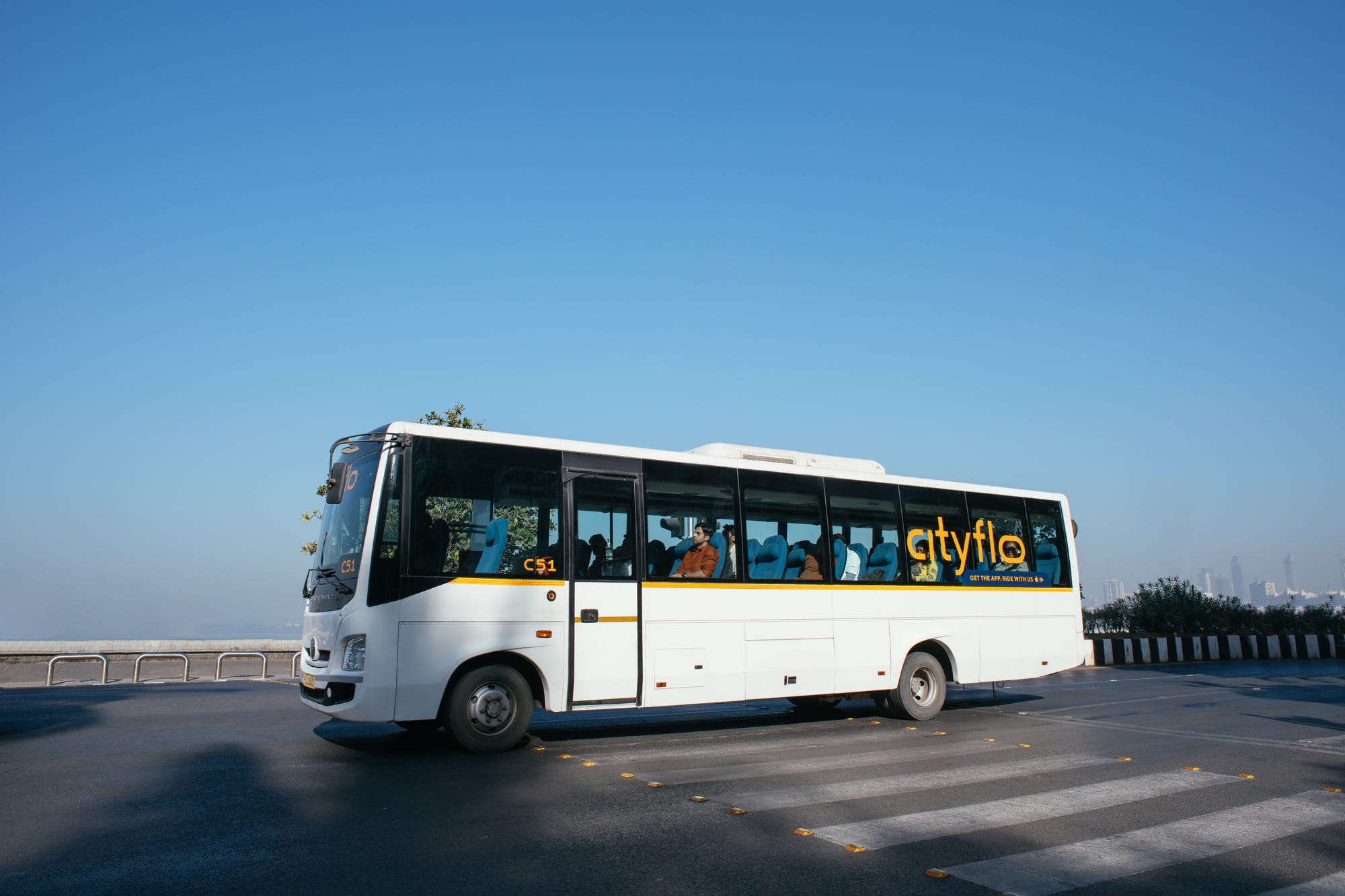
The company ran it without ceremony, and when the operator took it back for other work, discovered what it had been holding: customers demanded to know what had happened to their bus.
The Benz cost perhaps seven percent more to run, and it changed how the service was perceived — partly through a detail civilians never notice.
Its windows were sealed panes of glass rather than sliding ones, a format the industry calls packed glass, possible only when a builder trusts his own air-conditioning. Sealed windows mean silence, cooling, and a bus that looks like it belongs at an airport.
“It looks like a bus that deserves me — that was the customer feeling. You see people reclining inside and think: I want to be commuting like that. And it mattered that we were expensive. If you’re cheap, the same bus doesn’t mean the same thing.”
By the monsoon of 2018, the company had climbed out on its own — fares up, costs down, and the founders, who had stopped paying themselves in the worst months, drawing salaries again.
Four years of scraping had kept the four of them close. It had also left each of them carrying things they had never said to each other.
That monsoon they drove out to Bhandardara, a lake in the hills a few hours from the city, and pitched tents. They describe what followed as the most important night in the company’s history.
Around a campfire, the conversation moved from strategy to confession.
They talked until morning, in every combination — all four together, in pairs, one on one.
Each admitted he was privately certain he contributed less than the other three. Then each sat and listened while the other three described, in detail, what he was worth to the group.
“All our insecurities came out — typical impostor syndrome, all four of us secretly sure we were the weak one. We went through every combination of conversation that night. It flipped a switch. How we work with each other, even today, is grounded in that night. Eleven years in, four founders still together — I trace it to that.”
Rushabh came back from Bhandardara, went to the house of the woman he had been seeing casually — he had admitted his feelings to Sankalp, never to her — and told her. They have been married five years.
Late in 2018, India Quotient — whose partner Anand Lunia had just watched a portfolio company die attempting exactly this business — heard Jerin explain why every previous attempt had failed at the fare, and wrote a cheque of ₹3 crore on the theory that a team which had survived this long on so little had earned another look.
Months later, ZipGo’s patron collapsed.
The Essel Group, which had publicly promised ₹300 crore, hit its own liquidity crisis and turned off the tranches; ZipGo shut Mumbai and Bengaluru in early 2019 and folded its intracity business within months. Cityflo inherited its routes and its stranded passengers, and its daily rides jumped by half in two months.
“You keep flatlining, no matter what happens, and mathematically the inflection has to come. You’re the bear standing in the river. When the salmon jumps, you’re there.”
The nineteenth of March
Lightbox Ventures ran its process like a jury.
Founders who applied pitched the whole firm, which then voted; Cityflo’s application, made in late 2018, produced a term sheet only in October 2019, after months of presentations on every layer of the business.
Sid Talwar, the partner who led the deal, compressed his thesis into five words the founders never forgot: this is Indigo on roads.
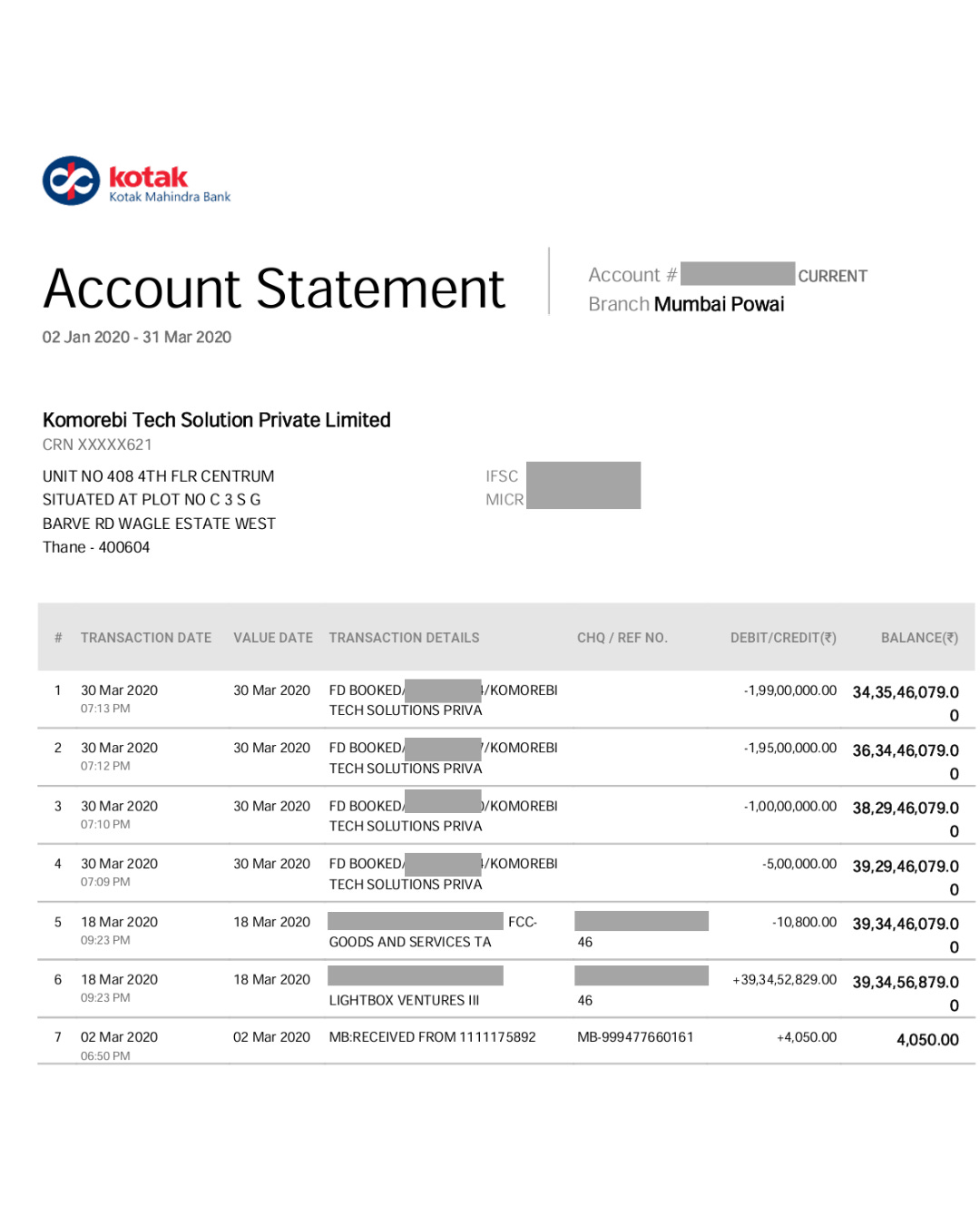
The Series A — ₹57 crore, the first institutional conviction the company had ever received — was wired on the 18th of March, 2020, delayed at the last by a storm over Mauritius that briefly trapped the money mid-route. Jerin spent that day at the ministry office, waiting for a filing to clear.
India announced a national lockdown within days.
Cityflo’s revenue went to zero with a bank account fuller than at any point in its history — the first time in five years the company had held more than six months of runway.
“We had never had more than six months, ever. My wife says the first day she met me, I told her the company would shut down in three months — and that it was always like that, I just never actually shut it. So when the lockdown came, I called the other three and said: we’re surviving, we’re not dying tomorrow, I’ll talk to you later. And I went and slept. People were messaging condolences — a bus company in a lockdown. I felt relieved.”
He messaged Talwar something raw: I don’t know what made you wire it, but thank you; if you had pulled out I’d have been heartbroken, and I’d have understood. The reply: we’re invested for the long term; this pandemic won’t last ten years.
During the pandemic, the company had no one to move, and spent its Series A standing still.
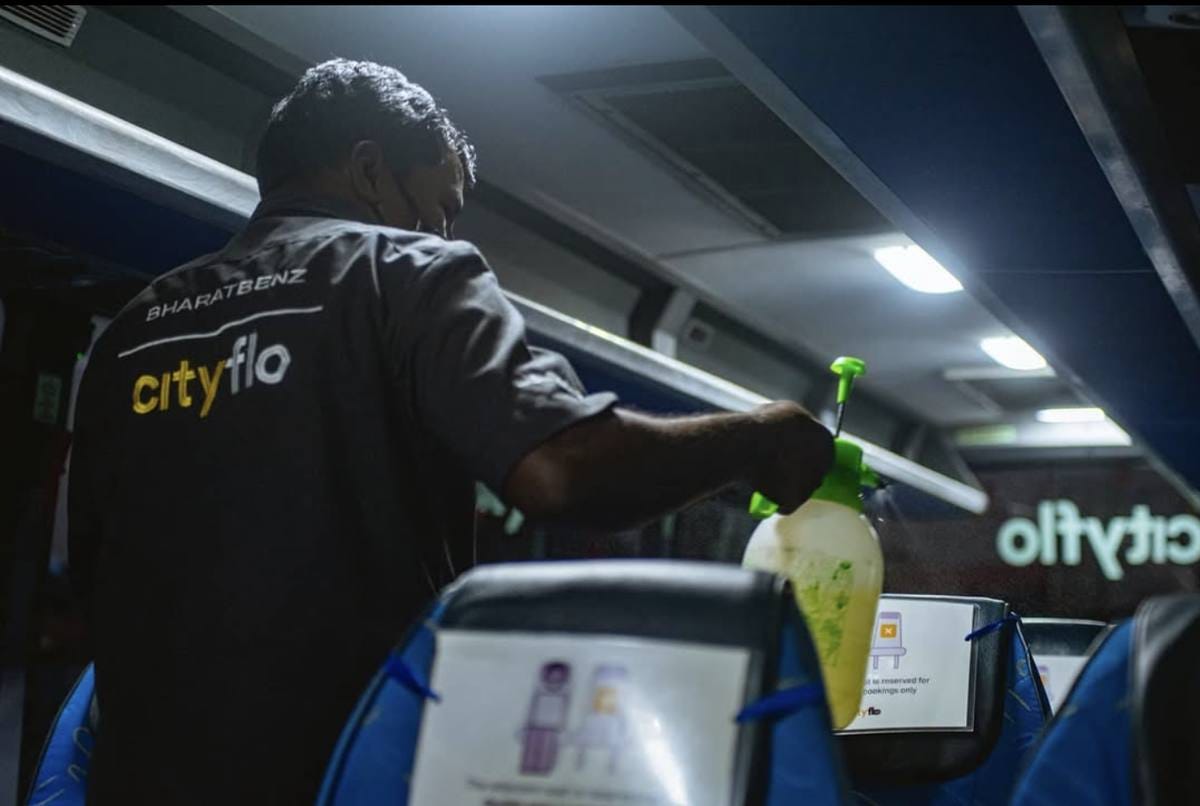
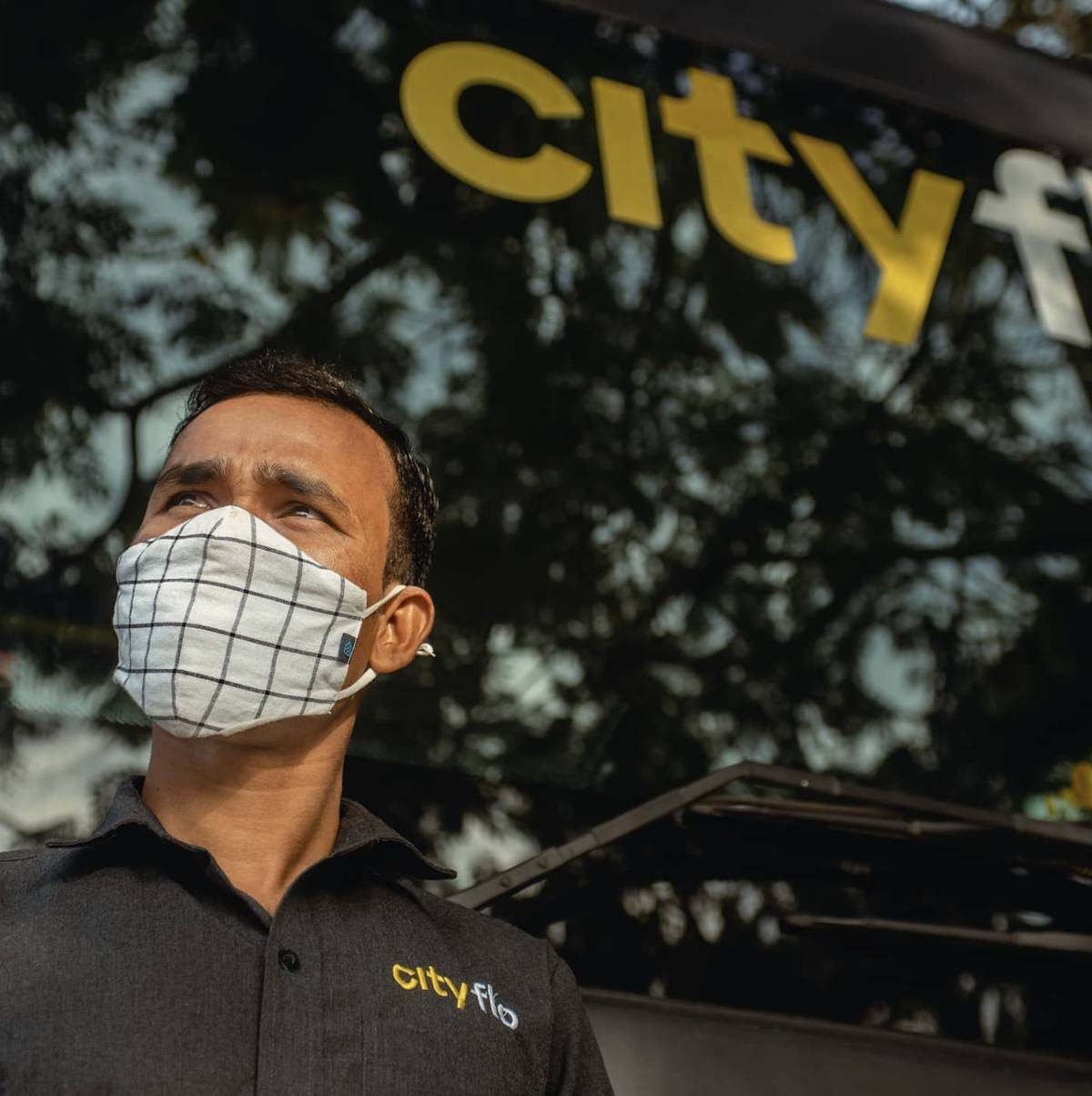
Contracts with operators were paused; the drivers — migrant men stuck in a shut city — could not be. Cityflo raised money from its own customers and delivered monthly rations to every driver in its system for the duration.
It also kept repaying an early bus financier through the RBI’s moratorium, on the logic that the buses had resumed essential runs and the debt was real.
The financier, from an old industrial family, was startled enough that he later insisted on converting his goodwill into equity. Over the whole shutdown, the company lost about ₹22 crore, a fraction of what its scale suggested, and Talwar set the recovery’s only target in a sentence.
“He said: when we come out of this pandemic, we will be the best bus service there has ever been. That was the goal. That was the whole plan.”
Rebuilding to that sentence, with the roads empty and nothing to lose, the company did everything it had been too poor or too timid to do.
A brand studio, Thought Over Design, rebuilt the identity. An interior project rebuilt the cabins toward an airline standard.
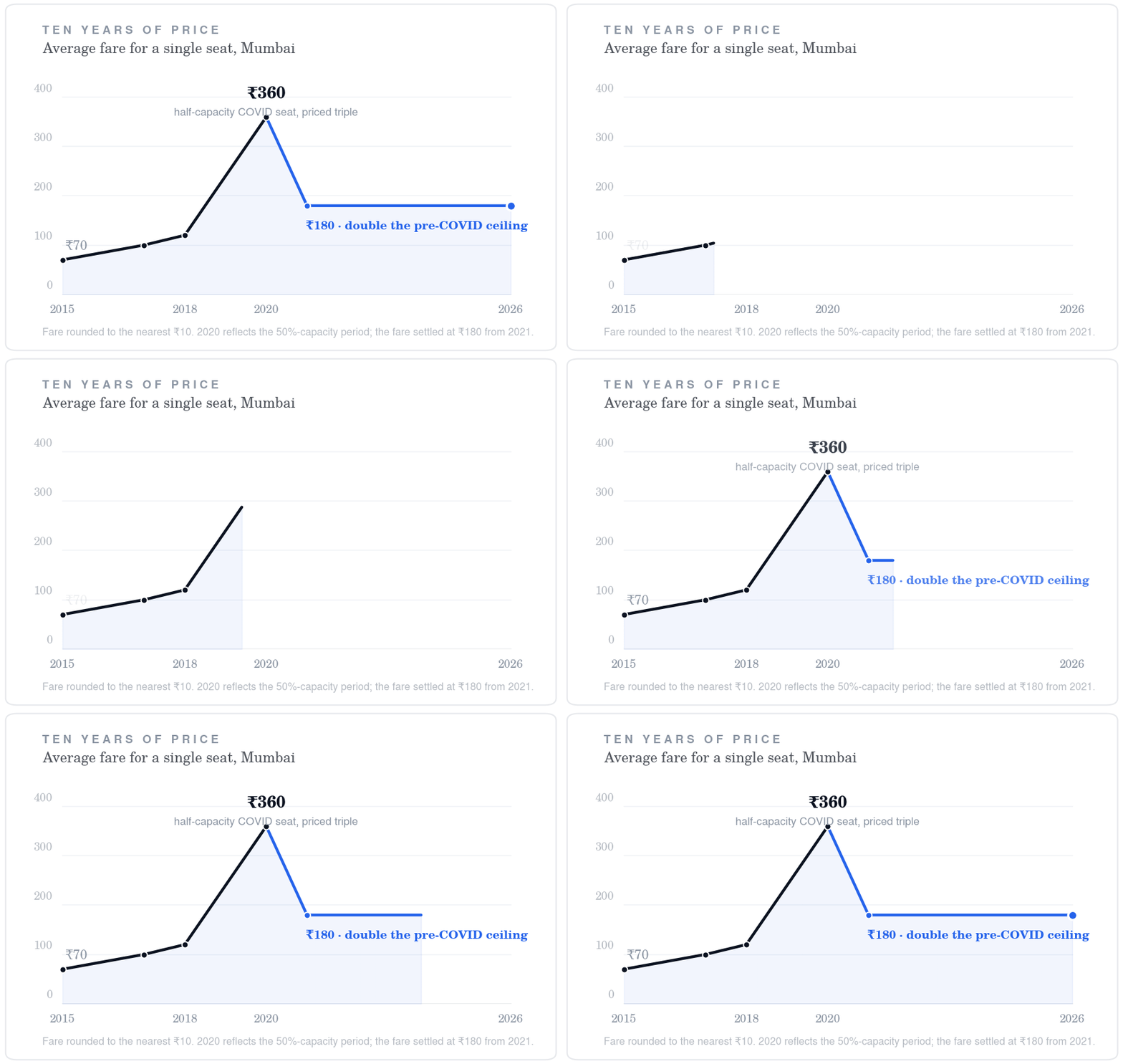
When offices reopened under a fifty-percent seating rule, Cityflo — sworn never to run a loss-making bus again — priced the socially-distanced ride at ₹360, nearly triple its old ceiling.
The buses filled.
“We grew to thirty buses at three-sixty, and we just sat there thinking: how wrong were we, all those years, at seventy? Three-sixty is clearly more expensive than driving. But by then the bus was a gorgeous white Benz, the driver was in uniform, and the promise was airtight.”
When capacity rules lifted, the fare settled at ₹180 — double the pre-pandemic level — and the arithmetic finally worked.
Eighteen of thirty-five seats covered a bus’s costs; at seventy percent occupancy, the business earned a gross margin near twenty-five percent, which, in a company that spends almost nothing on marketing, behaves like a consumer brand’s thirty-five.
Revenue climbed every year after that: about ₹10 crore in FY21, then ₹20 crore, ₹40 crore, ₹60 crore, ₹80 crore — held back only by how many buses the company could put on the road.
“We are a lower-middle-class startup. An Indian housewife running a company. We know how to make the money stretch.”
The shutdown returned a different company.
Before the pandemic, one bus in five was a Benz; after it, they all were, and the average fare had permanently moved from ₹120 to ₹180.
Five rupees a kilometre
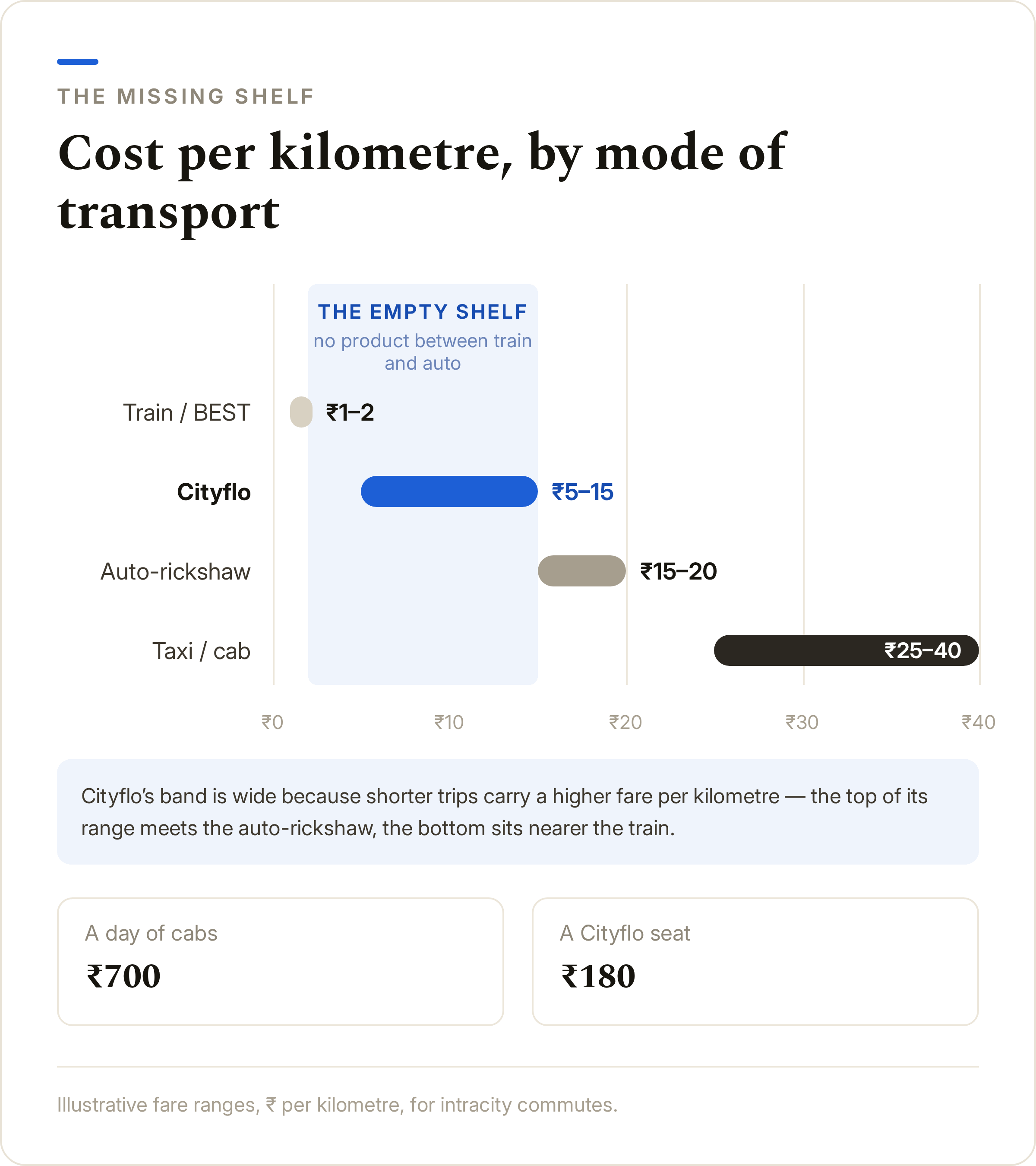
The market gap is specific: journeys of ten to twenty-five kilometres at five to six rupees a kilometre.
Below that price sits public transport, with its crowds and its last-mile walk. Above it sit autos at ₹15–20 a kilometre, fading out by the tenth kilometre, and cabs at multiples more.
For the daily office commuter — too far to ride a two-wheeler, too squeezed to burn ₹700 a day on cabs, too settled to stand in a train — there was no product at all. Cityflo’s route network is that missing shelf, built corridor by corridor.
“There are fifteen commercial clusters in Bombay and about fifty residential hubs — any thirty thousand households is a hub for us. Fifteen into fifty: seven hundred and fifty routes. That’s the whole market map. We run seventy.”
The unit of the business is the route, never the bus. A single bus on a corridor fails no matter how good it is — which is precisely what kept three generations of local operators from ever building this.
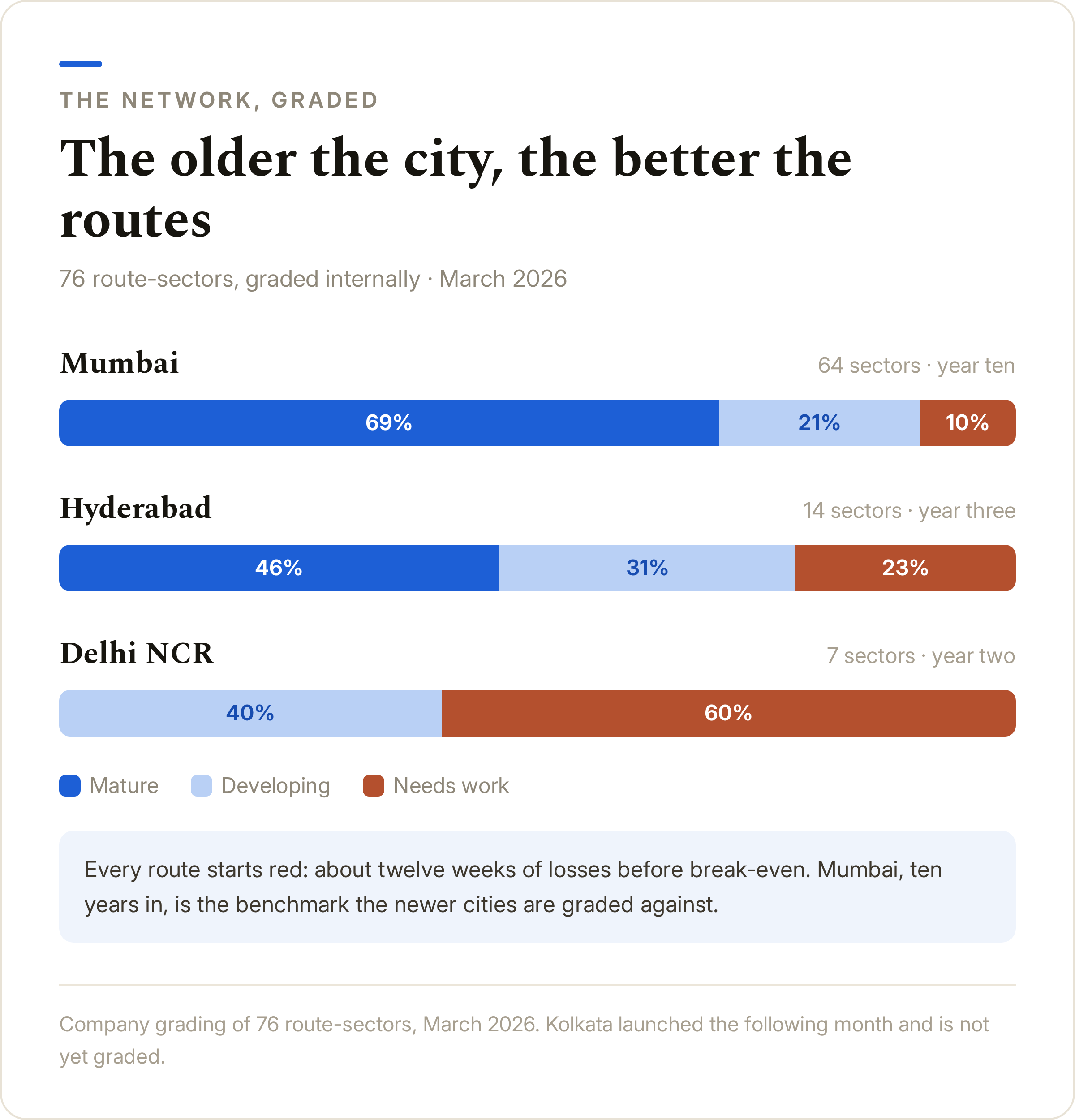
A route needs five to ten buses before it exists in a commuter’s mind, so every launch runs at a loss for about twelve weeks, then breaks even, then earns for years.
The bus itself belongs to someone else.
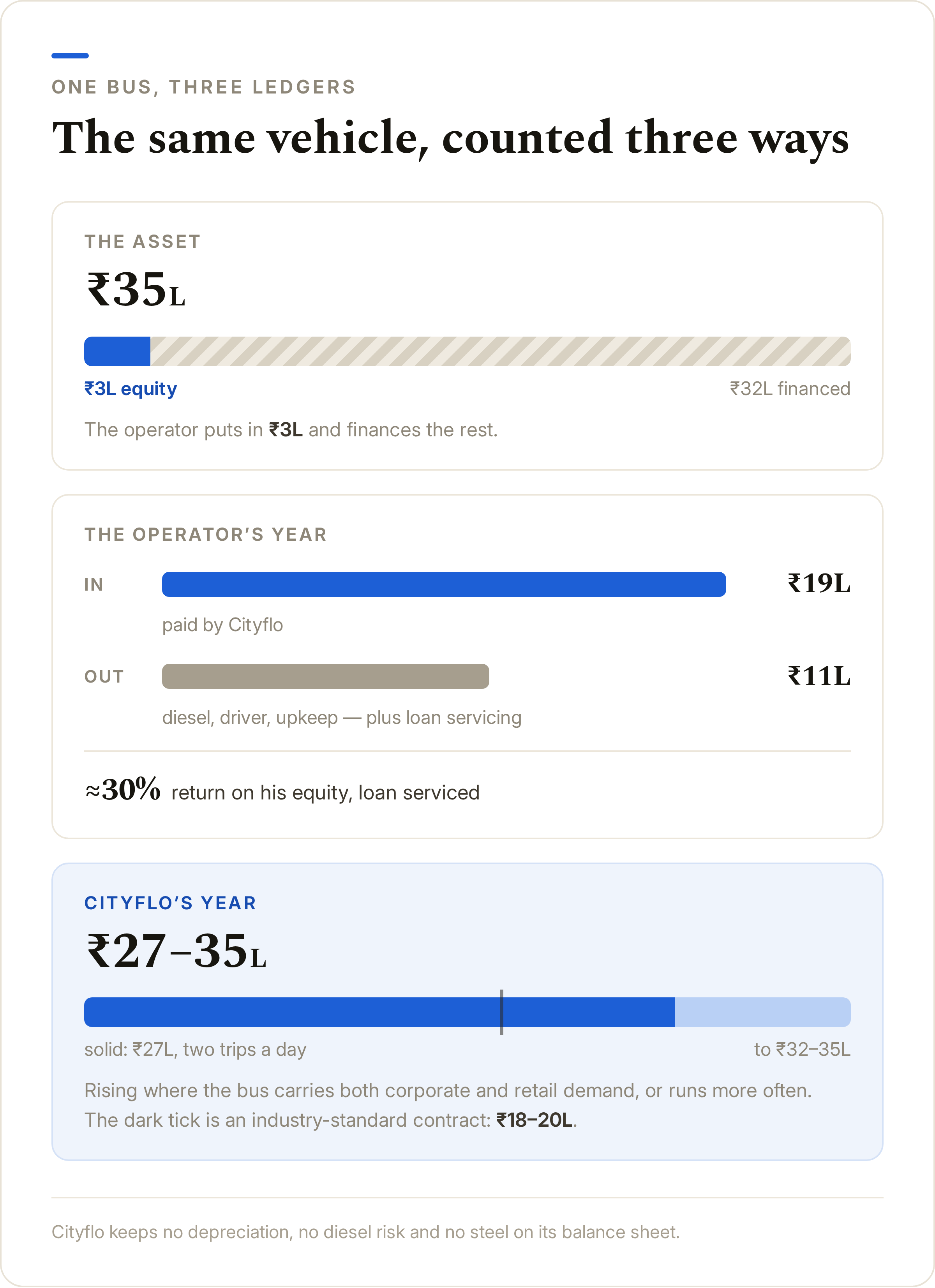
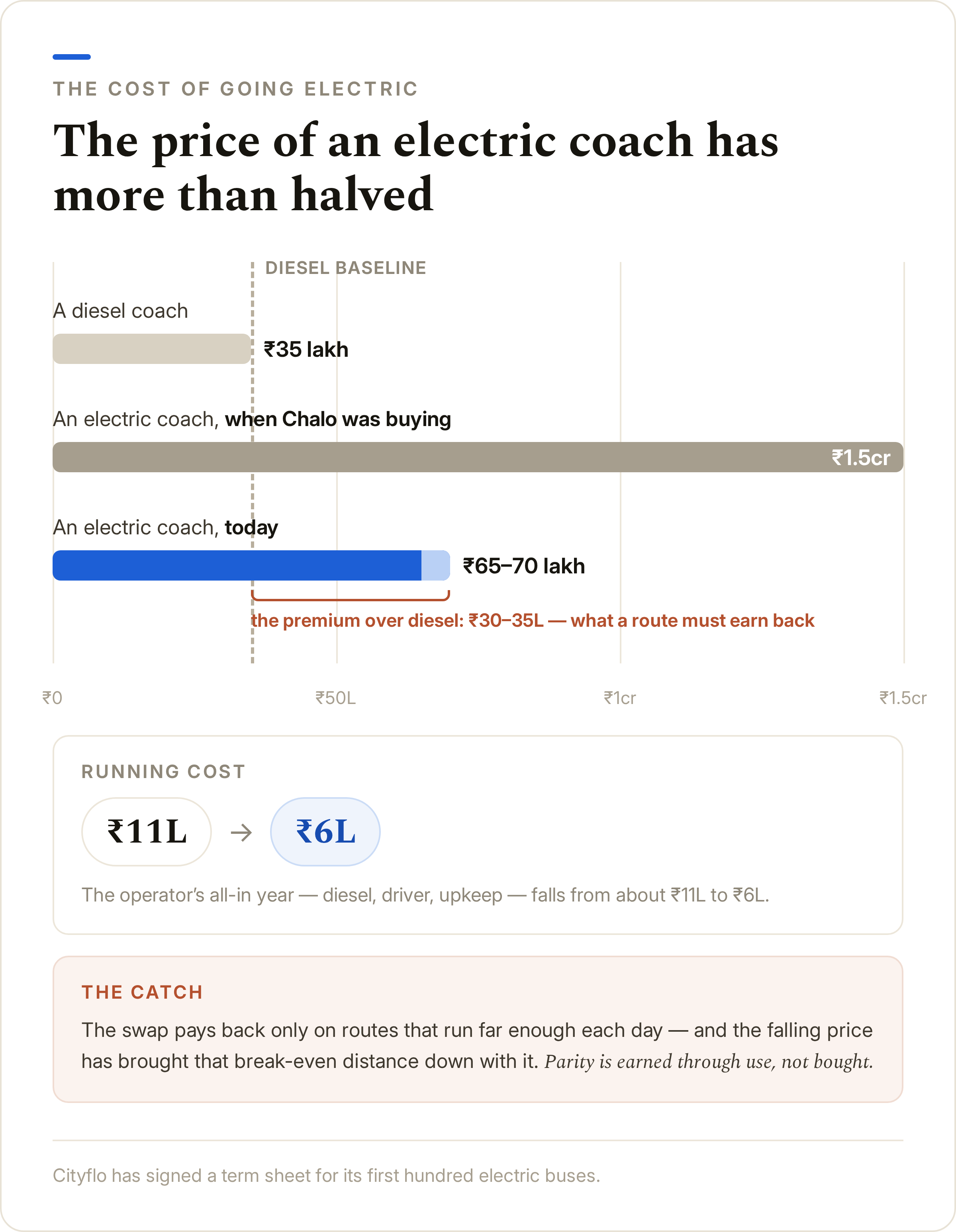
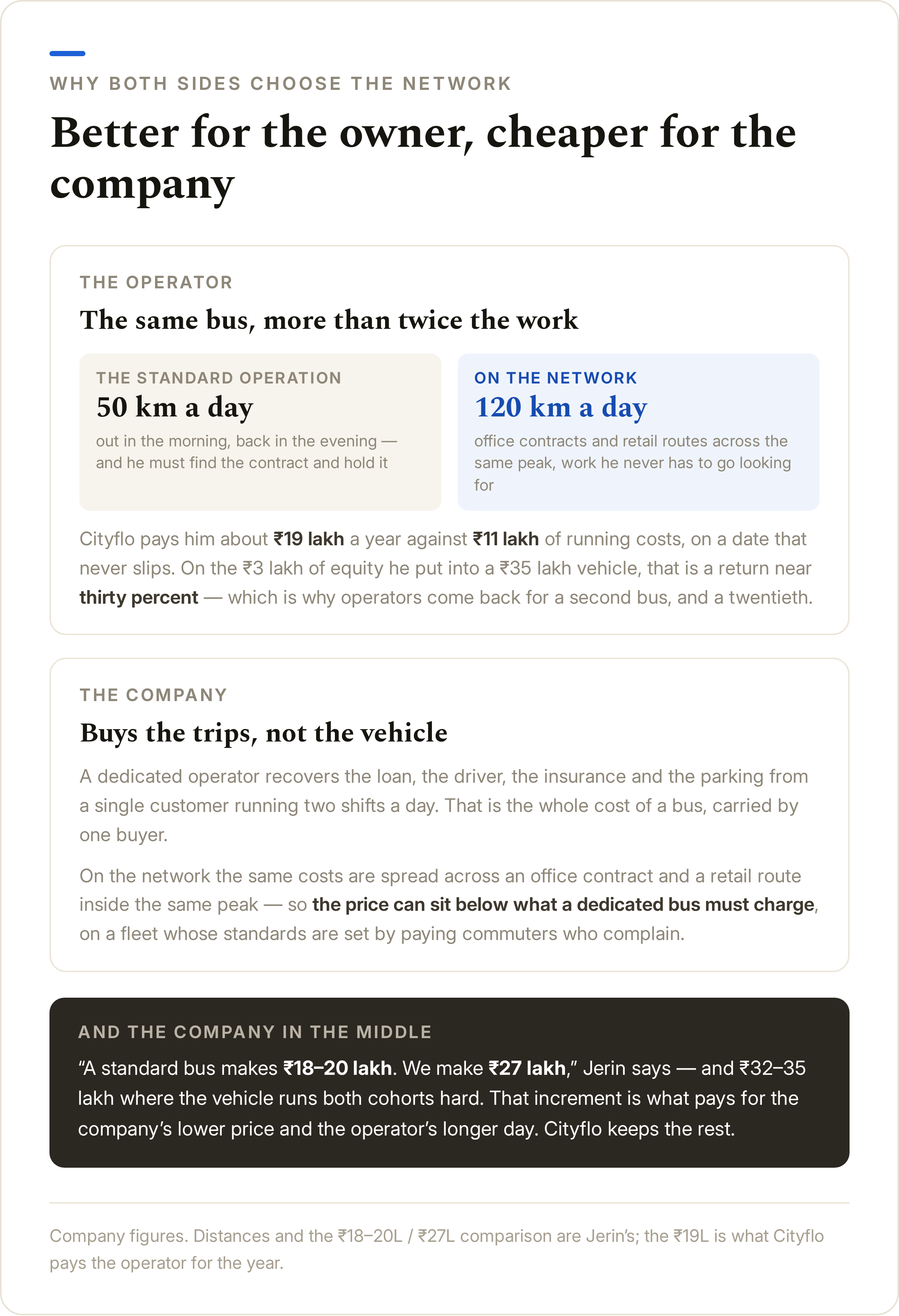
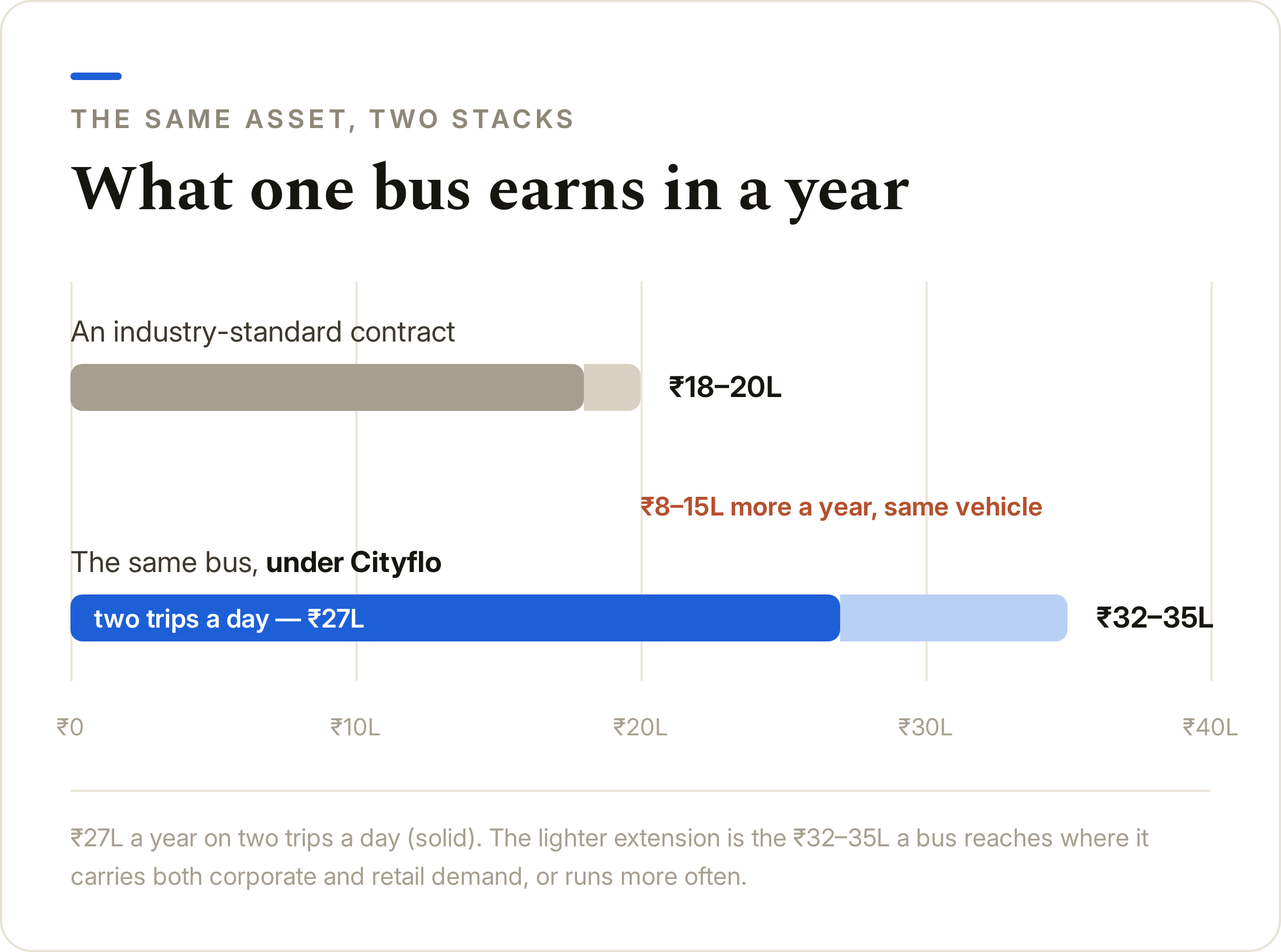
An operator puts ₹3 lakh of equity into a ₹35 lakh vehicle, finances the rest, and hands it to Cityflo, which pays him about ₹19 lakh a year against his ₹11 lakh of running costs — servicing his loan, returning roughly thirty percent a year on his equity, and leaving him, after five years, with a debt-free asset worth more than his original stake.
Cityflo earns about ₹27 lakh of revenue on that same bus on two trips a day, and ₹32–35 lakh where it carries both corporate and retail demand or runs more often — against the ₹18–20 lakh an industry standard contract earns.
The company keeps no depreciation, no diesel risk, and no steel on its balance sheet; what it keeps is the demand, the standards and the brand.
“It’s just an ROI machine. There’s a twenty percent engine sitting in owning the bus — that’s the operator’s, and he’s welcome to it. My return sits on the engine above it. We have operators on their third cycle: one bus, then five, then twenty. He doesn’t have to think about anything else.”
Around that core, the model stacks advantages.
Eighty-five percent of rides are prepaid subscriptions, so customers fund the company — the negative working capital Dixit had to explain to its own founders — and roughly ₹4 crore of passenger money sits with Cityflo at any moment.
Marketing has never crossed two percent of revenue, because a fleet of white buses crossing BKC every morning is its own billboard, and commuting is a topic Mumbaikars discuss unprompted.
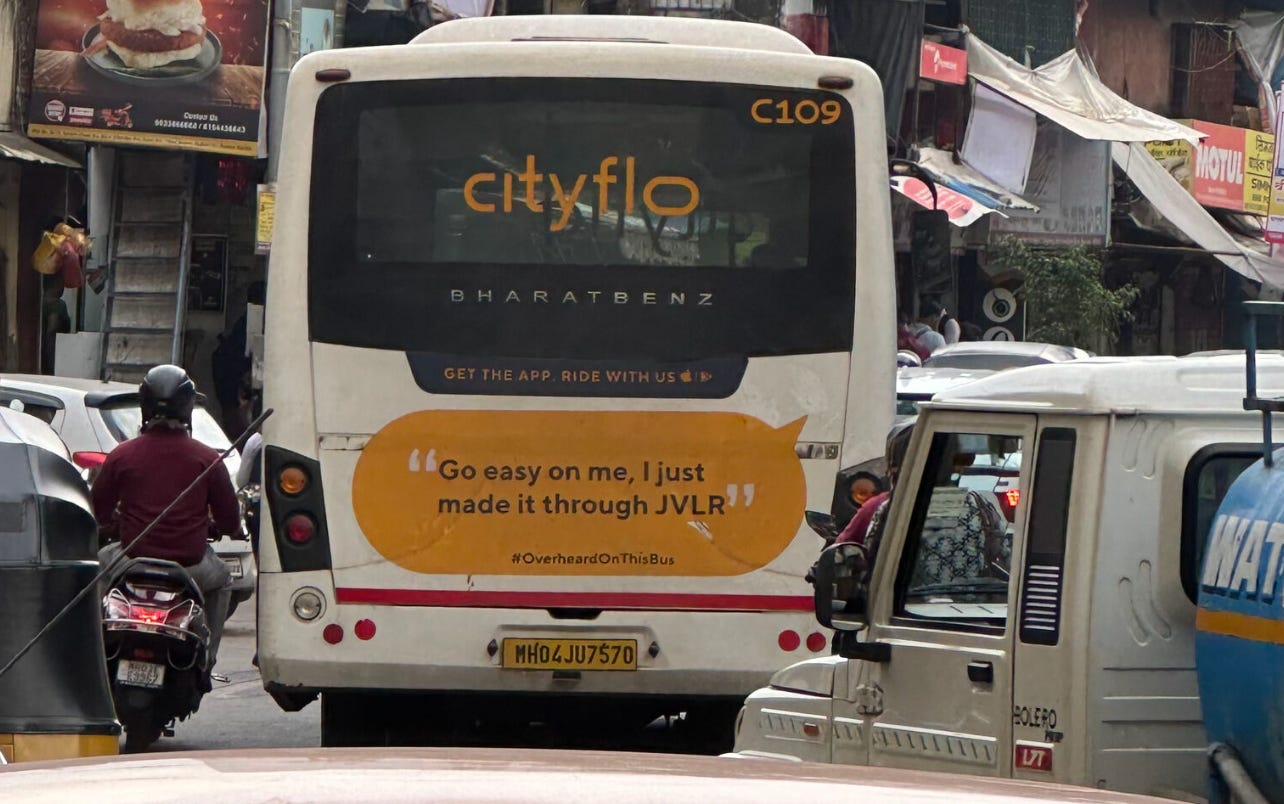
Advertising on the buses, once resisted as beneath the brand, now flows nearly untouched to the bottom line. Even fuel costs help: when diesel rises a rupee, a car-owner’s per-kilometre cost climbs ten paise while a thirty-passenger bus’s climbs one, so every price shock widens the gap between Cityflo and the car.
The company measures itself on a metric it invented, the Perfect Ride Score: the share of rides where nothing went wrong — booking, seat, timing, tracking, air-conditioning, driver. It currently runs at 84 percent.
“Reliability is the whole brand. I’m there every day, or I’m not your commute. We’re building it to the point where if we fail you, we pay for your Uber — end of discussion.”
The reliability shows up as loyalty. About seventy riders have crossed a thousand rides; a Thane regular is past two thousand, and updates Sankalp on his surgeries.
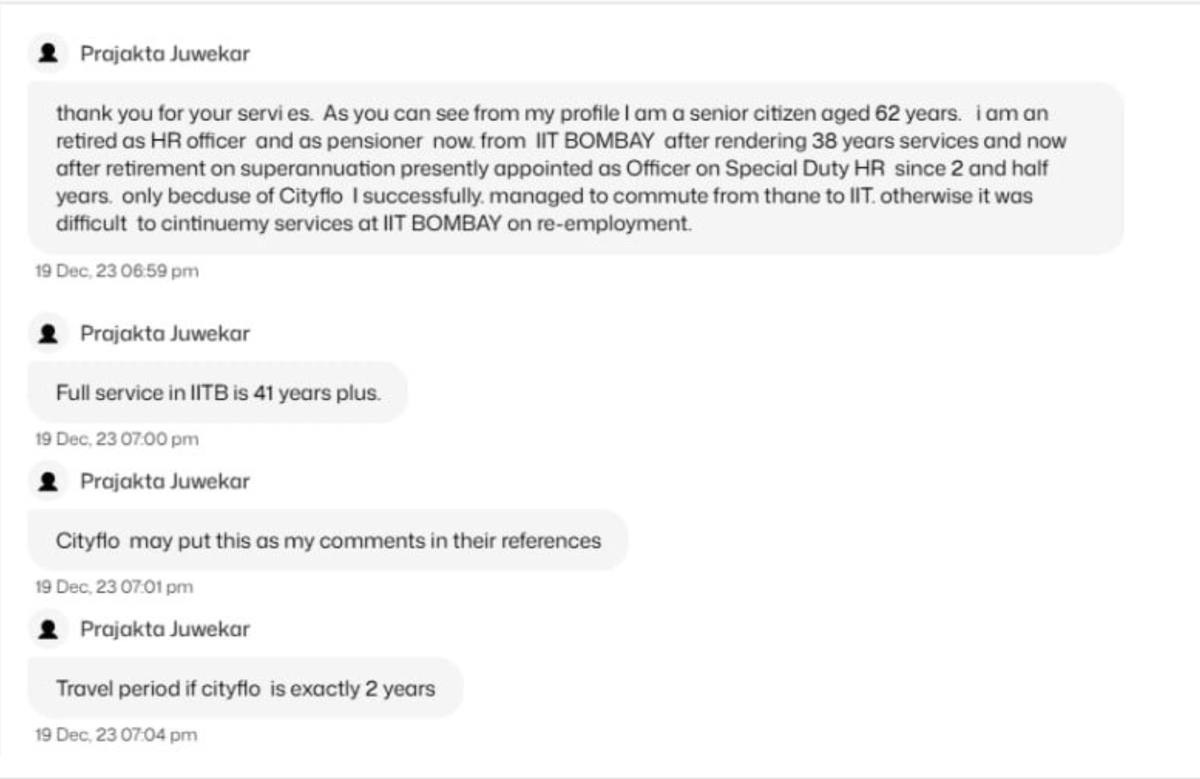
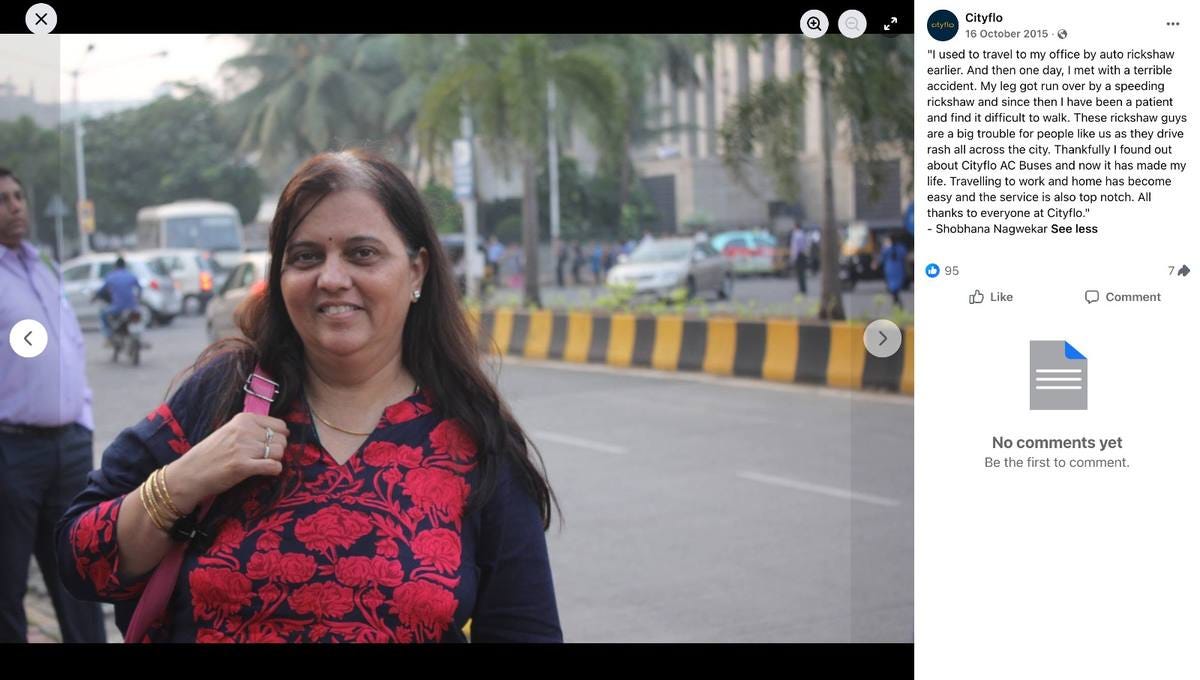
For some it was the difference between working and not.
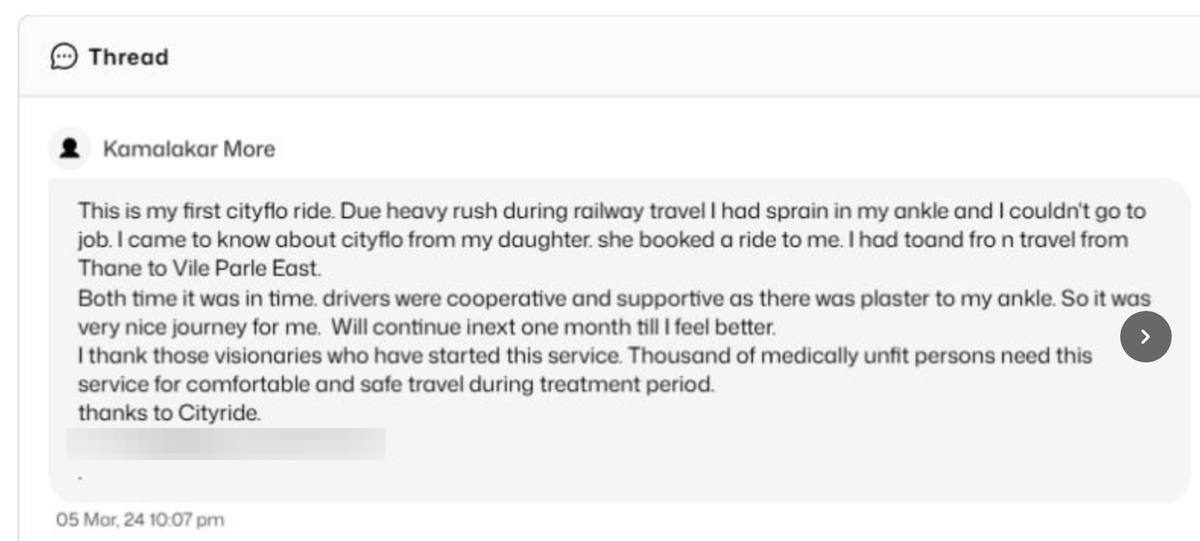
“One of our earliest customers was a woman with a leg injury who told us she’d have taken voluntary retirement without the service — she used it until the day she retired. Her son wrote to me last year, after she passed away, just to say thank you.”
The newest layer is yield. A mentor from the airline world pointed out that with fixed inventory, a single price leaves money on the table the company will need in bad years.
The same seat on the same bus now sells at different prices to different riders: full fare for the occasional rider whose alternative is a cab; cheaper on a monthly pass; cheaper still on a quarterly commitment; and cheapest of all for the young employee willing to book only in the last thirty minutes before departure, taking whatever is left.
“He said: your inventory is fixed — you cannot maximise yield without playing on pricing, and it doesn’t have to touch your premium positioning. Even in the corporate world there are people who cannot pay six thousand a month for a commute; it’s the same bus either way. And he told us — whatever monopoly you get on a route, earn it. Because the day competition comes, you won’t earn. Keep it for that day.”
A better bus at a third of the price
The moat got its real test in 2023, when Chalo — a bus-technology company roughly ten times better funded, running ticketing for thousands of public buses — entered Cityflo’s market under a BEST partnership, with brand-new electric coaches.
The new buses were, Jerin says flatly, better than his: quieter, wider, smoother.
For a year the two coexisted, because Chalo priced with the intention of someday earning money.
Then a new manager arrived on the rival side with a simpler brief — fill the buses — and monthly passes dropped to roughly ₹3,000 against Cityflo’s ₹8,000.
“That was a real attack — a bus five times sexier than yours at a third of the price. The routes started shaking. We’d never seen that kind of drop-off. Somewhere there was a limit to the moat — and this was it.”
The response came out of a book — Milind Lele’s Monopoly Rules, absorbed during the Buffett years — and it was retreat.
“There may be glory and honour in winning a battle, but there are no margins in winning a battle. Everyone comes out bloodied. We didn’t have the money to fight, so we gave ground on those corridors and built profitable routes elsewhere, and funnelled the money back. My team hated some of what we did. We sold ad space on the buses we’d sworn to keep clean. We ran corporate contracts we’d once called a bad business. We did what the situation demanded.”
The improvisation became a second business.
Corporate India had been waiting for exactly this operator: a brand that white-collar admins already rode to work, run by a company whose record stood up to procurement.
The corporate line went from nothing to about ₹40 crore of annual run rate in six quarters. The constraint on it is a rule of corporate life the founders find blackly funny.
“Every single one of them wants to work with you — it’s overwhelming. What holds them back is a structural inability to pay more for transport. The admin goes to the CFO and comes back with: why are you paying more, nobody pays more for transport. And then the same admin tells our team — in four months I have not once woken up at 6.45 wondering if the bus will break down. That is what they’re buying. It just doesn’t have a budget line.”
The rival’s economics — costlier buses, subsidised contracts, discounted fares — burned money at a rate no board sustains for long.
Chalo narrowed back towards the business it had built first, the ticketing and tracking systems it runs for public bus fleets in more than twenty-five cities, and the pressure eased. It still operates around a hundred electric buses, some of them on Cityflo’s own corridors.
Uber, which had entered Indian bus aggregation in 2024 with the familiar playbook of cheaper fares on adequate buses, wound the experiment down city by city and left its last Indian market in March 2026, refocusing on corporate employee transport. Jerin has stopped celebrating these exits; he has seen too many.
“Competition expands the market — they market the category with their money, and when they leave, the route is bigger than before them. But every serious attempt also teaches you the same lesson: this is an execution game. The giant’s strength is a simple, beautiful marketplace model, and that’s exactly what fails here. You have to construct the route. Be five minutes late on five days and I am never using your service again. If the bus is not clean, or the driver talks to me rudely, I am never using you again.”
One more lesson is seasonal. Demand rises and falls through the year, and Jerin can now read a rival’s morale off the calendar.
“The mood inside competing companies is lowest in November and December, because Ganpati, Dussehra, Diwali and Christmas are four months where this business gets hit. April, May, June you climb beautifully, so by July you’re exuberant, you add buses — and then the tide goes out and you think you’re failing while Cityflo is winning. It’s neither. It’s the nature of the business. It took us three years of planning cycles to see it, ten years in. For a newcomer to learn this costs two or three full cycles.”
Ad business
The other thing the team hated turned out to be the most profitable line in the company.
The idea arrived through Rushabh’s father, who knew a watch dealer with a long history of advertising on Mumbai’s public buses. He had put Swiss brands on the side of a BEST coach — a full wrap, the window doing duty as the dial — and he thought Cityflo was sitting on something better. The founders went to see him and came away persuaded.
They tried selling it themselves through 2024 and into the first quarter of 2025, choosing brands they liked: Atomberg, GIVA, The Whole Truth.
Campaigns came in bursts rather than months, and the permits, printing, pasting and removal took most of what arrived.
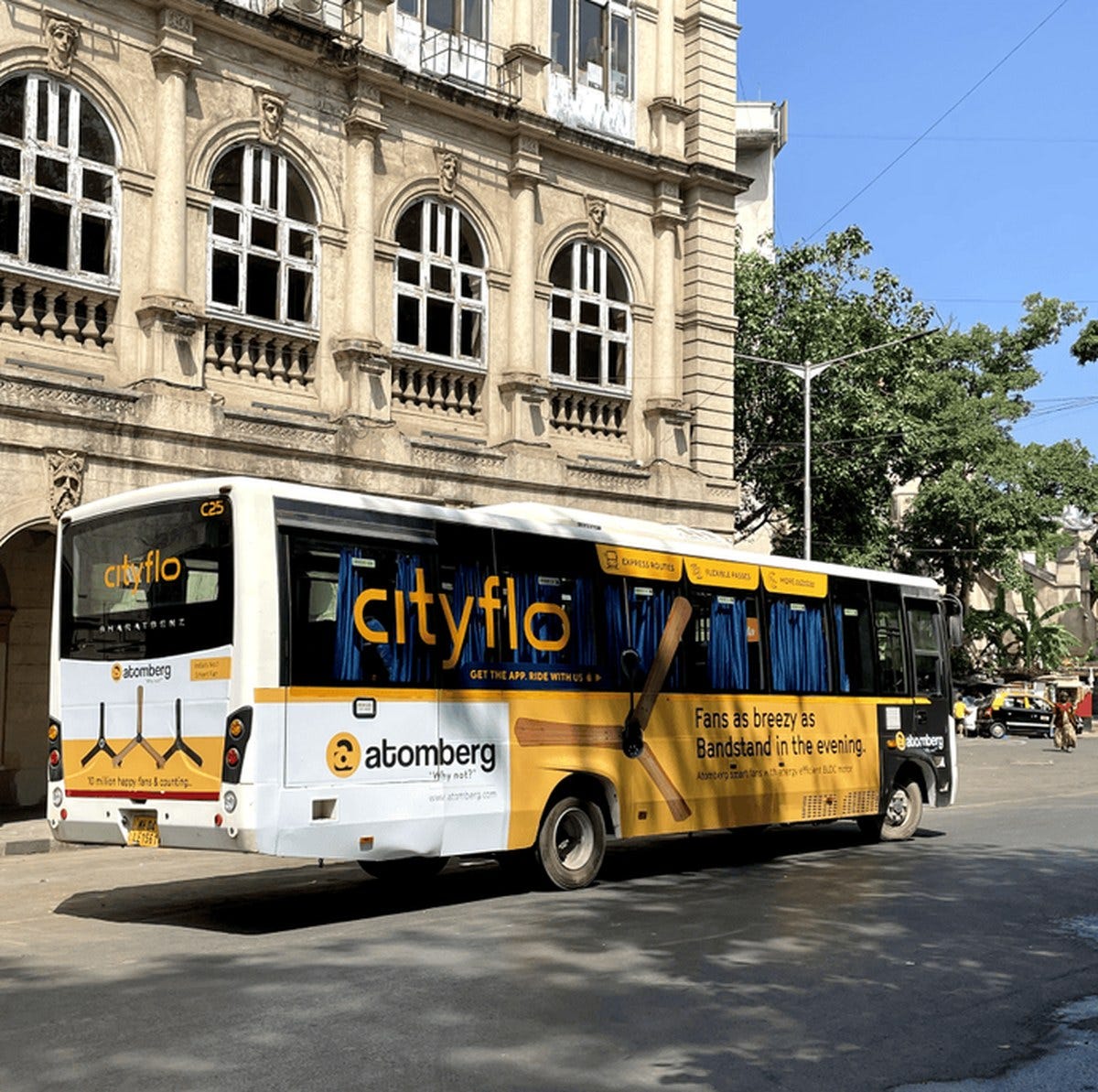
In April 2025 they handed the selling to Signpost, an outdoor-advertising firm that already sold the city’s public-bus inventory and whose own clients had begun asking for Cityflo specifically.
Signpost buys the fleet’s inventory outright at a fixed rate per bus per month, carries the permits and the production, and sells it on to advertisers at a margin of its own.
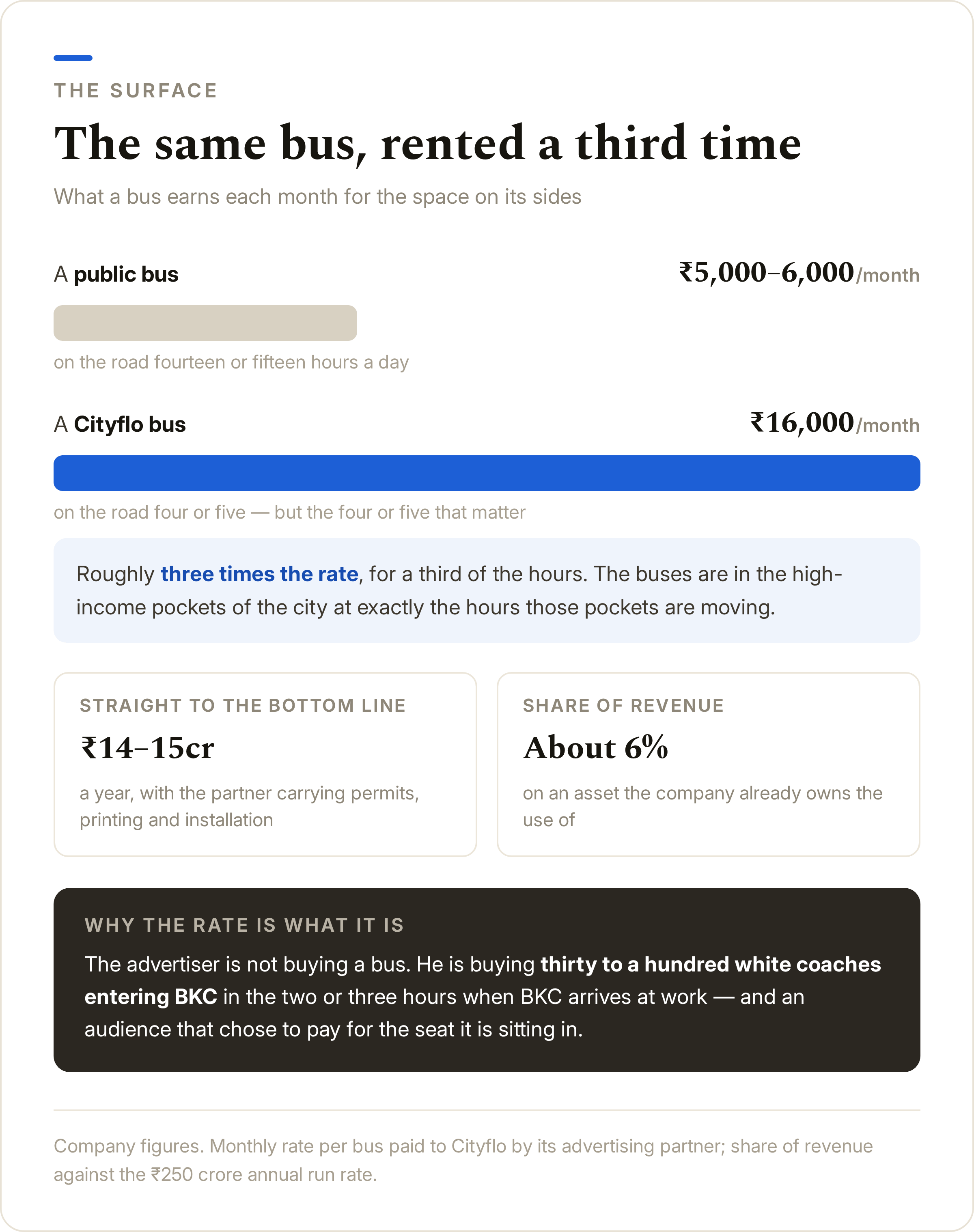
A public bus earns five or six thousand rupees a month for the same surface, and it is on the road for fourteen or fifteen hours against Cityflo’s four or five.
The rate is roughly three times higher for a third of the running, because of who is watching and when.
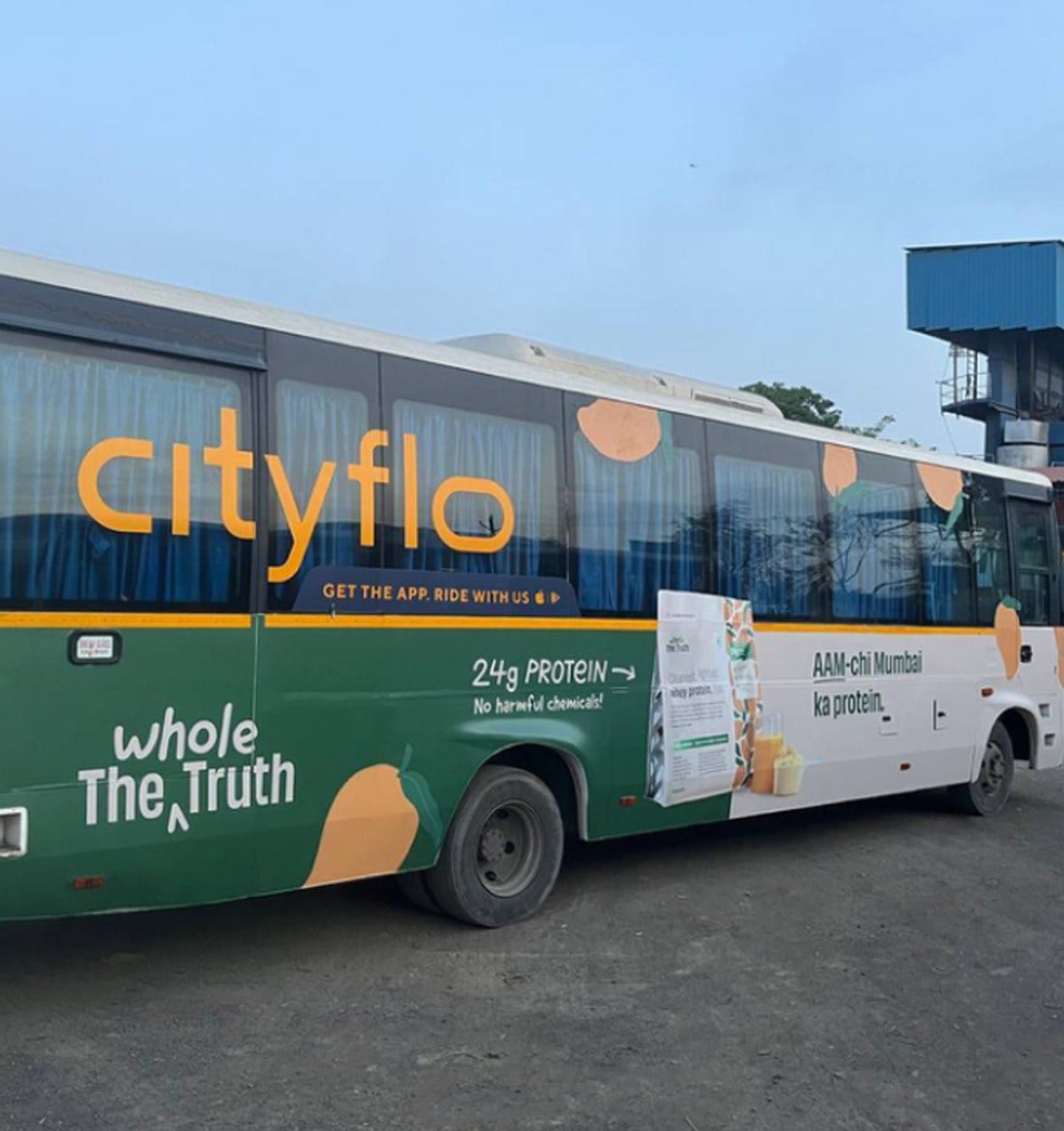
“Think about the route network. There are thirty, fifty, a hundred Cityflo buses entering BKC in the two or three hours when people are coming in, and it gives you visibility in all the high-income pockets of the city. It is impact media. If you buy twenty Cityflo buses in BKC, everyone in BKC will know you.”
It is the premium positioning collecting a dividend in a market the founders were not trying to enter. A brand built to justify a ₹180 fare turns out to carry a brand on its flank at a price no ordinary bus commands.
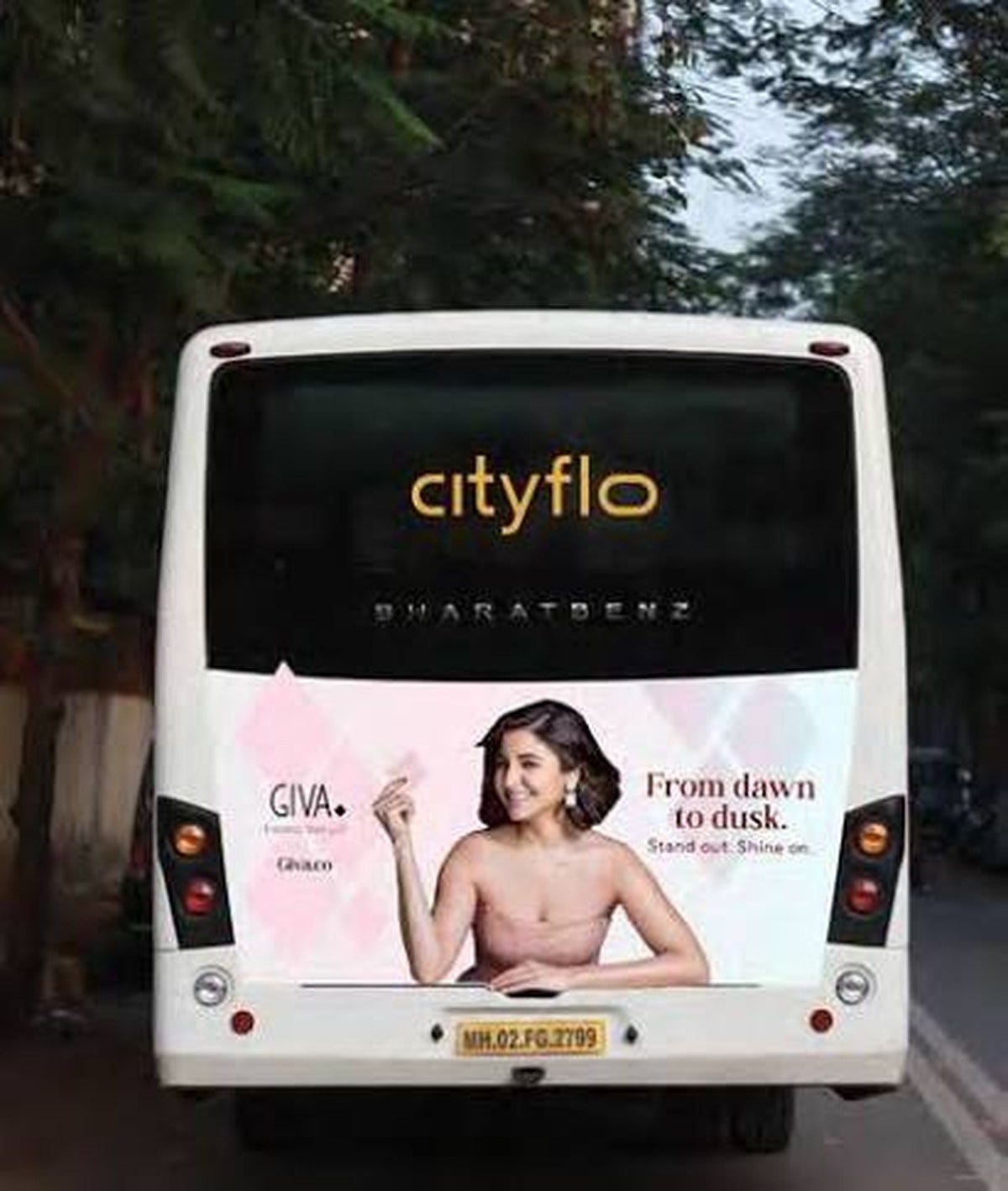
“By building a premium brand first, the ad on that is now a premium ad.”
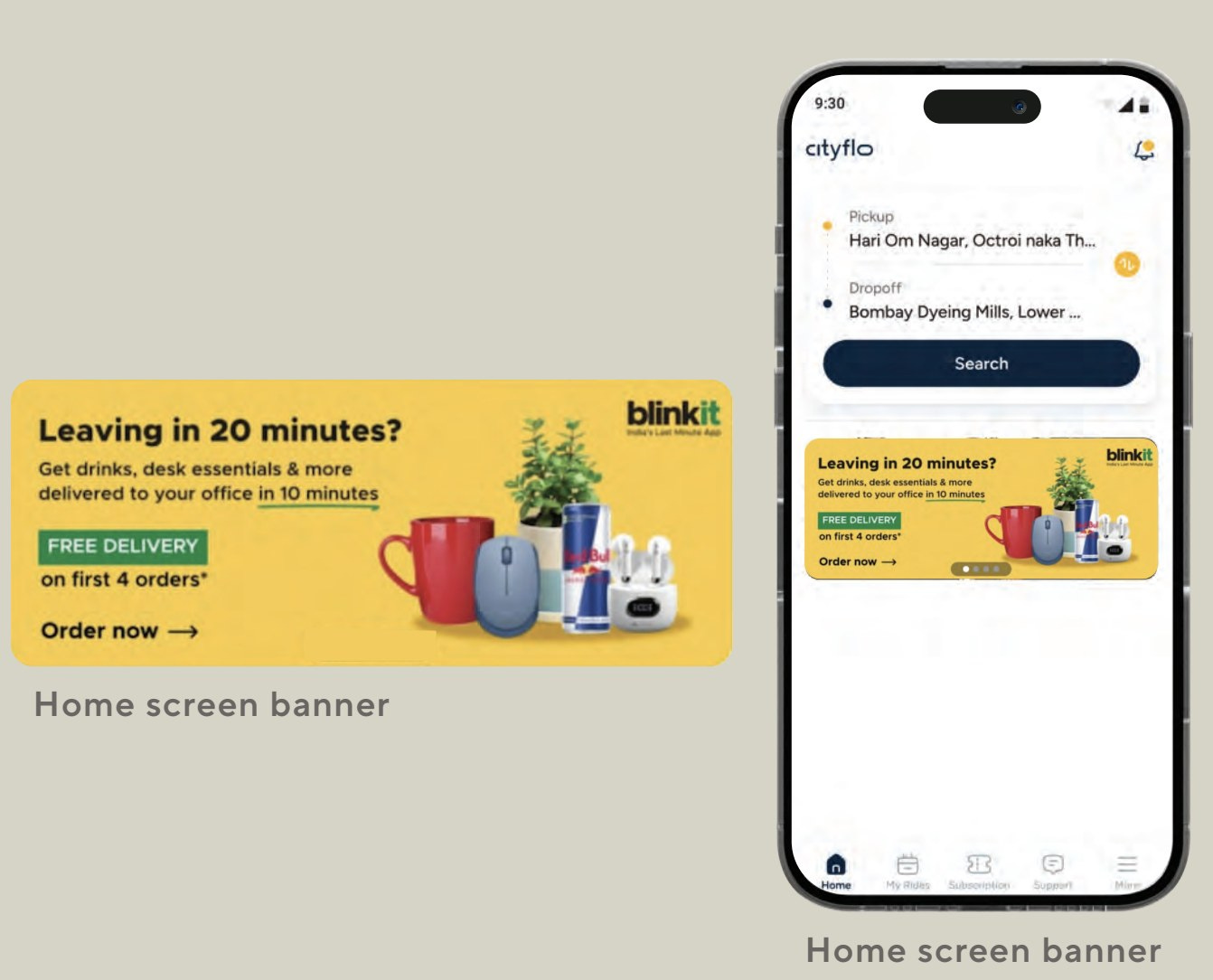
The inventory is not only the outside of the bus. A panel sits on the back of every seat, and the app carries a banner on its own home screen.
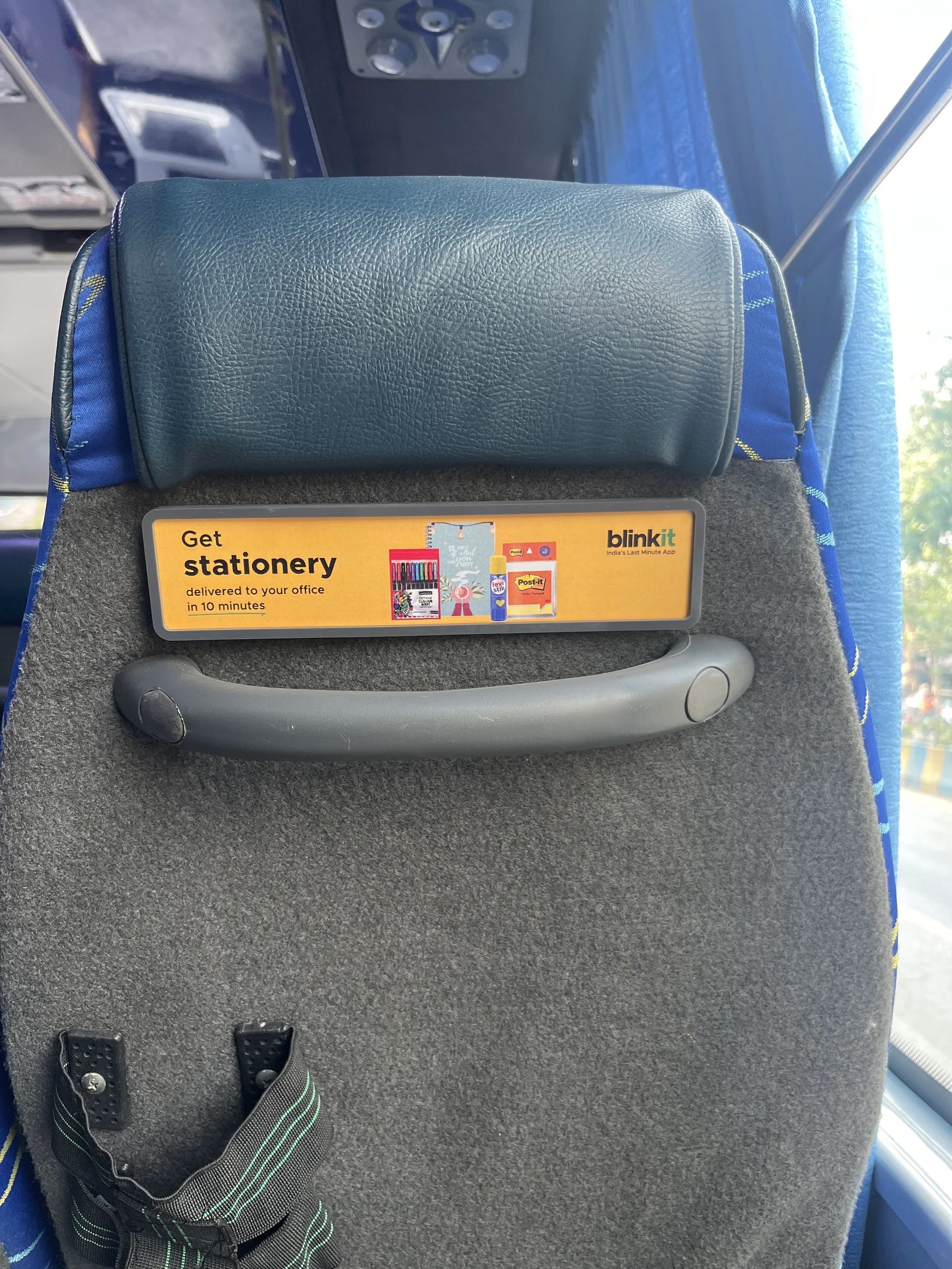
That makes the advertising unusually literal.
The seat-back offers stationery delivered to your office in ten minutes, to a rider travelling to that office; the banner in the app asks whether you are leaving in twenty. What is being bought is not an audience in general but a commuter at the moment of the commute.
The partnership opened with two hundred buses in Mumbai and went national inside a year. Hyderabad was expected to be the weak market — it launched at sixty percent of Mumbai’s rate on the assumption that nobody there would pay — and then sold out its entire inventory for twelve months, with the partner asking when more buses were coming.
Kolkata was two months old with advertising on all two hundred and fifty of its buses. The Tempo Travellers the company had refused to brand went up once the larger inventory ran short.
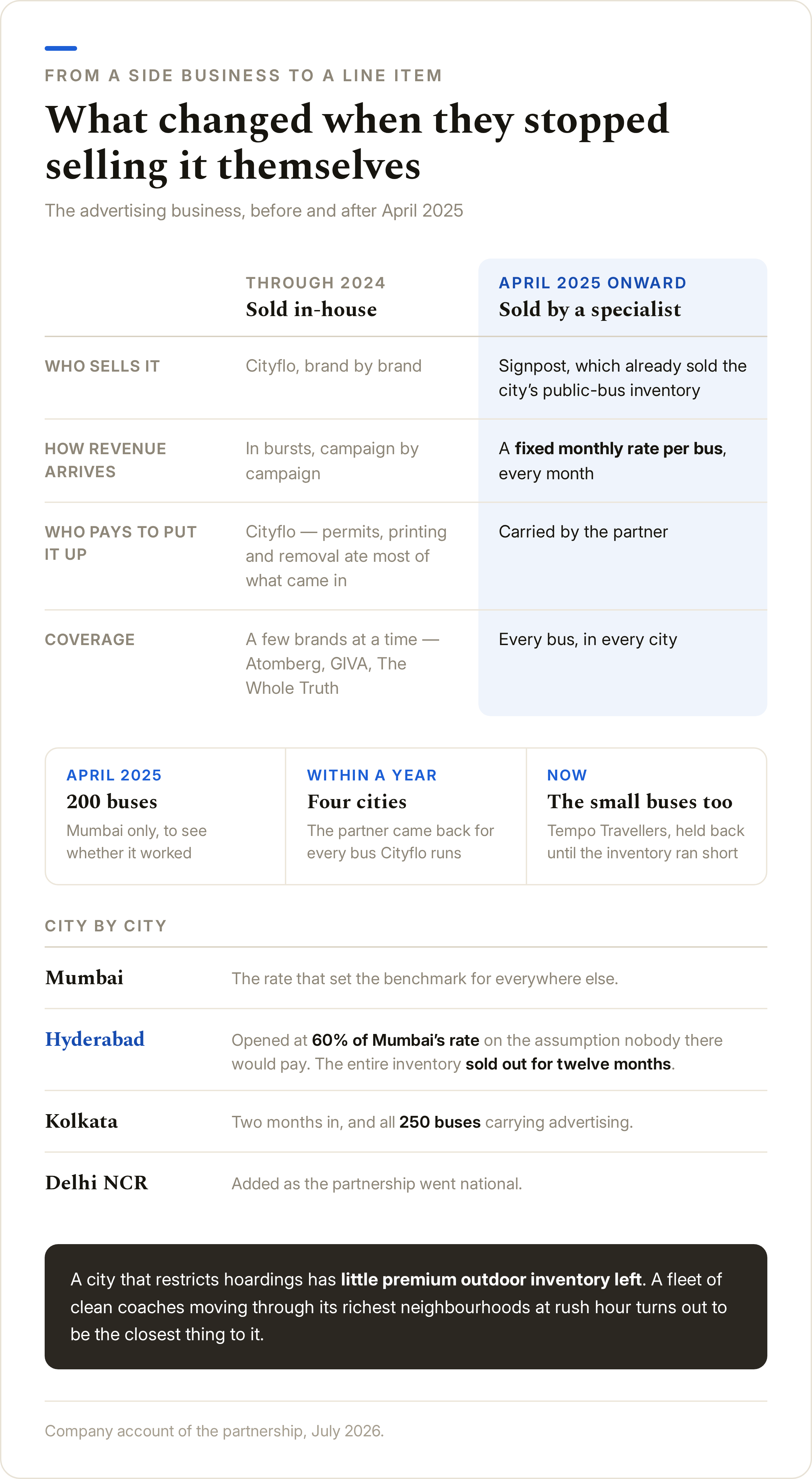
There is a structural bet underneath it. Cities that grow tend to permit fewer hoardings, not more, which leaves less premium outdoor inventory each year.
A fleet of clean white coaches moving through the richest parts of a city at the hours it goes to work is, as Jerin puts it, the new billboard — and one that no competitor can assemble without first building the network underneath.
Sharing scale economies
A staff bus is bought for one contract. It carries a company’s employees in at nine and out at six, and stands in a yard for the hours between.
The operator who owns it has to recover the loan, the driver, the insurance and the parking from that one customer — who is paying for a whole vehicle to make two trips.
About one and a half lakh of India’s twenty lakh buses run this way: one asset, one customer, one shift. Cityflo spent a decade refusing to be in that business.
“The B2B business as it is was too unattractive for us to put our lives behind. That ROE, that margin — I’m not going to do it.”
What changed the arithmetic is a fact about cities rather than about buses. A commuter’s own journey takes about two hours of the morning.
The city’s morning peak runs four or five, because offices in different parts of it do not start at the same time. The same is true again in the evening.
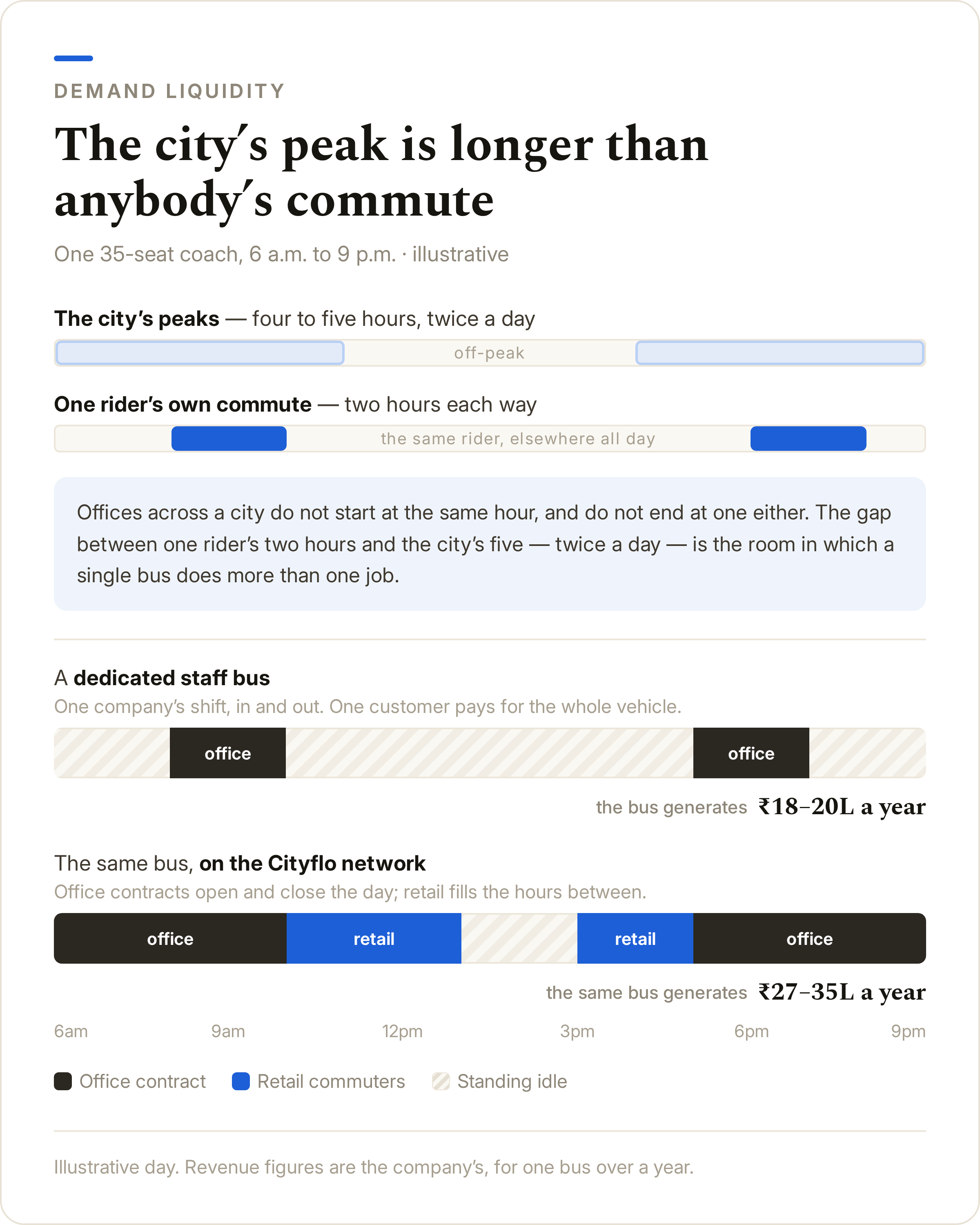
That gap — between one rider’s two hours and the city’s five — is the room in which a single bus does more than one job.
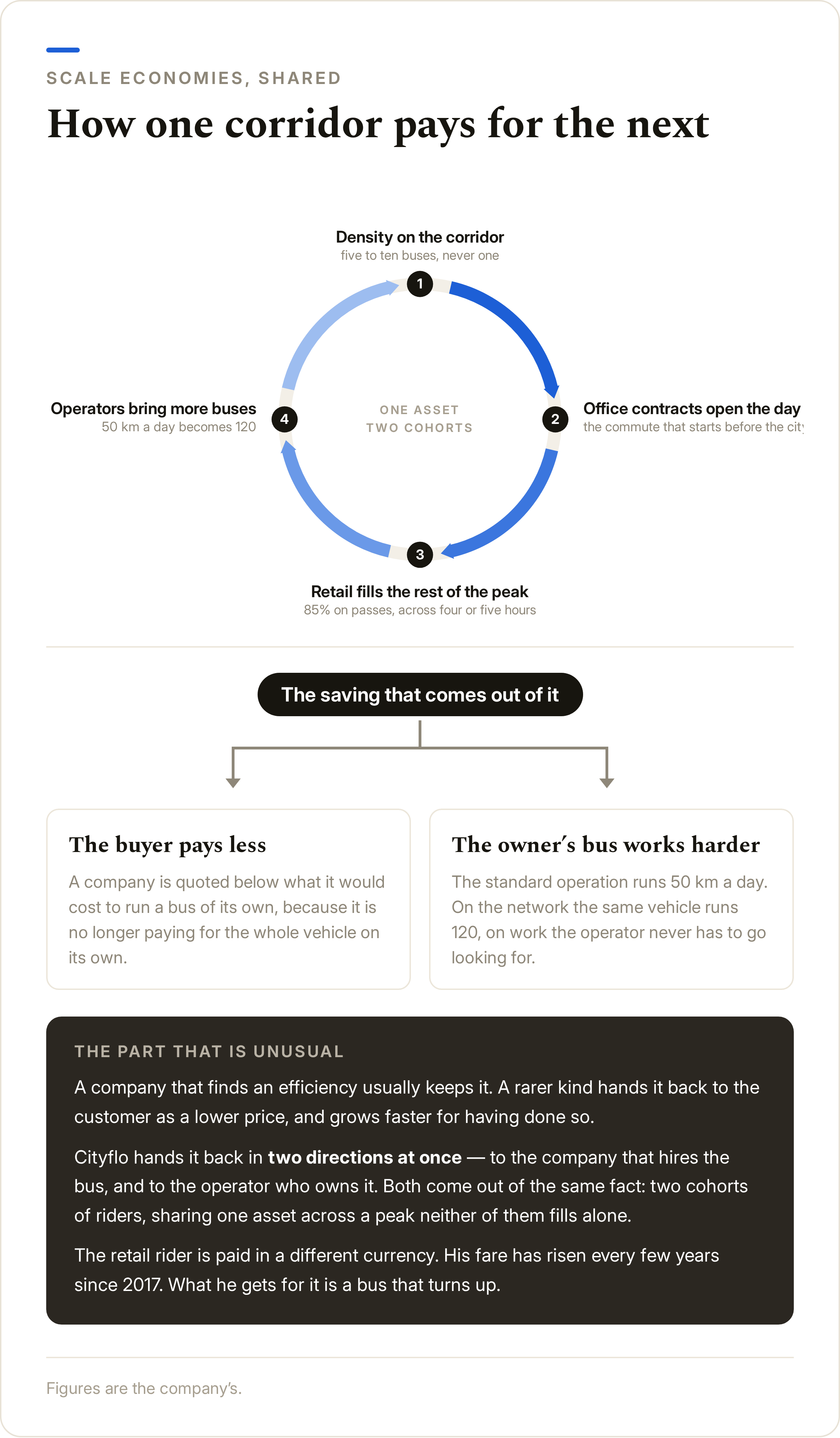
Cityflo’s buses open the day on office contracts, which begin before the retail commute does. They carry riders who booked their own seats through the middle of the day. In the evening, the order reverses, and the last run is office to home.
The effect is that no single customer is paying for a whole bus. An office contract and a retail route each cover a part of the same asset inside the same peak, which is why Cityflo can quote a company a price a dedicated operator cannot match.
The operator gains at the other end: the standard staff-bus arrangement moves a vehicle about fifty kilometres a day, out in the morning and back at night. On the network the same bus does a hundred and twenty.
“Someone says, I want a BKC feeder from the station. I’m like — yeah, I have buses in BKC. If the timings match, I’ll run the same one, and I can pass on the cost benefit. Because my buses are already covering all their costs. I just have to increase utilisation.”
Patwardhan’s rule had been that a bus must break even on two trips, and everything after that is margin.
The founders assumed the trips after those two would be more commuters. They turned out to belong to a different cohort altogether, buying a different hour of the same peak.
None of it works on one corridor alone.
Density is what makes a route reliable, reliability is what sells passes, and passes are what hold the retail half of the day in place while the office contracts anchor the ends of it. Each turn of the loop pays for the next.
Copying this means building both markets at once, and the retail one is the half nobody has managed. Jerin can list the attempts.
“This has had at least ten, fifteen attempts globally. Shuttl, ZipGo, Limo here. Careem tried it. Swvl in Egypt was listed, and eventually stopped the retail business and did only B2B. Uber tried it. Didi tried it. Gojek and Grab tried the bus.”
All of them could have sold corporate contracts. Several ended up selling only those. The retail network is the difficult half, and it is the half that makes the corporate half cheap.
“You basically bring all the demand into one place. Now I have a product that targets all of you.”
Jerin does not reach for a startup comparison to describe what this adds up to.
“This is what governments do in public transport. BEST maps railway stations, markets, schools, residential pockets, commercial pockets — and makes a route out of them. This is the first time it’s being done with no government involvement, privately, for a niche the public system doesn’t serve.”
Three days to build a city
The expansion, when it came, was fast.
In April 2026, as Uber Shuttle wound down, Cityflo entered Kolkata with two hundred buses. Mumbai had taken ten years to reach fifteen thousand daily rides; Kolkata took about three weeks.
The city team that runs those buses numbers four people, and the playbook travelled down to the level of window glass.
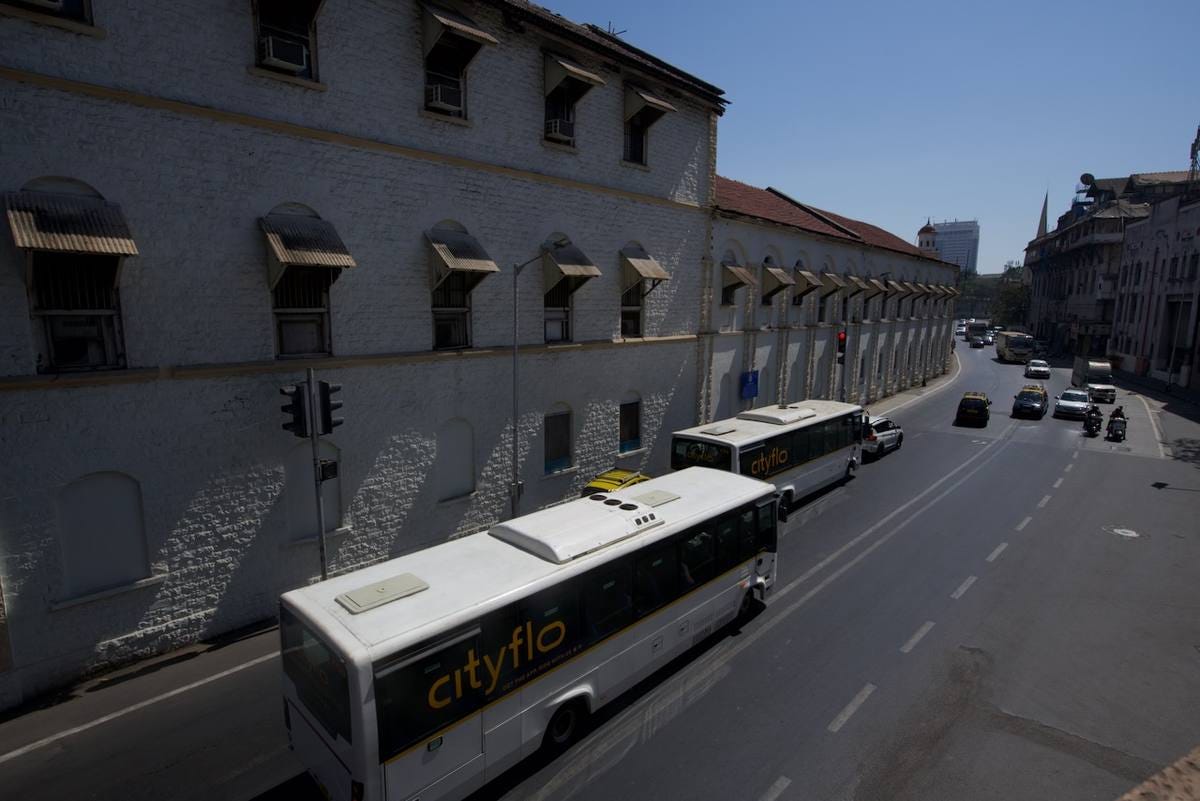
“When I went to Kolkata on the supply side, they told me: sir, you won’t get packed-glass buses here. Uber had run eight hundred buses in that city; a hundred and forty had sealed glass. I onboarded those hundred and forty first. Then Uber left, the operators needed work, and they converted their own buses — because now they’d seen the demand. We raised the standard of the city’s fleet without owning a single bus in it.”
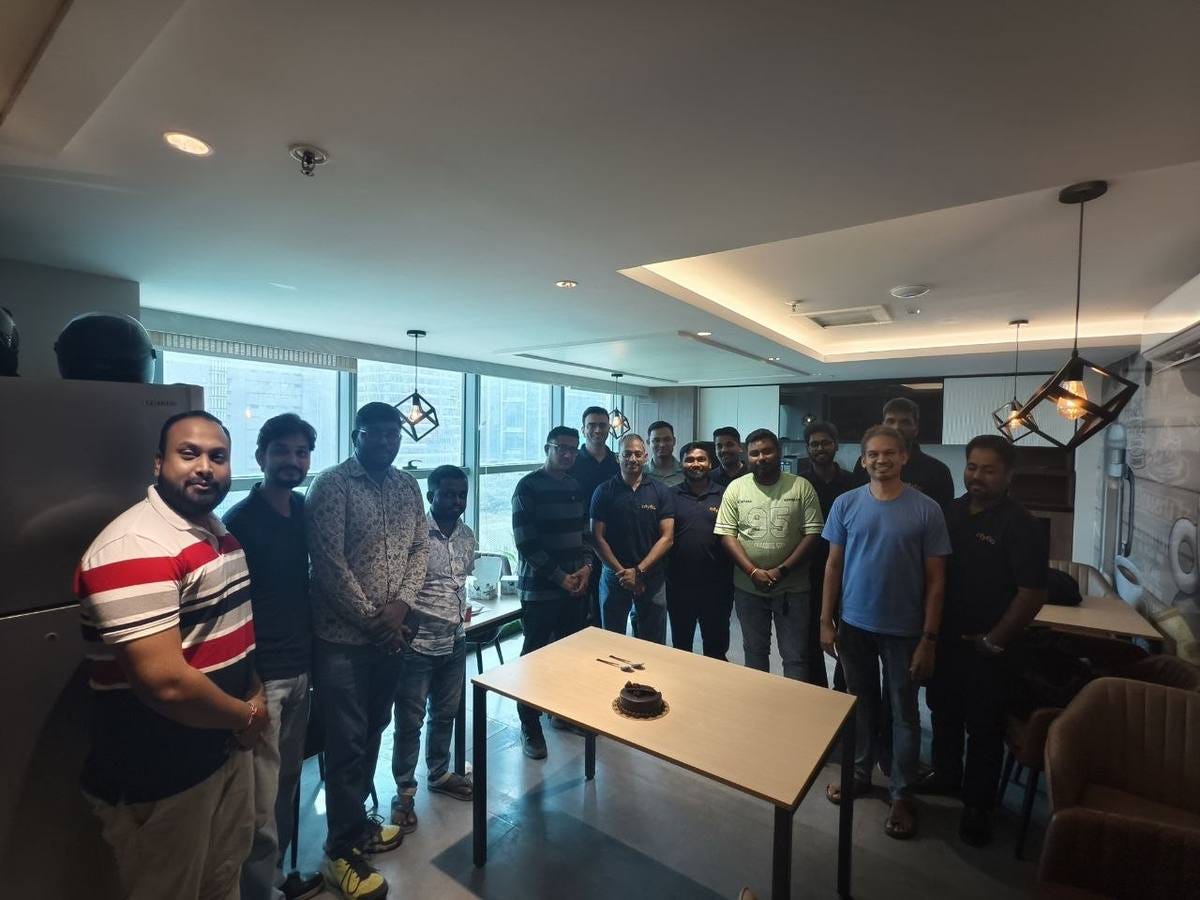
Part of the answer is the playbook — a decade of knowing exactly which corridor, which stop, which fare, which operator.
The other part is newer. In late 2025, the founders rebuilt the company around AI coding tools, and the constraint that had governed the company’s whole life — a fourteen-person engineering team against a backlog that never shrank — dissolved in a few months.
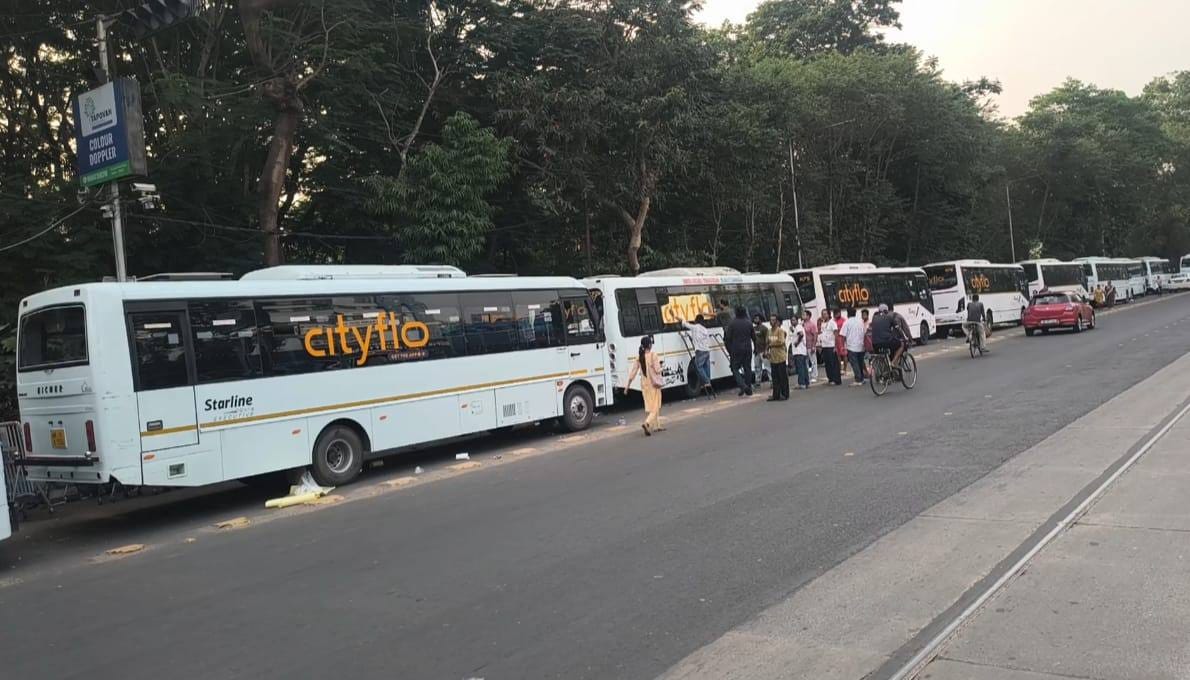
The partner dashboard that lets Kolkata’s fleet owners run the operations Cityflo’s own staff once handled was built in three days, on midnight calls between Rushabh in Kolkata and the engineers in Mumbai.
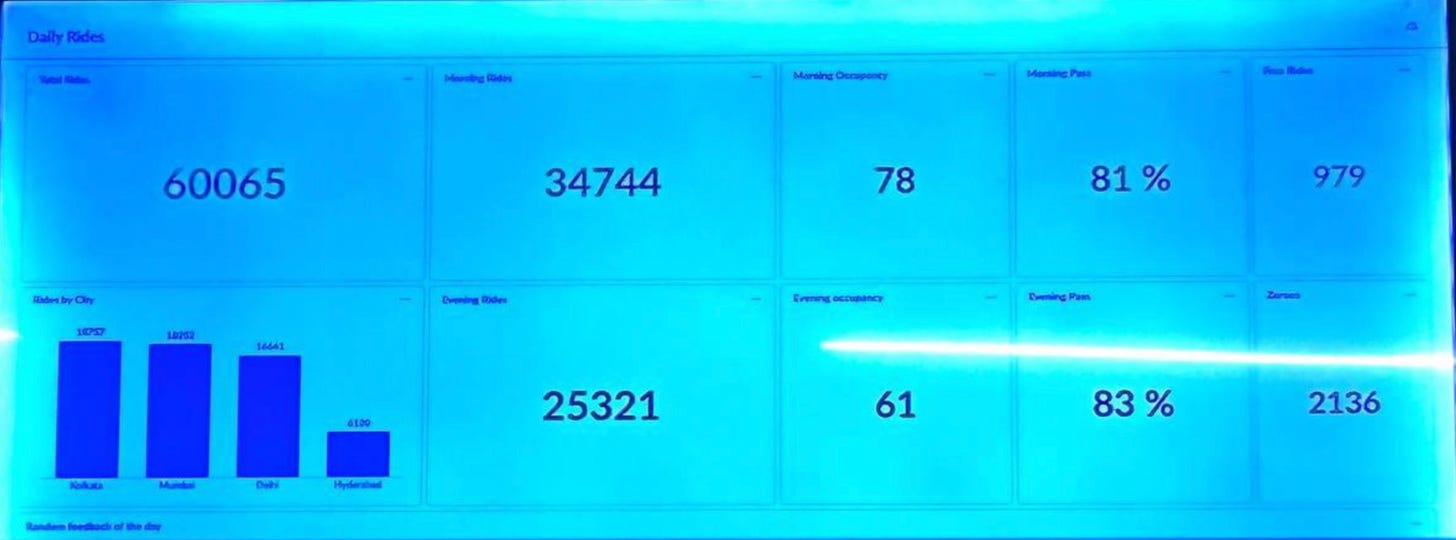
When Sankalp pitched a school chain that runs eight hundred buses, the pilot it demanded — a parent app, a driver app, an attendant app, an admin dashboard — was built in two weeks, without the engineering team, by the product head and Rushabh themselves.
The school’s supervisor asked for three more features at 5 p.m. and had them by morning.
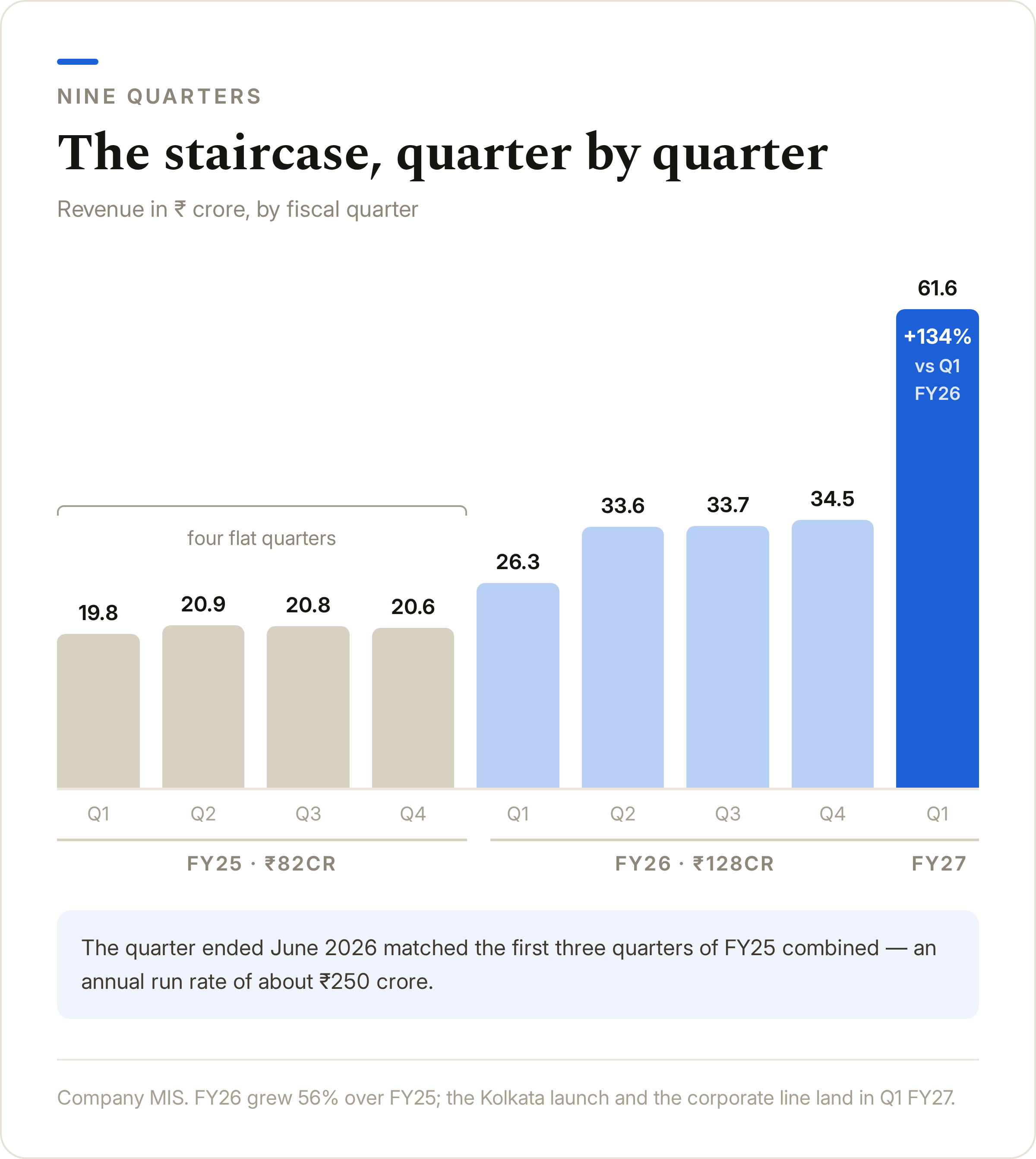
The acceleration shows up in the accounts. Through FY25, the company earned about ₹20 crore a quarter, four quarters running.
FY26 stepped up twice and closed at ₹128 crore, 56% over the year before. Then the quarter after the Kolkata launch brought ₹62 crore — up 79% on the quarter before it, 134% on the same quarter a year earlier, and level with the first three quarters of FY25 combined.
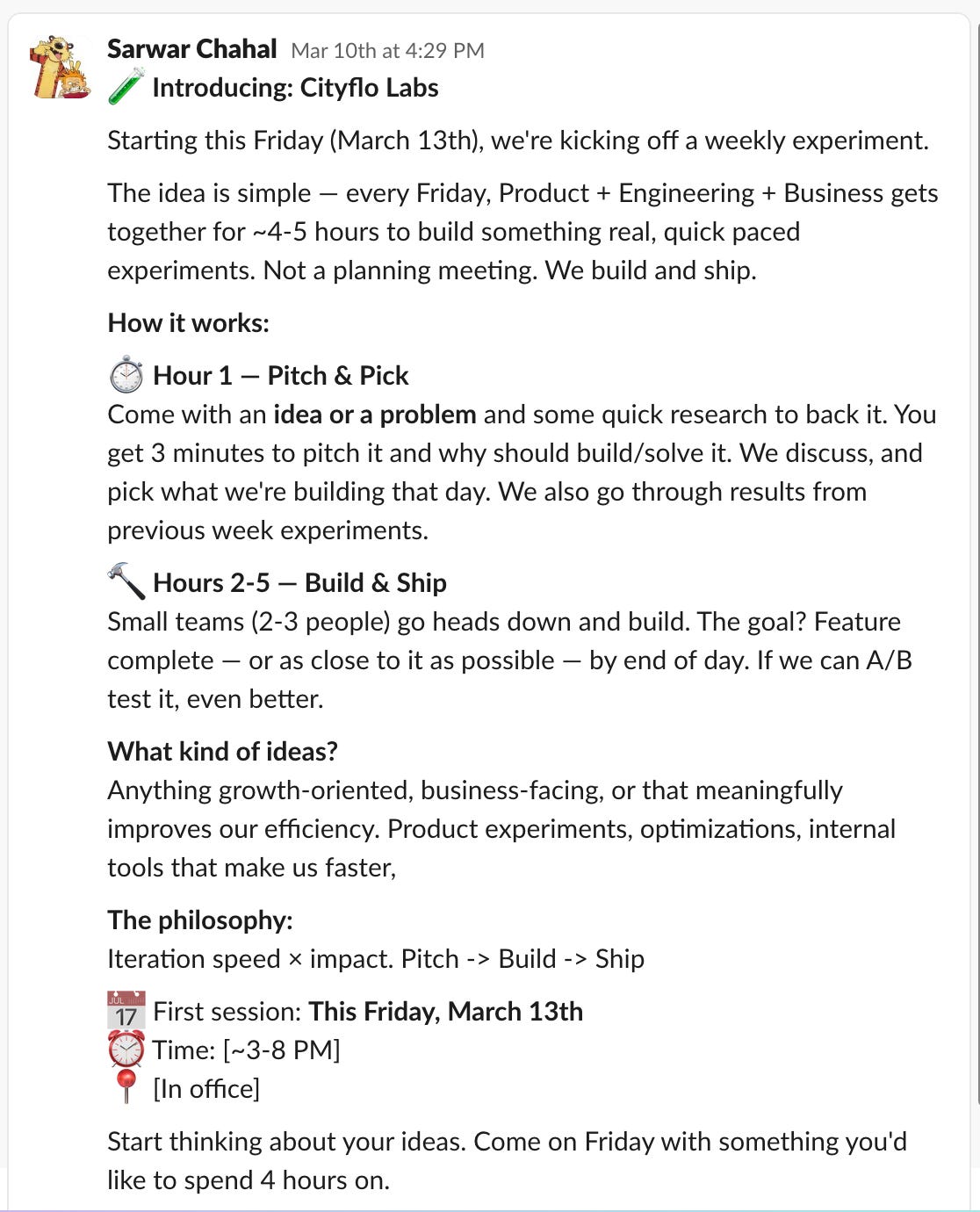
“Development bandwidth is no longer the bottleneck. You are limited by ambition and imagination. The finance guy rebuilt his own reporting. The head of customer support — who started his working life selling juice — built his own dashboard. Our ops team tags a bot when something breaks, and the investigation is done in minutes. All our business leaders — marketing, HR, finance — are using AI to build solutions. In a physical domain, I doubt any company in the country is keeping pace with our speed of development.”
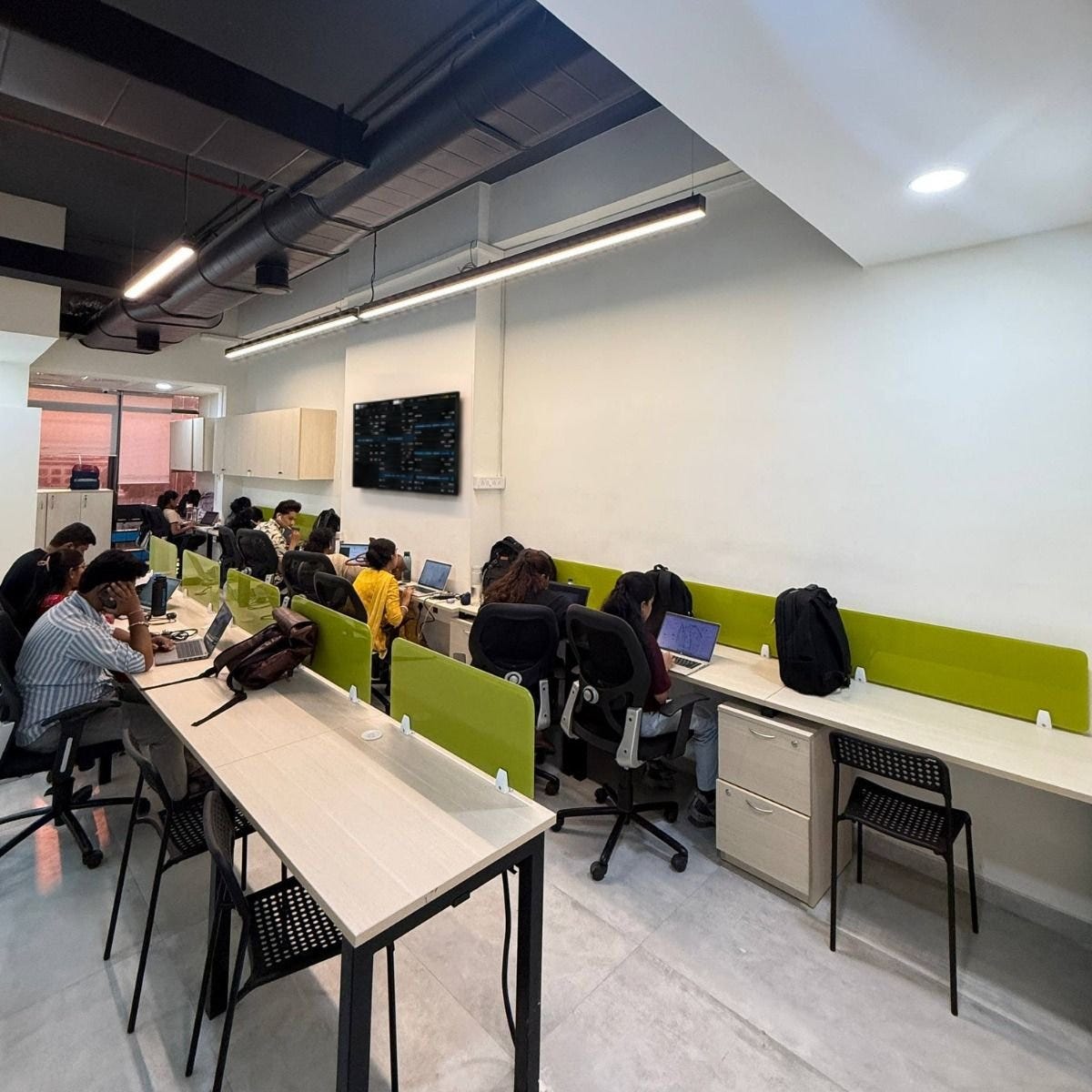
By the standards of its industry, the company that results is oddly shaped: about 220 employees, a ₹250 crore annual run rate, revenue per employee that resembles a software firm’s, and founders who still ride their own buses every week and write production code.
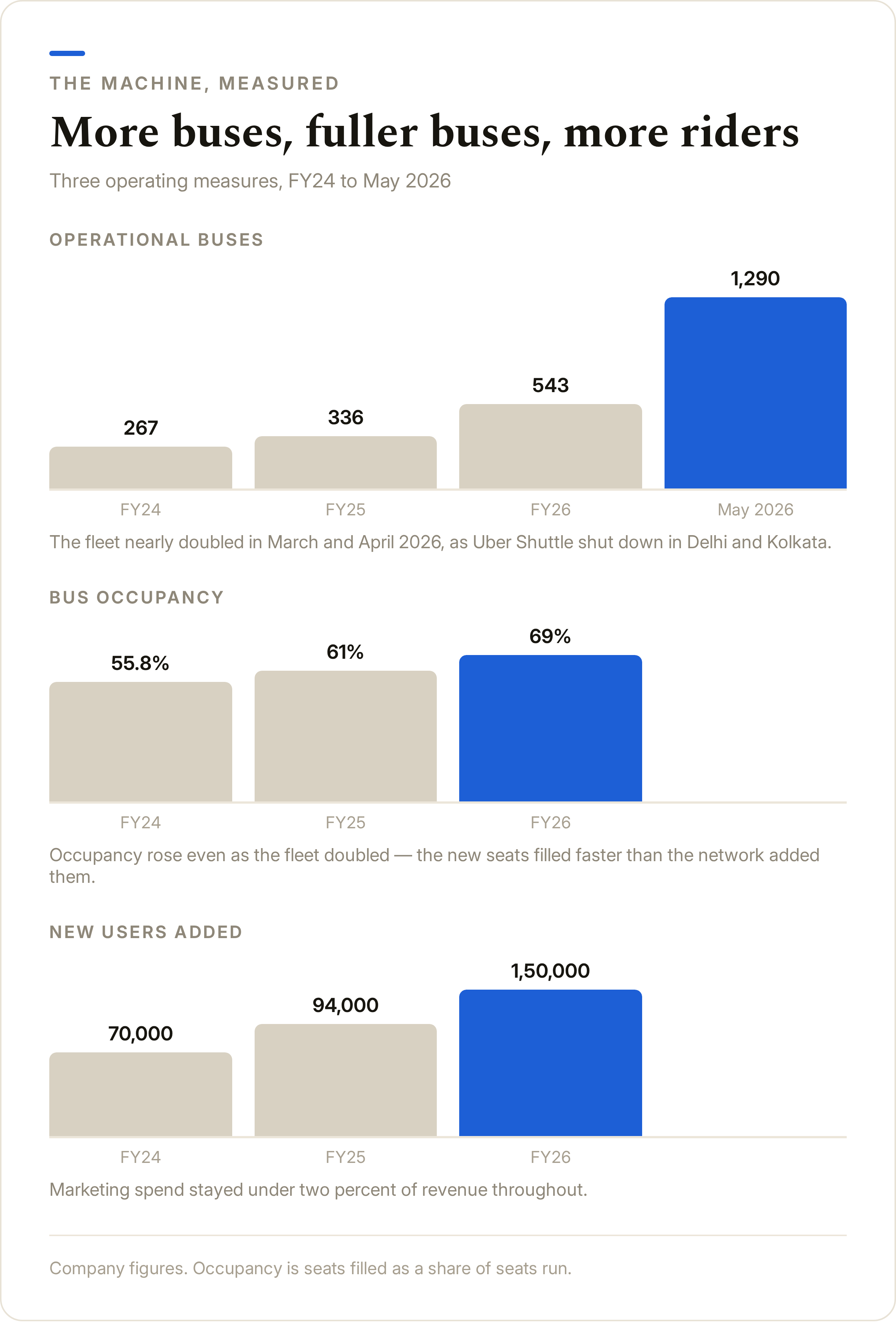
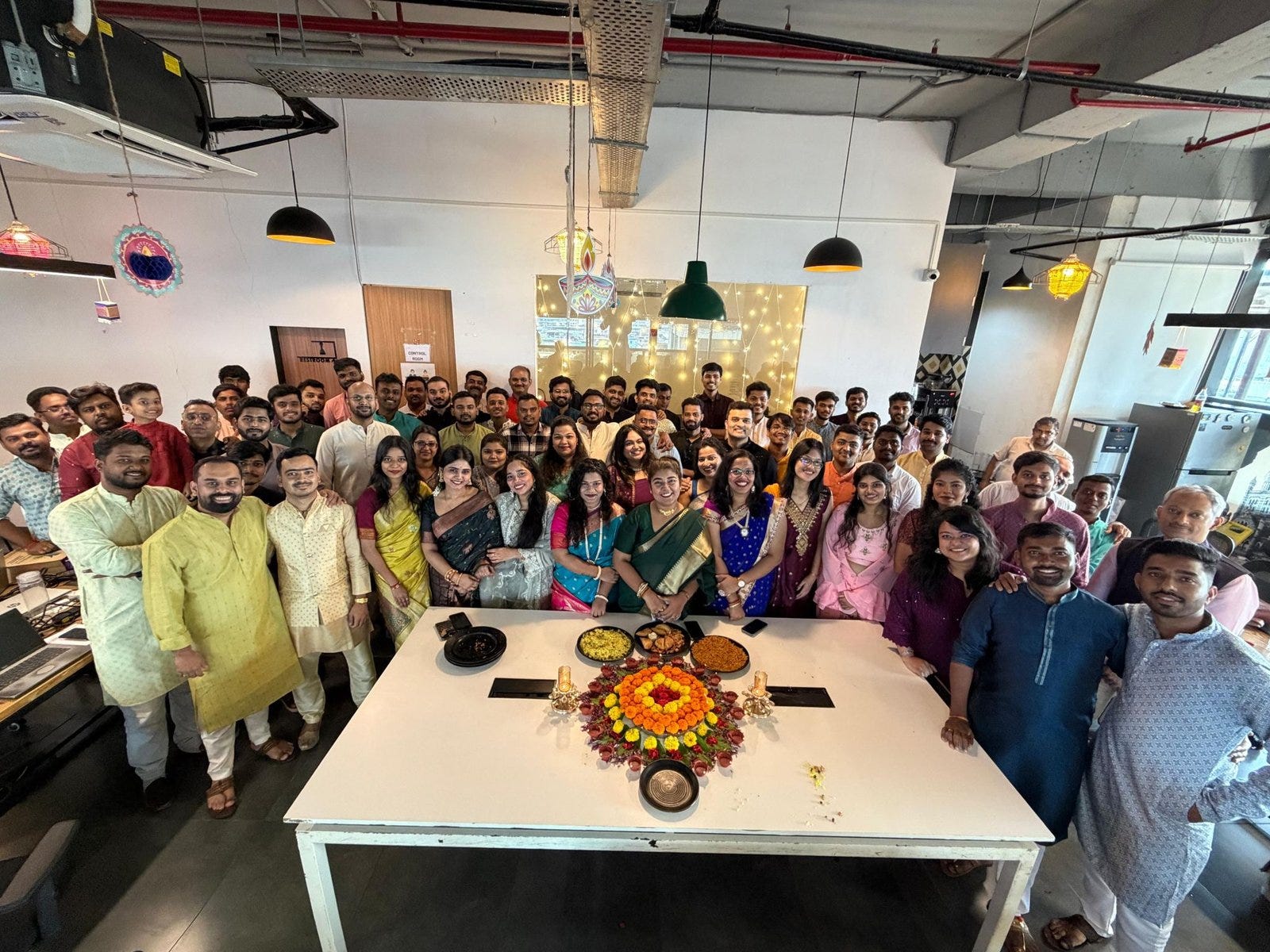
Rushabh recently shipped a feature that notices you standing at a stop and offers you an earlier bus — an idea he had while standing at a stop in Kolkata, wanting exactly that.
The network had become part of the city. Customers write in before changing jobs to ask whether a route will reach the new office, and before renting flats to ask which societies it touches.
One housing society’s secretary put a Cityflo stop in his election manifesto; a developer’s brochure features a founder, photographed unawares during an early shoot, boarding a bus as a neighbourhood amenity.
Six couples who met on the buses have married.

Captains
Ask the founders what limits the company now, and the answer has nothing to do with capital or demand. Buses can be financed. Routes are mapped.
What India lacks is people willing to drive. The arithmetic is stark.
A heavy-vehicle licence takes the better part of a year to earn; Maharashtra layers a badge requirement on top; the gig economy takes every young man with a two-wheeler before he ever considers the harder licence. BEST is short thousands of drivers by its own admission.
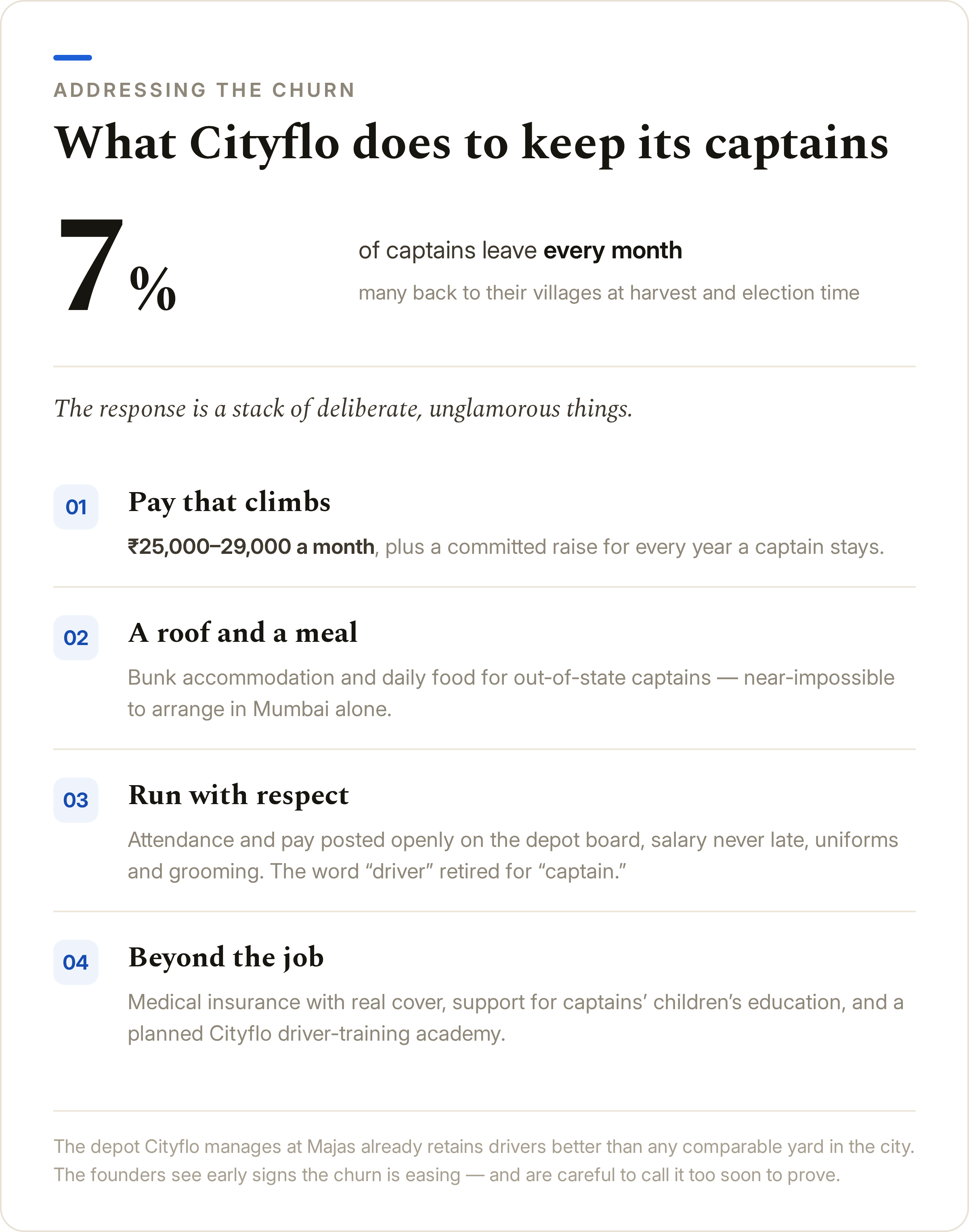
Cityflo receives about eighty driver applications a month, hires about thirty after testing, and loses roughly seven percent of its captains — the company retired the word driver — every month, many to their villages at harvest and election time.
A quarter of Mumbai’s roster comes from Assam and Bengal; when elections called them home one spring, the fleet dropped from four hundred running buses to three hundred.
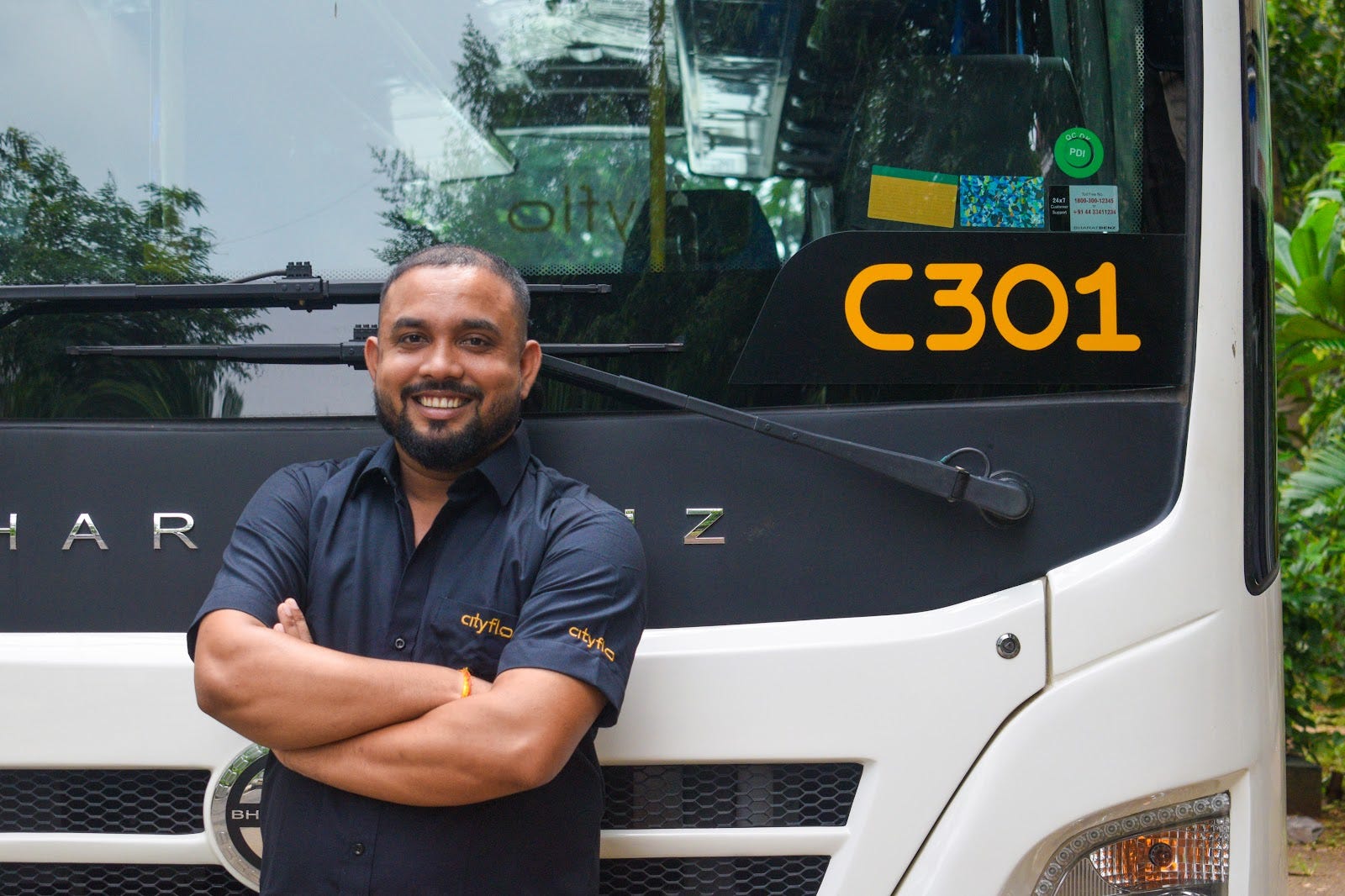
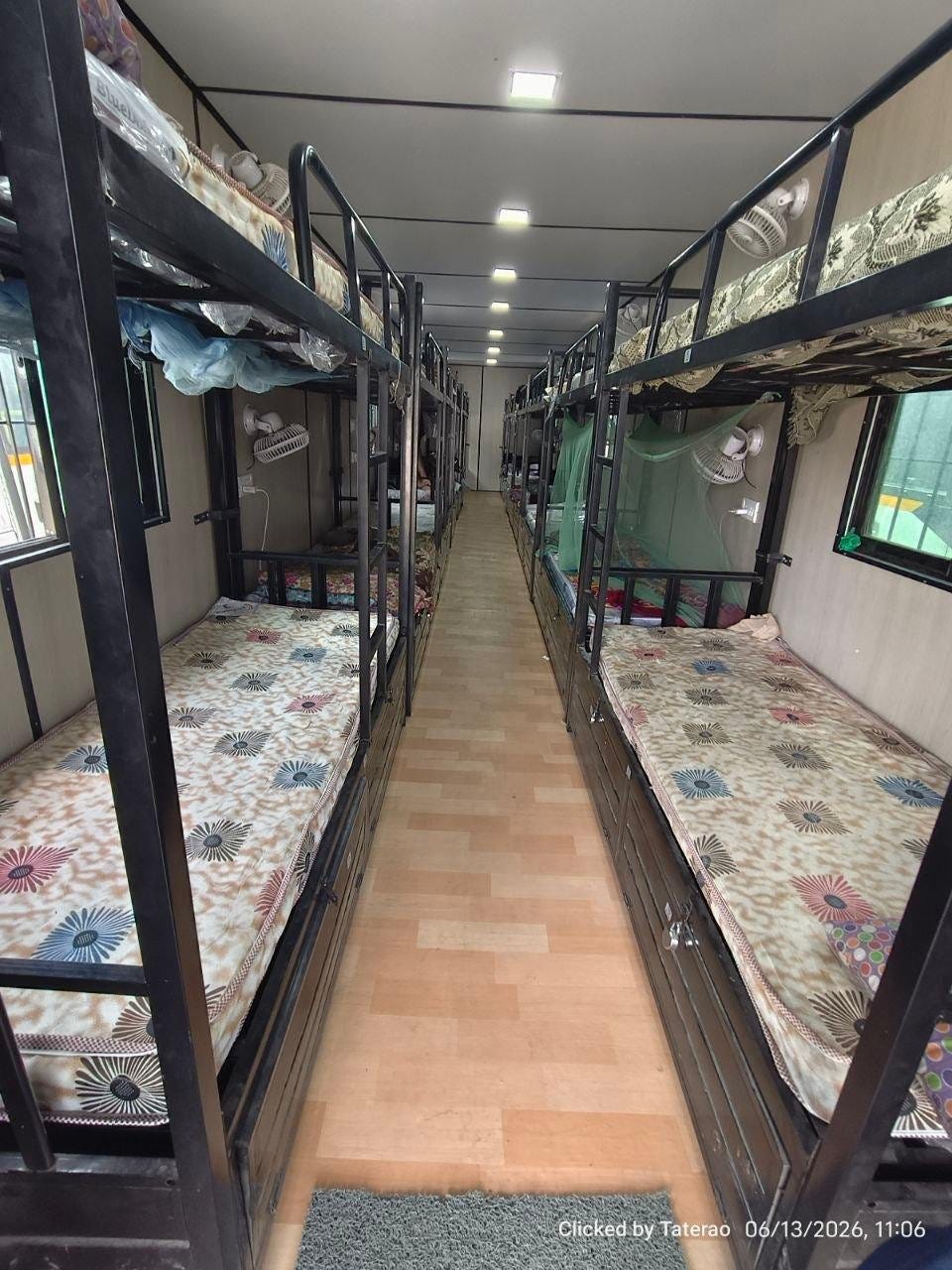
Salaries at ₹25,000–29,000 with committed annual increases. Uniforms, grooming, medical insurance that has paid out for surgeries, accommodation blocks with proper bunks for out-of-state captains, salary dates that never slip.
On the noticeboard of a depot Cityflo manages, the attendance and pay calculations are posted openly — a small thing that made it the rare depot where drivers arrive by referral.
“People need basic self-respect. Talk to a man properly, put him in clothes that fit, and he looks at himself differently in the mirror. The face of this brand is not the four of us — it’s the captain, every single morning.”
Rushabh’s version of the same conviction is more provocative, delivered recently to a busmaker offering air-suspension seats for drivers.
“I told them: make the driver’s seat worse. I want him to feel every bump, because that’s when he drives properly for the thirty people behind him. They were stunned, and then they said — you’re right, and nobody has ever told us this.”
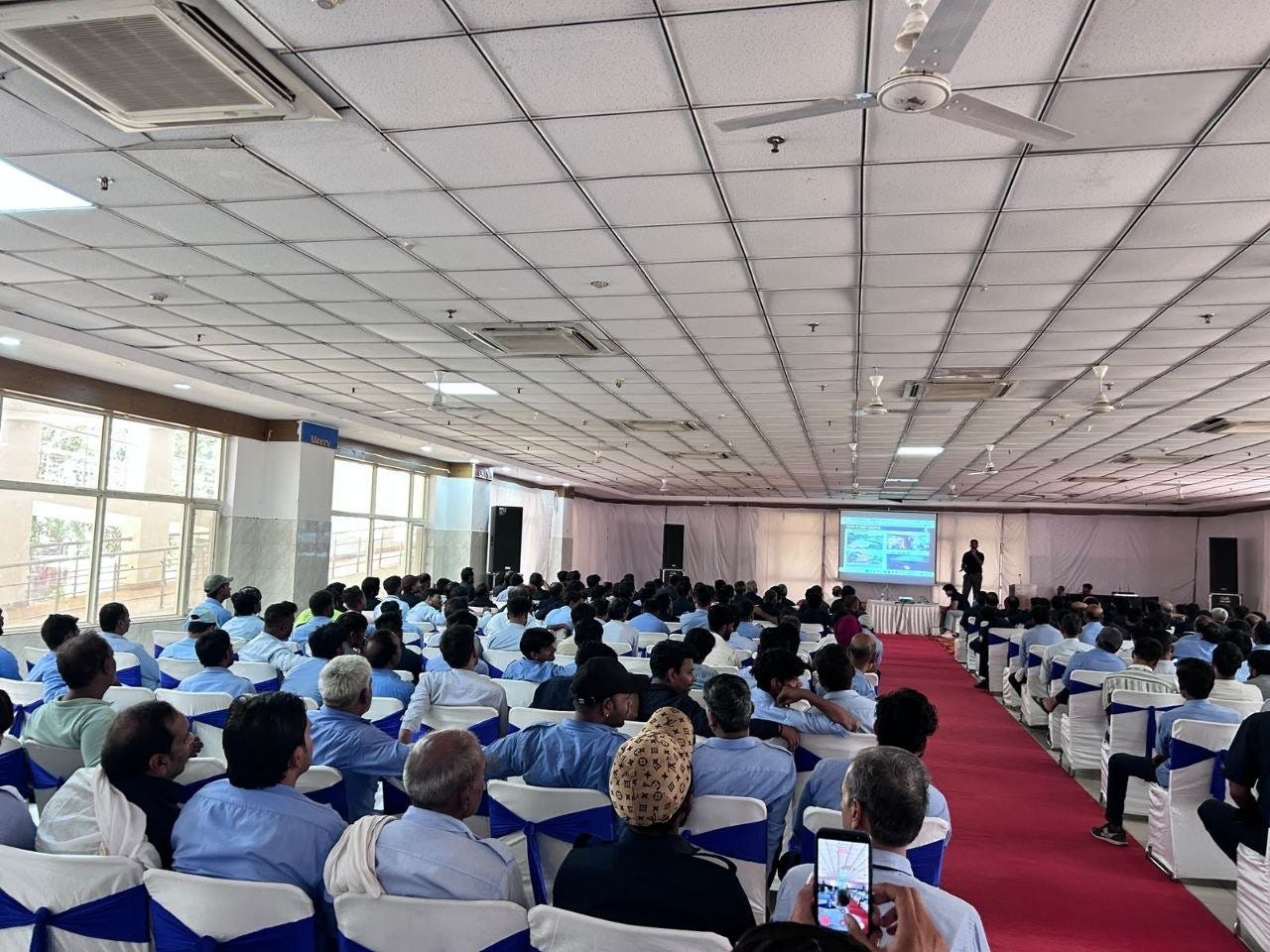
The long game is an institution: a driver-training academy, on the logic of the nursing colleges that turned a disrespected occupation into Kerala’s export industry, and of the airlines that made “captain” an aspiration.
The founders point out that no bus driver’s son currently plans to become a bus driver, and that whoever fixes that will own the choke point of Indian mobility for a generation.
The man who stopped the buses
In 2016, when the transport authority halted Cityflo’s fleet, one of the officials Jerin sat across from was a BEST veteran named Victor Nagaonkar — a lifer who had watched the undertaking run four and a half thousand buses in its prime.
He softened once he understood the young company was moving car owners, not poaching train passengers.
A decade later, Nagaonkar is retired from BEST and owns a quarter of Urban Glide, Cityflo’s public-transport subsidiary. The man who once enforced the stop order now runs the founders’ government business.
India has decided to electrify and privatise the operation of its public buses — tens of thousands of electric buses tendered, each costing about a crore, handed to infrastructure investors who know finance and manufacturers who know production. Almost nobody in the country holds the third skill: running a depot well.
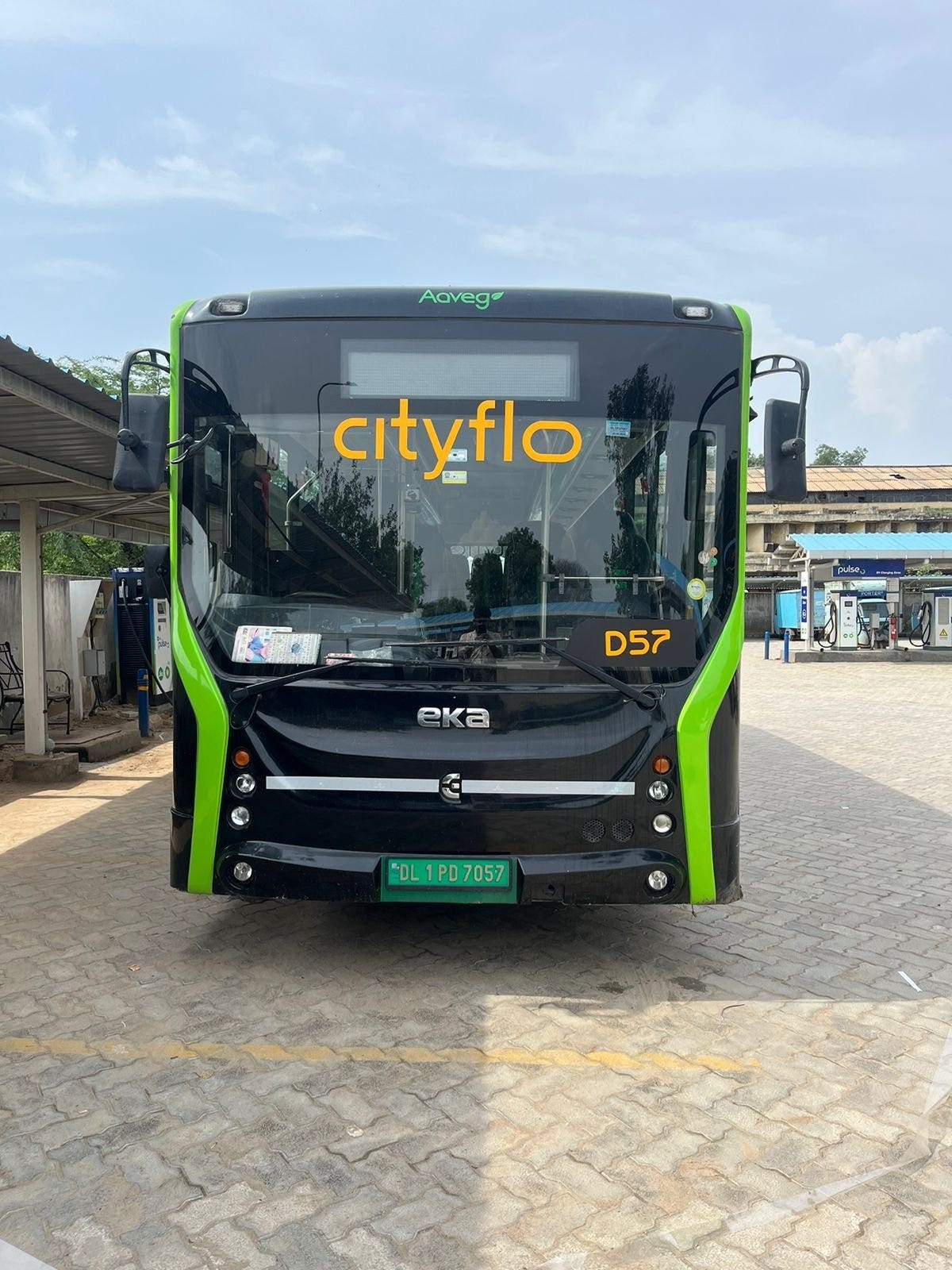
Urban Glide’s first depot, on Mumbai’s JVLR, digitised its rosters and its salary postings, and now retains drivers better than any comparable yard in the city.
In May 2025, Cityflo’s parent announced a joint venture with Globus Trans to run five hundred electric buses in state transit. Separately, and outside Urban Glide, the company runs electric fleets in Delhi NCR in partnership with Aaveg.
The founders describe the position with a phrase borrowed from infrastructure: the project-management layer of a build-out everyone else can only finance.
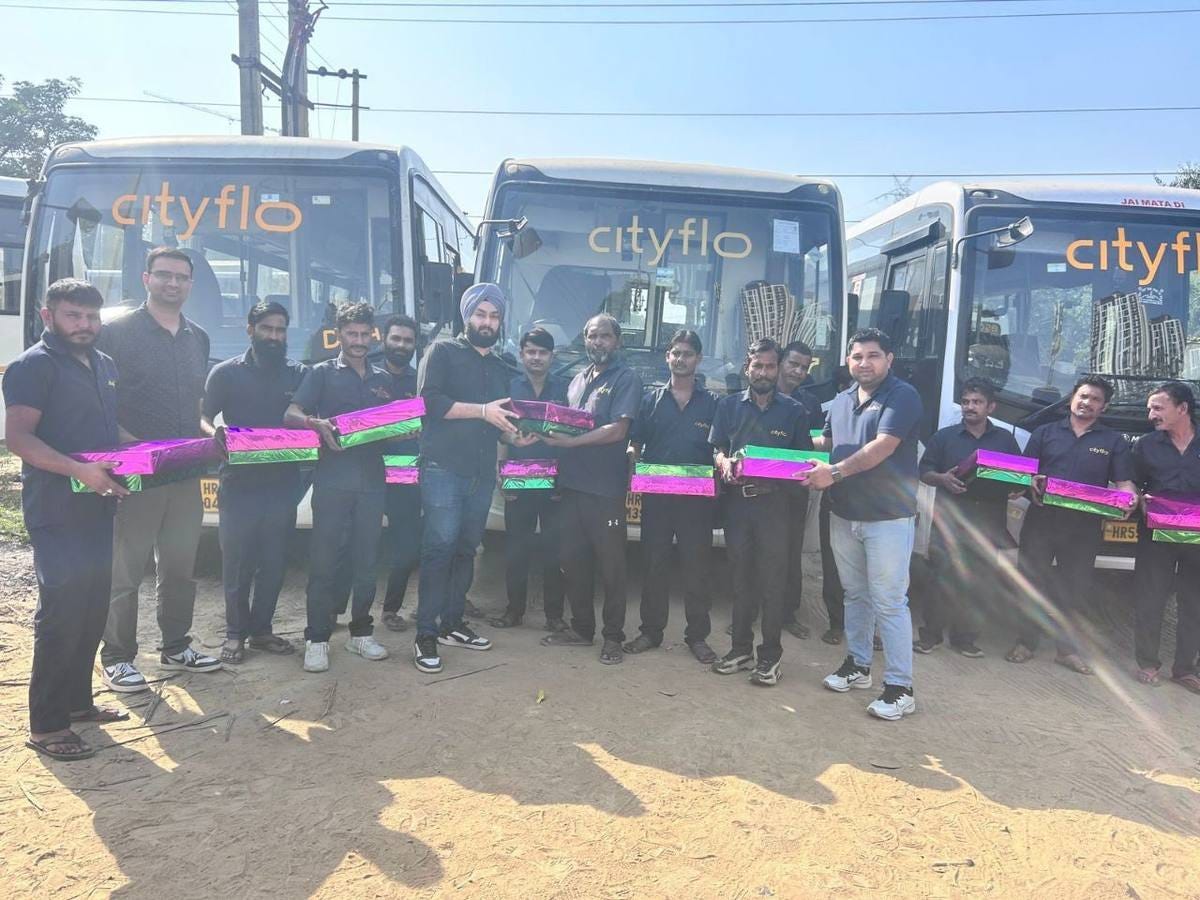
“The government pays per kilometre, the capital is ready, the buses are ready — and no one knows how to run them. We’ll take one or two rupees out of sixty and be the operating system. A municipal corporation near Mumbai got a hundred-bus grant and gave the job to the head of sewage disposal, because he was the only officer who had ever managed heavy vehicles. That is the size of the gap.”
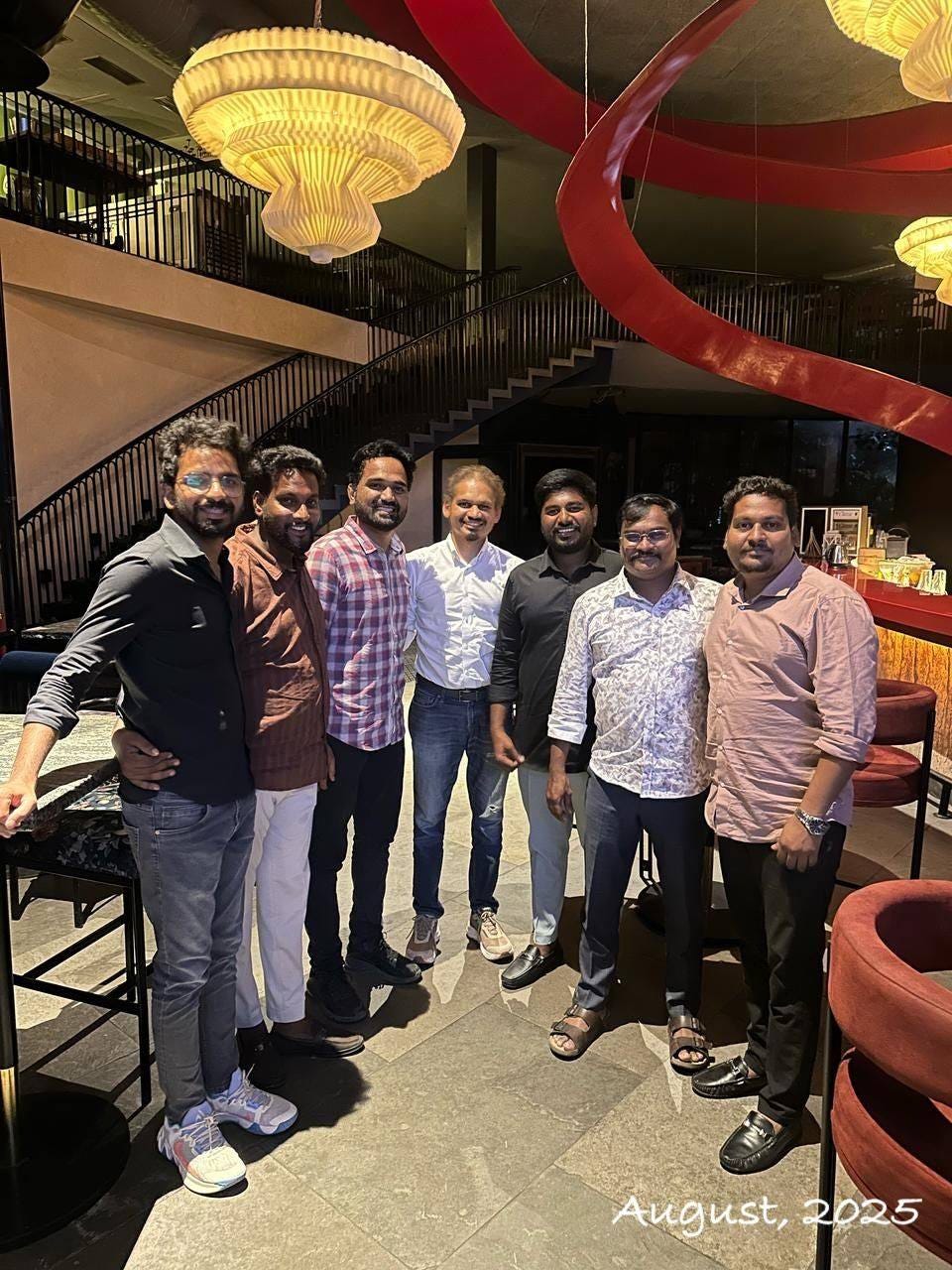
Electrification is arriving inside Cityflo’s own fleet on the founders’ terms, as arithmetic — adopted route by route, wherever a bus runs enough kilometres a day for the maths to close.
A term sheet for the first hundred electric buses is signed. The company’s filings count seventy-three lakh litres of fuel saved in FY25 and fifteen lakh private car trips replaced.
The third lane
The founders assumed for years that they were selling saved money and saved time. The customers describe something else: forty minutes between home and work with a seat, air-conditioning and no demands on them.
The ambitions are numerical: three thousand buses and ₹1,000 crore in revenue within about three years, at a designed EBITDA margin of 18%. Schools — a market the founders size at more than twice corporate commute — entered on the same buses.
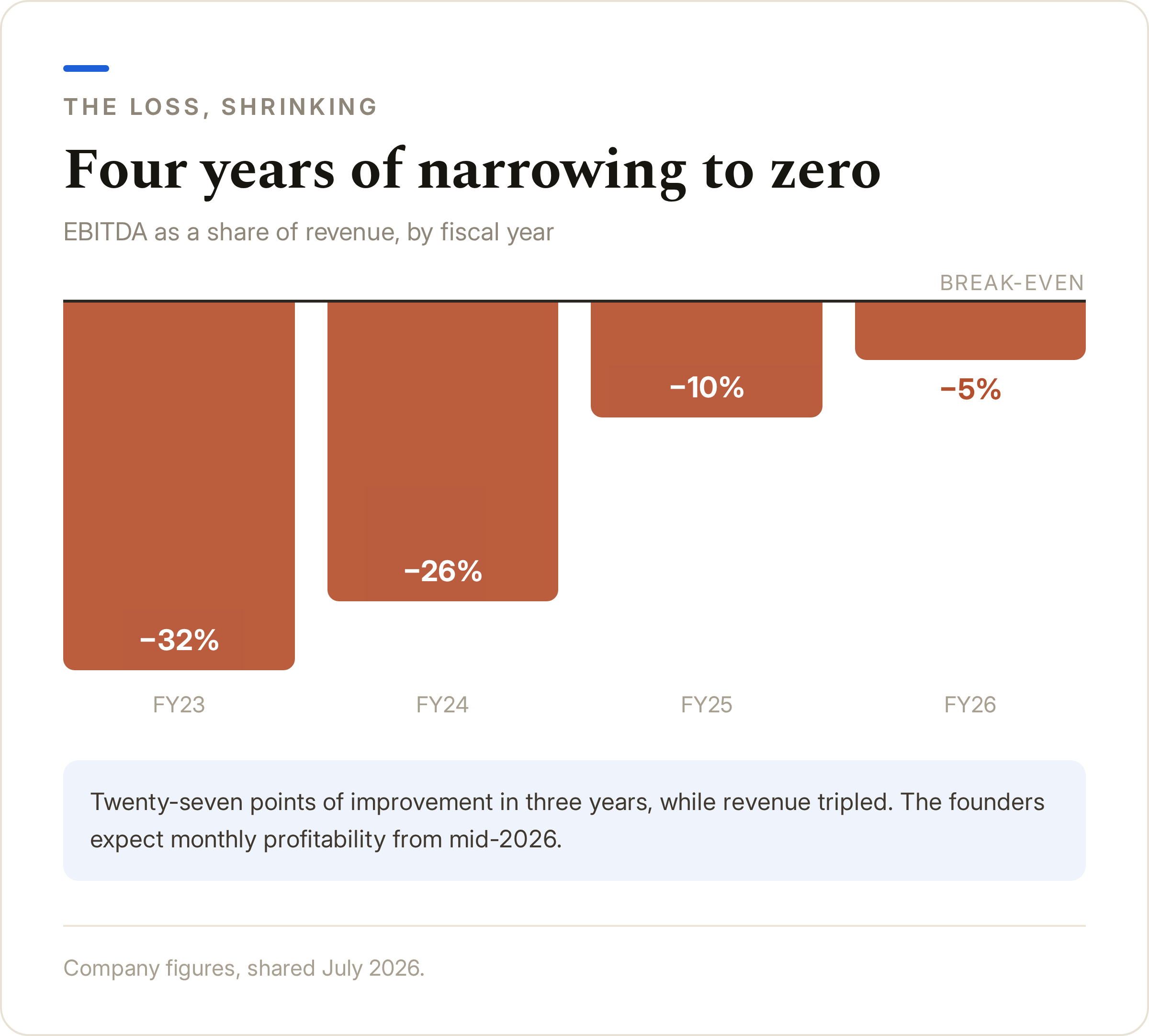
The third is public transit, through Urban Glide. Ankit describes where the three combine.
“Urban mass transit is fragmented, and nobody is solving all the problems together — tech, operational excellence, customer experience, driver shortage, route optimisation, brand. The operators can’t do it alone. We believe we can become the AWS of urban mobility. AWS started with compute and a database; now it’s a hundred services, plug and play. Wherever a piece of this industry has a problem, we go and solve that problem.”
Eventually, they say plainly, a listing — they believe a company whose product functions as a public good belongs in public hands, and note that no pure commute company in India has listed.
“Am I owning the customer, or am I owning the routes? Bookings can come from anywhere — any app, any aggregator, any corporate. I own the supply, and I collect the toll. Buses are what we have today; fundamentally we are a mobility company, and we’re not married to the form.”
Sankalp’s version of the destination: a layer above the road network, as fixed and as taken for granted as the roads. Infrastructure, he points out, does not move.
Ask Jerin for the lesson of the decade, and he refuses the obvious word. He was called resilient throughout the lean years and hated it every time.
“It’s like calling a stupid person brave. I’m not here to show my resilience or to persevere. I am opportunistic — I was always clear there was a large financial opportunity here, that there was money to be made. And people never understood why I had an issue with the word. It’s a bad business and you’re in it: how is that a compliment? Making a good business out of a supposedly bad one — that, I’m okay with.”
Pressed for what he does take credit for, his answer is plain: they kept flatlining, they kept learning, and they never lost the ability to stay. If we could do it, he likes to say, anyone could have — we aren’t that special.
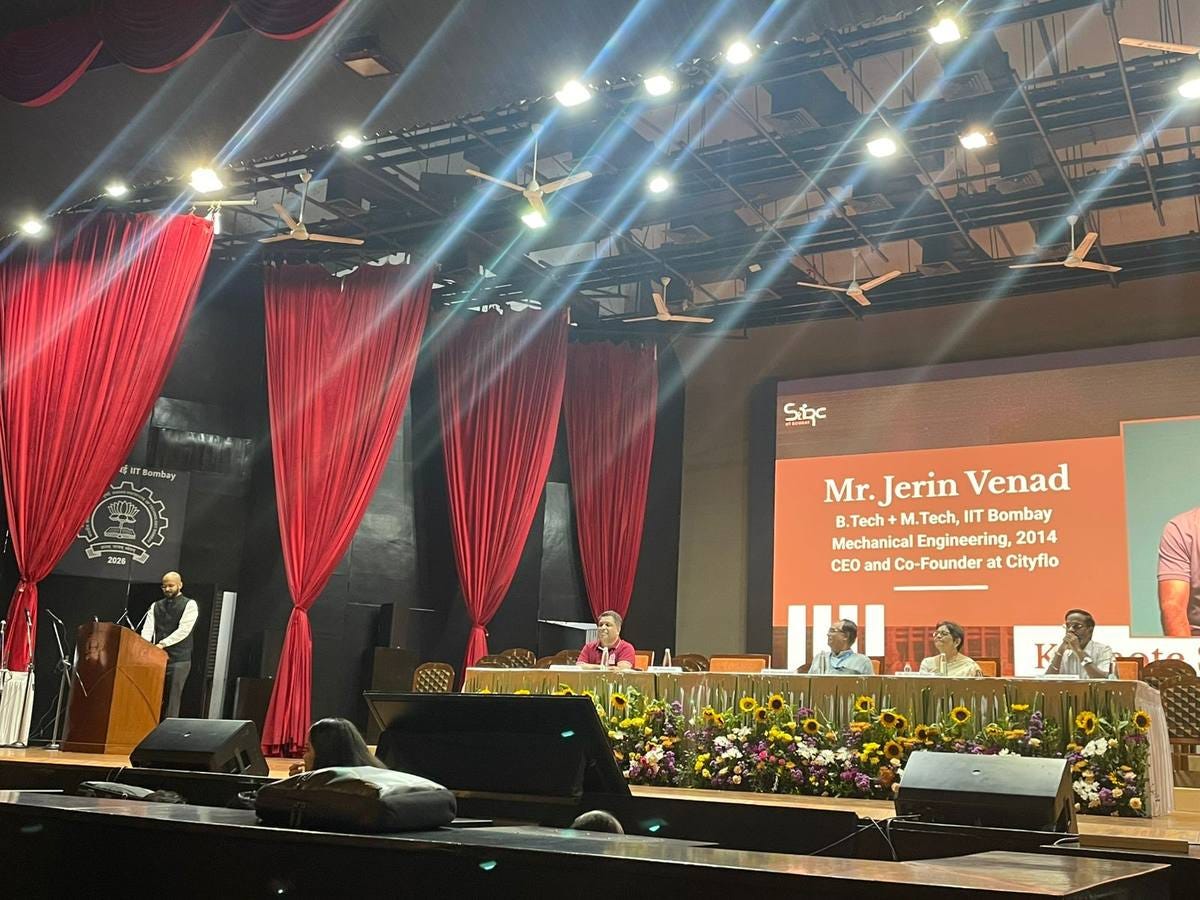
A month before these interviews, IIT Bombay invited him back to address a convocation. He told the graduates the thing he wished someone had told the six friends at the seafood restaurant.
“From tomorrow, the syllabus disappears. You are not given a problem to solve, and no one knows the correct answer. That is what you should spend your time on.”
The syllabus disappeared on the four of them in the summer of 2015. Eleven years on, all four are still at it.
If you want to discuss an opportunity with Cityflo, please write to us at banjan@tal64.com.
Safe Harbor Statement: This article contains forward-looking statements based on the current expectations, estimates and projections of Cityflo’s founders. These statements involve risks and uncertainties, and actual outcomes may differ materially. Financial figures for the privately held company are as shared by its founders and have not been independently audited by tal64. Nothing in this article constitutes investment advice or a recommendation to buy or sell any security.
This story is based on extensive interviews with Jerin Venad, Rushabh Shah, Sankalp Kelshikar and Ankit Agrawal, founders of Cityflo, conducted in Mumbai across 2026. This is NOT a paid article.
Great long read!
Great read and great company!